• Hello!

    Either you have not registered on this site yet, or you are registered but have not logged in. In either case, you will not be able to use the full functionality of this site until you have registered, and then logged in after your registration has been approved.

    Registration is FREE, so please register so you can participate instead of remaining a lurker....

    Please be certain that the location field is correctly filled out when you register. All registrations that appear to be bogus will be rejected. Which means that if your location field does NOT match the actual location of your registration IP address, then your registration will be rejected.

    Sorry about the strictness of this requirement, but it is necessary to block spammers and scammers at the door as much as possible.

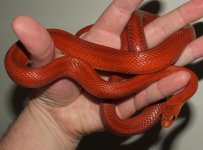
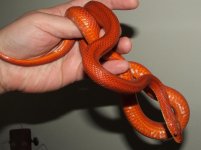
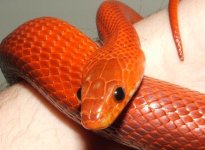
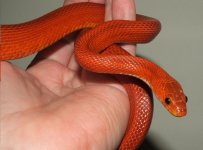
Carol the Red Snake

Roy Munson

New member
I've been setting a bad example here, posting 3 non-corn photo threads in one day. So I figured that I had to get a corn thread in. Carol is an '06 striped bloodred (het anery), and I think she's pretty darned amazing. She started kind of slow, but she's up to a respectable 140g. I'm pretty sure that she'll be ready for my striped anery-blood in '09. :)
 

Attachments

  • 020108 carol (1).JPG
    020108 carol (1).JPG
    69.1 KB · Views: 256
  • 020108 carol (9).JPG
    020108 carol (9).JPG
    57.9 KB · Views: 256
  • 020108 carol (20).JPG
    020108 carol (20).JPG
    72.2 KB · Views: 256
  • 020108 carol (24).JPG
    020108 carol (24).JPG
    63.2 KB · Views: 253
Her belly is RED?? That's cool! I wonder what makes some of them come out red, and some pure white.
 
het anery... let me get this straight. "het" is a trait they will pass down to their young, correct? and anerythristic means lacking red...so this snake, which is all red, cannot pass any red down to her young?
 
Her belly is RED?? That's cool! I wonder what makes some of them come out red, and some pure white.
Thanks. :) I've never seen a "red" bloodred (e.g., blood, hypo-blood) with a pure white belly. I'd like to know why lav-bloods don't have a purpley "bleed" onto their ventrals, or why anery-bloods don't have any "bleed" either. :shrugs:

Tula_Montage said:
Shes absolutly perfect Dean. I adore those wee speckles of white on her belly!
Thank you. She DOES have a great belly. :)

MrsCornSnake said:
WOW!!!!!

That is one diffused corn! I love her color. You should charge extra for her babies.
Thanks! I like the idea of charging extra for her babies. So how many do you want? :grin01:

Eriathiel said:
Gosh! Looks like I'll be bugging you to put more then garters in my box...
I'll keep a bigger box handy, just in case. ;)
 
Speechless!

Carol's a real sweetheart! :dancer:Thanks for the classic Munson shot! She's got great abs!:cool::cool::cool::cool::cool:
 
Thanks Tom! :cheers:
het anery... let me get this straight. "het" is a trait they will pass down to their young, correct? and anerythristic means lacking red...so this snake, which is all red, cannot pass any red down to her young?
No, that's not correct. The answers to your questions are complicated, but I'll try to make it as simple as I can.

Like all animals, baby snakes inherit one copy (allele) of a gene from each parent for every genetic trait. Every trait has a location (locus) on a chromosome where both contributed alleles reside. Most non-normal (mutant) corn pattern and color traits, like anerythrism (lacking red), are recessive. This means that the baby must inherit one copy of the same mutant gene from each parent for the mutant gene to be expressed (visible). When this happens, and the trait is expressed, that mutant gene is said to be in homozygous form (homo = same). When the snake receives a mutant gene for a trait from one parent, but the other parent contributes a non-mutant (normal) gene, the mutant gene is said to be in heterozygous form (hetero = different).

So in the case of this snake, a het anery, she received one anery gene from one parent, but a normal, non-mutant gene from the other. So the trait is not visible, but she is carrying it in het form. So at the anery locus, the two genes are not the same (one is normal, the other is anery). When she breeds, she can contribute a copy of either the normal gene or the mutant gene to each of her offspring. So there's a 50% chance that she will pass on the gene that is in het form (in this case anery) to each of her offspring.

So if she's paired with a snake that isn't even carrying anery in het form (and barring other mutant traits), the babies of this red snake WILL ALL be red.

If she's paired with a snake that's het for anery, each snake has a 50% chance of contributing a copy of the anery gene to each hatchling, and each hatchling will have a 25% chance of getting two anery genes and expressing anery. There's a 50% chance of each baby getting just one copy of the anery gene, and there's a 25% chance that each baby will not even get one copy. So statistically, 75% of the babies WILL be red.

If she's paired with a homozygous anery, the het anery female will still only have a 50% chance of contributing a copy of the anery gene. But the homozygous male can ONLY contribute an anery gene, since both copies of the gene at the anery locus are the mutant gene. In this case, there's a 50% chance for each baby to be het anery, and there's a 50% chance for each baby to be homozygous for anery. So even here, 50% of the clutch WILL be red.

I hope this helps. If you're interested in this stuff, you'd probably be better off finding a better reference than me. ;)
 
Holy $&#*$@ Dean!! That has to be one of the most gorgeous snakes I have ever seen! What a perfect shade of red! Absolutely Amazing!!
 
Thanks Rich, Tom, and Deb! :cheers:
She is OUTSTANDING Dean :dancer:
Hey! I remember you! :grin01: Thanks Lore. I have a PM I haven't read yet. If it's not from you, you need to send me one and tell me how things are going... Great to see you around! :D
 
Thanks Tom! :cheers:
No, that's not correct. The answers to your questions are complicated, but I'll try to make it as simple as I can.

Like all animals, baby snakes inherit one copy (allele) of a gene from each parent for every genetic trait. Every trait has a location (locus) on a chromosome where both contributed alleles reside. Most non-normal (mutant) corn pattern and color traits, like anerythrism (lacking red), are recessive. This means that the baby must inherit one copy of the same mutant gene from each parent for the mutant gene to be expressed (visible). When this happens, and the trait is expressed, that mutant gene is said to be in homozygous form (homo = same). When the snake receives a mutant gene for a trait from one parent, but the other parent contributes a non-mutant (normal) gene, the mutant gene is said to be in heterozygous form (hetero = different).

So in the case of this snake, a het anery, she received one anery gene from one parent, but a normal, non-mutant gene from the other. So the trait is not visible, but she is carrying it in het form. So at the anery locus, the two genes are not the same (one is normal, the other is anery). When she breeds, she can contribute a copy of either the normal gene or the mutant gene to each of her offspring. So there's a 50% chance that she will pass on the gene that is in het form (in this case anery) to each of her offspring.

So if she's paired with a snake that isn't even carrying anery in het form (and barring other mutant traits), the babies of this red snake WILL ALL be red.

If she's paired with a snake that's het for anery, each snake has a 50% chance of contributing a copy of the anery gene to each hatchling, and each hatchling will have a 25% chance of getting two anery genes and expressing anery. There's a 50% chance of each baby getting just one copy of the anery gene, and there's a 25% chance that each baby will not even get one copy. So statistically, 75% of the babies WILL be red.

If she's paired with a homozygous anery, the het anery female will still only have a 50% chance of contributing a copy of the anery gene. But the homozygous male can ONLY contribute an anery gene, since both copies of the gene at the anery locus are the mutant gene. In this case, there's a 50% chance for each baby to be het anery, and there's a 50% chance for each baby to be homozygous for anery. So even here, 50% of the clutch WILL be red.

I hope this helps. If you're interested in this stuff, you'd probably be better off finding a better reference than me. ;)
oy! i'm gonna have to read that over a few times. but i'm definitely interested!
 
Back
Top