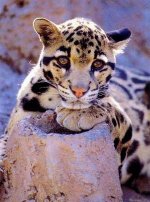
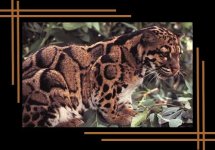
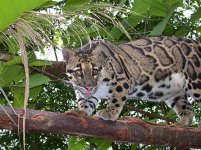
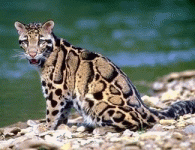
Tula_Montage
It's Jager time!
Today "five news" decribed it as "the first feline descovery in over 2 centurys".
Apparently this cat has been known about since the late 19th century? Why have they decided that it is an entirley new species after all this time?!
Heres an article on the reclassification of the Borneo clouded leopard.
Clouded leopard deemed new species
The Borneo clouded leopard has small cloud markings
The secretive rainforest animal was originally thought to be the same species as the one found in mainland South-east Asia.
The news comes just a few weeks after a WWF report showed that scientists had identified at least 52 new species of animals and plants over the past year on Borneo.
"Who said a leopard can never change its spots?" said Stuart Chapman, WWF International Coordinator of the Heart of Borneo programme.
"For over a hundred years we have been looking at this animal and never realized it was unique. The fact that Borneo's top predator is now considered a separate species further emphasizes the importance of conserving one of the most biologically diverse habitats on Earth."
Researchers at the US National Cancer Institute say the differences between the Borneo and mainland clouded leopard were found to be comparable to the differences between other large cat species such as lion, tiger, leopard, jaguar and snow leopard.
Stuart Chapman, WWF: "Who said a leopard can never change its spots?"
They believe the Borneo population likely diverged from the mainland population some 1.4 million years ago.
"Genetic research results clearly indicate that the clouded leopards of Borneo should be considered a separate species," said Dr Stephen O'Brien, Head of the Laboratory of Genomic Diversity, US National Cancer Institute.
"DNA tests highlighted around 40 differences between the two species."
The results of the genetic study are supported by separate research on geographical variation in the clouded leopard, based mainly on fur patterns and colouration of skins held in museums and collections.
"The moment we started comparing the skins of the mainland clouded leopard with the leopard found on Borneo, it was clear we were comparing two different species," said Dr Andrew Kitchener, Department of Natural Sciences, National Museums Scotland.
"It's incredible that no one has ever noticed these differences."
The Borneo clouded leopard has small cloud markings, many distinct spots within the cloud markings, grey fur and a double dorsal stripe. It is darker than the mainland species.
Clouded leopards from the mainland have large clouds on their skin with fewer, often faint, spots within the cloud markings. They are lighter in colour, with a tendency toward tawny-coloured fur and a partial double dorsal stripe.
By taking into consideration the forest conditions in Borneo, a total number of 5,000 to 11,000 Bornean clouded leopards are estimated to live there, the WWF noted.
The total number in Sumatra could be in the range of 3,000 to 7,000 individuals. However, further studies are needed to obtain better population data.
The last great forest home of the Bornean clouded leopard is the Heart of Borneo, a 220,000km2 wild, mountainous region - about five times the size of Switzerland - covered with equatorial rainforest in the centre of the island.
Destruction of their habitat is the main threat they face, according to the WWF.
Apparently this cat has been known about since the late 19th century? Why have they decided that it is an entirley new species after all this time?!
Heres an article on the reclassification of the Borneo clouded leopard.
Clouded leopard deemed new species
The Borneo clouded leopard has small cloud markings
The secretive rainforest animal was originally thought to be the same species as the one found in mainland South-east Asia.
The news comes just a few weeks after a WWF report showed that scientists had identified at least 52 new species of animals and plants over the past year on Borneo.
"Who said a leopard can never change its spots?" said Stuart Chapman, WWF International Coordinator of the Heart of Borneo programme.
"For over a hundred years we have been looking at this animal and never realized it was unique. The fact that Borneo's top predator is now considered a separate species further emphasizes the importance of conserving one of the most biologically diverse habitats on Earth."
Researchers at the US National Cancer Institute say the differences between the Borneo and mainland clouded leopard were found to be comparable to the differences between other large cat species such as lion, tiger, leopard, jaguar and snow leopard.
Stuart Chapman, WWF: "Who said a leopard can never change its spots?"
They believe the Borneo population likely diverged from the mainland population some 1.4 million years ago.
"Genetic research results clearly indicate that the clouded leopards of Borneo should be considered a separate species," said Dr Stephen O'Brien, Head of the Laboratory of Genomic Diversity, US National Cancer Institute.
"DNA tests highlighted around 40 differences between the two species."
The results of the genetic study are supported by separate research on geographical variation in the clouded leopard, based mainly on fur patterns and colouration of skins held in museums and collections.
"The moment we started comparing the skins of the mainland clouded leopard with the leopard found on Borneo, it was clear we were comparing two different species," said Dr Andrew Kitchener, Department of Natural Sciences, National Museums Scotland.
"It's incredible that no one has ever noticed these differences."
The Borneo clouded leopard has small cloud markings, many distinct spots within the cloud markings, grey fur and a double dorsal stripe. It is darker than the mainland species.
Clouded leopards from the mainland have large clouds on their skin with fewer, often faint, spots within the cloud markings. They are lighter in colour, with a tendency toward tawny-coloured fur and a partial double dorsal stripe.
By taking into consideration the forest conditions in Borneo, a total number of 5,000 to 11,000 Bornean clouded leopards are estimated to live there, the WWF noted.
The total number in Sumatra could be in the range of 3,000 to 7,000 individuals. However, further studies are needed to obtain better population data.
The last great forest home of the Bornean clouded leopard is the Heart of Borneo, a 220,000km2 wild, mountainous region - about five times the size of Switzerland - covered with equatorial rainforest in the centre of the island.
Destruction of their habitat is the main threat they face, according to the WWF.