• Hello!

    Either you have not registered on this site yet, or you are registered but have not logged in. In either case, you will not be able to use the full functionality of this site until you have registered, and then logged in after your registration has been approved.

    Registration is FREE, so please register so you can participate instead of remaining a lurker....

    Please be certain that the location field is correctly filled out when you register. All registrations that appear to be bogus will be rejected. Which means that if your location field does NOT match the actual location of your registration IP address, then your registration will be rejected.

    Sorry about the strictness of this requirement, but it is necessary to block spammers and scammers at the door as much as possible.

Dog training advice needed

Hypancistrus

New member
I have a 9 month old Golden Retriever pup/dog named Riley. He is very large- weighing 75 pounds at this point. He's probably going to get bigger. I am having a pretty serious problem with him regarding walking on the leash. Every time I take him out, he pulls so hard that it takes all of my strength to hold him back. This causes me tremendous physical discomfort- aches in my knees, shoulders, and back- and causes him to cough and choke as the collar cuts into his throat.

He has been through puppy kindergarten and does sit very well, and down most of the time. He also returns to me (his recall is very good). The way they tried to teach heel in PK did not work for us. They had us walk around with a handful of treats clenched in our left fist, the theory being that they would follow where the treats went and learn to walk at our heel. Riley just jumps on you if you don't give him the treats.

I really need to fix this problem. It's gotten to a point where I don't even want to walk him anymore because I know he will make me angry with his constant pulling and I will be in pain afterwards. I have a martingale collar (the kind that is part chain and part nylon) because I thought maybe feeling the collar tighten (it can't close all the way) would slow him down. It doesn't.

I really want to be able to enjoy walking my dog, but at this point I just don't know what to do. Any advice or even reccomended books would be greatly appreciated.
 
I have a 9 month old mastiff who is 110 pounds and I know how you feel. A few months ago she was starting to get bad with the pulling. So I got a gentle leader. It's a sort of collar/strap that fits around the muzzle. It looks like a halter you put on a horse. Anyway, the dog starts to pull ahead and the gentle leader tightens around his mouth, closing it, and turns his head to the side. You're controlling his head, not his neck. And it works!

My suggestion is to do a full stop when the dog starts to pull. Make him sit and then you release him when he is ready to go again. It'll be bad the first few times, expecally with the gentle leader, and you may only go about 50 feet the first time. But this is a contest of wills between you and him. You either win, or you spend the next 15 years not walking your dog.
 
It looks like a halter you put on a horse. Anyway, the dog starts to pull ahead and the gentle leader tightens around his mouth, closing it, and turns his head to the side. You're controlling his head, not his neck. And it works!

I forgot to mention that I tried that too. He wouldn't go anywhere with it on, just spent the whole time rubbing his face on the ground trying to get it off. I ended up returning it the next day.

Should I try again? It just seemed like a waste of money if he wasn't even going to walk with it on.
 
I have a 9 month old mastiff who is 110 pounds and I know how you feel. A few months ago she was starting to get bad with the pulling. So I got a gentle leader. It's a sort of collar/strap that fits around the muzzle. It looks like a halter you put on a horse. Anyway, the dog starts to pull ahead and the gentle leader tightens around his mouth, closing it, and turns his head to the side. You're controlling his head, not his neck. And it works!

My suggestion is to do a full stop when the dog starts to pull. Make him sit and then you release him when he is ready to go again. It'll be bad the first few times, expecally with the gentle leader, and you may only go about 50 feet the first time. But this is a contest of wills between you and him. You either win, or you spend the next 15 years not walking your dog.
I've got a similar device,called a Halti, for Ellie. It was after realising that she just didn't 'get' the idea of check chains,so constantly pulled and choked herself, and trying a harness that she used to just pull me along!
I was a little embarrassed at first, I'd never walked a dog who didn't learn to behave on a collar, but it meant walking Ellie became fun again instead of a pain.
 
You probably should take him to a real obedience class, not a PC one. One where the instructor and students actually compete in AKC trials. Goldens are smart, obedient dogs. He should be a quick learner if someone can show you how to train him. That would require, IMO, at least a chain training collar and possibly, if the instructor recommends it, a pinch collar. Basically, you require him to walk at your left side, on a slack lead, never stepping in front of you. Start with him sitting at your left, even with your ankle. Step off on your left foot and say "heel." If he lags, don't say anything else, just give him a quick jerk, not a choke, to pull him to his feet. If he lunges ahead of you, give him a correction (jerk) at his neck level, straight back toward your left hip, and repeat until he gives in and stays in that area. Frequently stop, and require him to sit facing ahead, in line with your left hip, but without an additional "sit" command. He should just automatically sit when you stop walking. You may jerk up on the lead while pushing down on his rump every time you stop, until he gets the idea. After a few minutes, give him a break, by saying "ok!!!!!!!!!" and throwing your hands up and allowing him to jump around, and say good dog. Start by working in a circle or large square, but advance as he gets the hang of it to turns. To turn left, bump him forcefully if needed with your left knee. To turn right, be ready for him to continue on straight, and give him a correction, at his neck level, to get him to turn as soon as he forges ahead and misses your turn, at the same time saying "watch me!" Something else you want to work on, and build on, is the "watch me" command. He needs to have his eyes on you at all times. You will accomplish this by continually asking him to "watch me!" Say it in an excited but quiet tone of voice. You don't need any treats to keep his attention, just ask him again to "watch me" every time he looks away. He will quickly develop the habit of maintaining eye contact with you. When teaching him to heel, or any command for that matter, you only give him the command one time- don't keep continually repeating "heel" the whole time you are walking. After he is good at a walk, start out walking, then change your pace to a slow jog, saying "watch me" if needed. You can also start working on a figure eight at this time.
 
I forgot to mention that I tried that too. He wouldn't go anywhere with it on, just spent the whole time rubbing his face on the ground trying to get it off. I ended up returning it the next day.

Should I try again? It just seemed like a waste of money if he wasn't even going to walk with it on.

See, what I meant about the contest of wills? YES buy it again. Petra did the same thing -- well, actually she freaked out and threw herself down the stairs, but she's like rubber or something, and she was okay -- And the second time she still put up a little bit of a fight. But by the third day she was fine. Now she loves the darn thing because it means she's getting a walk.
b.jpg


Look! See?
I'm sure it had nothing to do with being at the beach. ;) :shrugs:

Anyway, the first time is really hard. But it gives you a level of control over your dog, and that's exactly what you need. He will walk with it, and it's not the cure-all answer to pulling -- but from my experience made her 95% better. Still working on that other 5%, but I know she'll get it.
 
I forgot to mention that I tried that too. He wouldn't go anywhere with it on, just spent the whole time rubbing his face on the ground trying to get it off. I ended up returning it the next day.

Should I try again? It just seemed like a waste of money if he wasn't even going to walk with it on.

I had the same problem with my 80 pound girl Syd - and it took her a while but she got used to the gentle leader... no we have no problem!

I recommend it!
 
I am a very big fan of the "Dog Whisperer" Ceaser..Not sure if you've seen his show..but his methods DO work...I've seen them done and I've used them myself...this is how I've gotten my dog to walk at my side..

When first getting ready to start the walk make sure your dog is in a calm submissive position..not jumping on you at the sight of the leash..If he does this calm him down, wait for him to sit and wait for you..place the leash on him..Now when opening the door have him sit next to you until the door is open..Not pull you out as soon as it opens..when you go out the door make sure you are the first one to step out not the dog..This is showing the dog you are the dominant one on this walk and you will be leading the walk..Once outside lead your dog out the door and have him sit next to you until you close the door, lock it (etc.) Now..when on the walk have the collor on the upper part of the neck..the lower part of the neck is their strongest part and thus they will pull and not feel much..have the collar on the far upper part of the neck so that if you just give a simple tug, their head will turn..Keep a calm assertive posture and thought pattern as your are on the walk..Don't feel doubt of worry about him pulling because he will pick up on these feelings and will start to pull...The minute he pulls give a strict jerk back on the leash returning him to your side..If he pulls toward the grass..don't let him go to it..only let him start sniffing once he calms down..this tells him and shows him you are the leader..not him...if you let him sniff around and let him call the shots he will control the whole walk..Each time he pulls tug him back to your side..when you see his head turning to go somewhere give him a tug to get him out of that frame of mind to keep his attention on you..It will take several minutes to a half hour into the walk but he will eventually get it and start walking along side you...Also a dog that pulls could also mean he has a lot of un-used energy..a dog the size of yours should be getting walked 3 times a day at a half hour to 45 minutes each walk..Also when walking try to keep it at a brisk walk to keep his mind concentrated..If the walk is to slow or to fast they tend to get anxious and thus it also starts some retalliation..I hope this helps...good luck to you...
 
You probably should take him to a real obedience class, not a PC one. One where the instructor and students actually compete in AKC trials.

I am planning on doing the next level of obedience with him this summer, but I missed out on the class this fall because of house buying and all. I know he definitely needs it (and so do I) but I need something to do in the meantime....

I am concerned about the jerking on the collar. He doesn't respond at all to that unless I pull back so hard it literally pulls him off his feet. And then I am hurting from the effort and feeling bad for hurting him. :bang:
 
I have a few suggestions that have worked really well for people I know. Personally, I'm not a fan of the muzzle type leads... but that's just my preference. Here's what has worked:

Walk using a harness. It gives you more control over the dog's body, and also gives him a different "feel" to the walk. In a sense, the harness mentally re-trains them to behave certain rules while they're in it, the same way that seeing-eye and hearing dogs are 'on the job' when in their harness.

If you're still having problems with the harness, you can add to it to get more control. This actually might be a good starting step for you. You'll need a harness, Riley's regular collar, and a slim (yet strong) leash. Hook the leash up to the harness, but then run the cord of the leash through the hook on the collar. When you pull on the leash, the distance between the hook of the harness and the hook of the collar will shorten. This brings the dogs head up and the haunches down, encouraging him to a sitting position. While pulling, you should use the "heel" command. The good thing about this method is that bringing the dog to a near-sit will make it harder for them to pull on your arm, which means your arm hurts less. I'd personally recommend this one. I used it to train my doggie (part german sheppard and part wolf - HUGE puppy) and it worked really well for me. When I trained him, I was also about 12... so much smaller than I am now. They do also make special harnesses with a collar for this method, but they're freaking expensive.

Remember to praise a lot. When you pull on the leash, it should be gentle pressure instead of a jerking motion. Also, you want to make sure there is a firm start to the walk, and a firm end. This is another reason I like the harness. It is a clear sign to the dog that they're going on a walk (not just running around in the park) and they are expected to behave.

Good luck
 
I used to show collies in obedience -

many, MANY years ago!

The advice already given is great! Most beginners just don't get the idea of how the correction (quick jerk, then release) works until they see it demonstrated. It is really hard not to just pull back against the dog, but that just doesn't work. It has to be JERK (correction), then release, as many times as needed. If you can get a quick demo from somebody who is experienced, you will be surprised how quickly it can work. Unfortunately, it will probably take longer to train you how to keep doing it properly than it will to get the dog to respond to it, lol. It takes a lot of concentration, but gets easier once you actually see it work.
 
I like the halter that tightens around their chest not the mouth. I used it on our golden and he did well. Now we have the part border collie and he was pulling me down so we got the same type of halter he hasn't pulled me down anymore. I should also add we started taking him out at night to run loose in the grass (we live in a mobil home park, so it's a nono). I think the new harness and the reward has worked wonders. susang
 
I am concerned about the jerking on the collar. He doesn't respond at all to that unless I pull back so hard it literally pulls him off his feet. And then I am hurting from the effort and feeling bad for hurting him. :bang:

A real obedience instructor can show you how to correct your dog without hurting him- although I strongly doubt you are hurting him at all- he is hurting you. My "qualifications" come from training and showing dogs, ranging from a rott to a coonhound to several pugs to french bulldogs to an English cocker spaniel up to the highest level of obedience training, the Utility Dog level. I have trained my dogs under instructors who themselves are competing at a national level. If you want a trained dog, not a dog you bargain for good behavior with- you need to take him to a class taught by a real trainer.
 
If you want a trained dog, not a dog you bargain for good behavior with- you need to take him to a class taught by a real trainer.

I just want him to be trained enough that he can go places with me without being a bother. I really want him to be a part of all, or most, aspects of my life. And he is a good dog, a really good dog- never wets in the house, doesn't bark except at strangers, but this pulling is one of the biggest hurdles in our relationship right now.

That being said, I am pretty sure it is me that needs training!! :rofl: In how to manage a big dog.
 
Buy or try to rent Season One of the "Dog Whisperer and watch what he does to train dogs to walk on the leash correctly..The quick jerk IS needed..It's a correction..a gentle tug would be like a mom asking her daughter to stop having a tantrum at the toy store..the jerk is the correction..the mother doesn't ask the daughter..she TELLS the daughter and corrects her..this is the same thing..The dog is showing unwanted behavior..You cannot just ask him to stop or just tug on it..You need to show leadership on the walk and assertiveness..a quick correct command is good to..some people use "No"...others make a noise to get the dog's attention to let the dog know that the behavior just performed was unwanted..and like I said..if you put the collar on the high part of the neck (right where the head starts) you'll have much more control over him..the lower part of the neck will give him strength to pull...
 
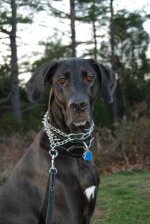
Ok I have a great dane mix. And with a dog that size pulling and jumping is no joke. I suggest you use a prong (pinch) collar. This does not hurt him even thought it looks like a torture device. Normal choke collars can cause damage to the trachea when not used correctly (which is often). The collars are adjustable and the most important part is making sure you have it sized right on him without a lot of slack. your dog should still wear a normal collar for his tags. I found it better to have the normal collar and pinch collar in reverse order than Is on my dog in the photo. In other words his tag collar would be closest to the top of his head. Also note that this is no substitution for seeking a reputable obedience trainer. Try looking for a trainer that DOESN'T require you to not feed your dog before class and doesn't keep shoving food down your dogs throat. Neither of which are good for your dog. Dogs need to think about what they are doing and not be thinking "gimmie food gimmie food" the entire time.
 

Attachments

  • resizeDSC_0060.JPG
    resizeDSC_0060.JPG
    81.7 KB · Views: 47
Good advise on the correction method. An additional suggestion, it's easier for this method to work if you can play with your dog giving her a good run to work off some energy beforehand.
 
Hey- I met my husband at dog training school. I'm just saying! Aside from that, the school I went to had classes every night- multiple classes. During the day too. You could take the same class several nights a week with the same or different instructor, for like $3/class or something. (That was in the 1980's) It'd be something really fun for you to do, and you never know, you might really get into it, then you could take your dog to fun matches with all the people you know from dog school, and then move on to real shows! It is SO FUN!!! And then there is agility, and tracking, and what's that thing where they race over the jumps- a couple fun offshoots that your dog might like!
 
It'd be something really fun for you to do, and you never know, you might really get into it, then you could take your dog to fun matches with all the people you know from dog school, and then move on to real shows! It is SO FUN!!! And then there is agility, and tracking, and what's that thing where they race over the jumps- a couple fun offshoots that your dog might like!

We did puppy agility this past summer on Saturday mornings. He really enjoyed it. No jumps, because he is too young, but we did most of the other pieces of equipment. We are going to take the second level agility course this spring. He will be over 12 months by then and able to do appropriately sized jumps.

I would like to do competetive obedience with him, but it's finding the classes around here that is tough. I was going to a local dog training club (where we took Puppy kindergarten) but like I said, I got off track because of the house, and now they are not offering the class I need until spring. :angry01:

In addition, I think he would be an excellent therapy dog as he really does love people. Just have to get him trained before I even attempt that. I've thought about trying tracking or search and rescue as well- he sure does have a nose on him. So there's a lot that we can do, and a lot that I want to do, once we get through the puppy stages. Sometimes I forget he is still a puppy, because he is so big!

Oh, and did I mention flyball? I really want to try that, but I don't think he will like it. He's not a fan of tennis balls! :eek1:
 
Back
Top