• Hello!

    Either you have not registered on this site yet, or you are registered but have not logged in. In either case, you will not be able to use the full functionality of this site until you have registered, and then logged in after your registration has been approved.

    Registration is FREE, so please register so you can participate instead of remaining a lurker....

    Please be certain that the location field is correctly filled out when you register. All registrations that appear to be bogus will be rejected. Which means that if your location field does NOT match the actual location of your registration IP address, then your registration will be rejected.

    Sorry about the strictness of this requirement, but it is necessary to block spammers and scammers at the door as much as possible.

Koda the Dwarf Boa

Aozora

Blue Sky Reptiles
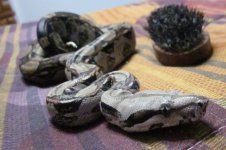
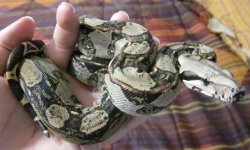
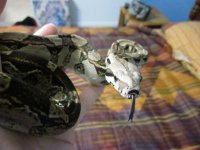
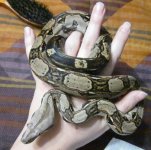
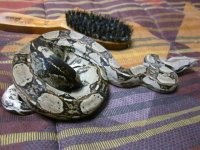
I went to Repticon Columbia today to get some probes swear to God only probes, and walked out with a boa. Meet Koda (Lakota for "friend")! Hairbrush is for size comparison only and not to comb his mustache.

He's a dwarf boa--according to his breeder, he's 2 years old, and he only weighs 279g. The breeder said his mother was only 3' fully grown, so since he's male he may not get a whole lot bigger. At most, he'll reach her size. He's got some arabesquing, and he's het for albino.

I can find a lot of information about standard boas, but I find very little about dwarfs. In particular, I have absolutely no idea what kind of feeding schedule to put him on. Can anyone with experience in boas, especially dwarf boas, please help me out?
 

Attachments

  • Koda1.JPG
    Koda1.JPG
    127.4 KB · Views: 103
  • Koda2.JPG
    Koda2.JPG
    90.9 KB · Views: 103
  • Koda3.JPG
    Koda3.JPG
    91.4 KB · Views: 103
  • Koda4.JPG
    Koda4.JPG
    82.8 KB · Views: 103
  • Koda5.JPG
    Koda5.JPG
    90.4 KB · Views: 103
That moustache is AMAZING! What a doll :D I myself am just starting to consider a standard size boa so I haven't read much up on the dwarfs...I am sure someone will chime in though :)
 
Very cute. That's a Charlie Chaplain stache. That little dude is amazing, and way better than some probes!
 
The breeder didn't give you any more info than dwarf boa? There are lots of different localities. I feed my taramuharas every ten days to two weeks, they have a slower metabolism than corns.
 
I don't man to rain on anyone's parade, I really don't... but 300 grams at that age is malnutrition that happened at a critical stage of growth.

I do not see an obvious sign of him being a pure dwarf locality...

3 feet is unreasonably small for an adult female as well. And he bred her at that size? seriously?

Well, at the very least he's got a shot at a happy life... but I really do think that the breeder did not disclose everything he should have, or he has no business breeding Boas...

At any rate, a sub-adult male... feed him no more than the maximal rat he can handle( 1.5 times his widest "section") every 2 weeks.
Once he is 3-3.5, feed once every 3 weeks, and from time to time skip another week( 3 weeks- feed, 3 weeks feed, 4 weeks feed, 3 weeks feed).
 
Dwarves (and super dwarves) can run fairly small and that animal does not look like it's suffering from malnutrition...it is not thin...looks lean and healthy. I feed all boas and pythons every 2-3 weeks. They have slow metabolisms and in some species they can prolapse if fed too often....Also a fat boa is not pretty-or healthy. I never feed larger than the size of the body either. They are NOT cornsnakes and can have issues if fed large prey on a regular basis...mostly getting too fat...although they can easily do so. I'd say every 2 weeks is perfectly fine while they are young though......
 
Unlike reticulated pythons, there's no such thing as "dwarf" vs "super dwarf" in Boas. It is not a single gene mutation in Boas(neither is it in retics but the fluctuation is so extreme that they divide dwarfs into small and smaller).

A very slow feeding regiment will not always yield thin Boas- especially when they grow. It will cause:
1- a much slower growth rate.
2- They will not "unlock" their optimal growth genetic potential since they did not have sufficient energy/protein etc at the critical time-frame(the first 2 years being the most critical, and the next 2 being important too, but not as. After that the growth is very slow).

Kind of surprised about the prolapse comment, never had a Boa rectal prolapse on me, and this is the first time I encountered an opinion stating they are more prone to it than other species. I do not think they are particularly prone to it, not more than other species at least.

Like Pythons, they have a slower metabolism rate when compared to colubrids. Force-feeding in Boas is not recommended as it is with Pythons- it seriously endangers their fertility.

I have been working with dwarf locality Boas for the past 7 or so years... I've literally seen and worked with hundreds of animals- no BCI (or other Boa sub-species) locality averages at 3 feet for adult mature females. The norm for most males from dwarf localities would be 4-5 feet, slender...yes, but this is small for the age, and since it bears no distinct locality markers, it is very likely a cross with mainland, meaning that it is supposed to be even bigger.
 
I've had pythons prolapse....not any of my boas (although I have heard of it occasionally in boas), but I did have one of my pythons prolapse....I do not over feed as a result and because they are so slow as metabolizers I think they are waaay over fed in general. I don't even feed colubrids weekly...except my false water cobras...cornsnakes are on the same schedule as everything else and do beautifully...no more hips on my breeding females and no more egg binding either. I would think with many snakes if you were conservative in your feeding the animal matures more slowly...as they would in the wild. I don't feed even my baby boas more than every 10 days or so or have had lackluster feeding responses with more often. As a result they mature more slowly but they do reach normal size by 4 to 5 years of age and show no difference between weekly fed and mine that are fed more conservatively.
 
I've had pythons prolapse....not any of my boas (although I have heard of it occasionally in boas), but I did have one of my pythons prolapse....I do not over feed as a result and because they are so slow as metabolizers I think they are waaay over fed in general. I don't even feed colubrids weekly...except my false water cobras...cornsnakes are on the same schedule as everything else and do beautifully...no more hips on my breeding females and no more egg binding either. I would think with many snakes if you were conservative in your feeding the animal matures more slowly...as they would in the wild. I don't feed even my baby boas more than every 10 days or so or have had lackluster feeding responses with more often. As a result they mature more slowly but they do reach normal size by 4 to 5 years of age and show no difference between weekly fed and mine that are fed more conservatively.

Kudos on that,
I can't say I feed -as- slowly... but I read several articles that state that the largest specimen of snakes actually occur in the wild, meaning that the biggest animals are not necessarily those who eat the most- rather, a slow, but steady regiment may be a more effective way to get snakes to "put on some size", even if it takes more time.

For colubrids I feed once every 5-7 days for babies, once every 10 or so days as sub adults, and once every 2 weeks for adults(males will get smaller meals than females).

Boas- once a week for babies, once every 2 weeks as sub adults. Adults- Females will continue to get a meal once every 2 weeks, and males will get once every 3-4 weeks.... and I will intentionally skip meals from time to time.

These are with breeding in mind.
 
I asked the breeder if he was an insular locality, because he sure didn't look like any locality I knew about. He confirmed that no, this little guy is not a locality type. The breeder said that he eats like a horse, he just... doesn't... grow. In fact, the breeder said he was feeding him weekly on rat pups, which seems like way too often in my opinion.

Regardless, if he's this size at 2 years old, I doubt he's going to grow very large even on a regular healthy feeding regimen.

Even if he isn't a dwarf, Koda is my kiddo now and I'll take care of him for his entire life.
 
And for clarification, by rat pup I mean the equivalent of the mouse fuzzy, not the mouse peach fuzzy.

I bought him some rat weanlings, took a quick measurement of his body and went to my rat/mouse breeder and determined what would be the right size for him. Not going to even try to feed him for another week.

He's quite shy, very different in behavior from a corn. I'm used to snakes exploring their new cage, but he went straight for his Kleenex box. I caught him on his warm log last night, but he "froze" at the sight of me and he was back in his Kleenex box when I went into the room again half an hour later.
 
And for clarification, by rat pup I mean the equivalent of the mouse fuzzy, not the mouse peach fuzzy.

I think that this is the problem.
newborn BCI handle these... and past the 3-4'th meal, will usually be able to tackle adult mice with no problems.

Physically he isn't thin, his muscle tone is as it should be- I never said the snake wasn't healthy, just that it wasn't brought up as well as it could have been and that I hope the breeder didn't try to command a high price.

He'll be a neat pet for sure, a mini mini Boa.
 
Well then... Feeding a boa is a lot different than feeding any of my other snakes. My corns will strike at the meal and "kill" it, but then aside from the odd tail rattle they're just as placid as corns usually are. My sand boas get mad if they're interrupted while eating, but they just gently take their mice and proceed.

Koda struck and wrapped his rat, but then he had a hard time finding the head. I went to help him like I do with my corns, prodding the head with the tongs, and he lunged at it open-mouthed. That was *HIS* rat and he was going to defend it. He stayed wrapped tightly for nearly half an hour before he calmed down and found the head.

Lesson learned... Give the boa his rat and leave the boa alone.
 
Boas have two set of personalities.
One you're used to, and one you get to know when there's food in the enclosure.
Some remain very placid... others, most, become downright insane.
 
My Isis likes to retreat with her food back into her hide. Which, I've read isn't too uncommon in boas. She isn't a problem feeder at all though, it's like "start to put rat into enclosure, see boa head peek out, almost get rat to ground level, BAM GONE!"
 
Back
Top