-
Hello!
Either you have not registered on this site yet, or you are registered but have not logged in. In either case, you will not be able to use the full functionality of this site until you have registered, and then logged in after your registration has been approved.
Registration is FREE, so please register so you can participate instead of remaining a lurker....
Please be certain that the location field is correctly filled out when you register. All registrations that appear to be bogus will be rejected. Which means that if your location field does NOT match the actual location of your registration IP address, then your registration will be rejected.
Sorry about the strictness of this requirement, but it is necessary to block spammers and scammers at the door as much as possible.
You are using an out of date browser. It may not display this or other websites correctly.
You should upgrade or use an alternative browser.
You should upgrade or use an alternative browser.
mass confussion
- Thread starter Richard
- Start date

Darin Chappell
Very Senior Hillbilly
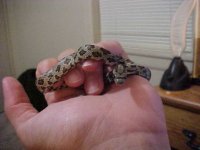
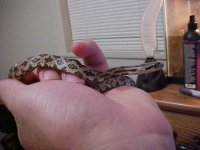
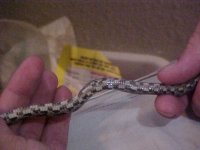
I know that you read my post on the other forum (hence the inclusion of prarie kingsnake as one of the options), but since you have a better series of pictures here, let me say for a certainty. That IS a prarie kingsnake. I catch them all the time here in Missouri.


Horridus
Pantherophis my a**
Juv. Ratsnake (Elaphe obsoleta ssp.)
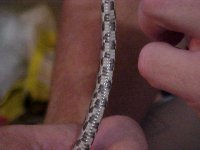
Thats definantly not a Prairie King (Sorry Darin), it is a ratsnake. Ventral scalation, Eye size, and head shape are definative Elaphe. Difficult to tell from the photos whether it is a Great Plains Ratsnake or a Juvenile Texas/Black Ratsnake I would say it is the latter depending upon where in Oklahoma it was found. The head marking and blotching is not textbook Great Plains (E. guttata emoryi) but they can be quite variable.
short version:
Juvenile Ratsnake (I would say Black) Elaphe obsoleta obsoleta
Thats definantly not a Prairie King (Sorry Darin), it is a ratsnake. Ventral scalation, Eye size, and head shape are definative Elaphe. Difficult to tell from the photos whether it is a Great Plains Ratsnake or a Juvenile Texas/Black Ratsnake I would say it is the latter depending upon where in Oklahoma it was found. The head marking and blotching is not textbook Great Plains (E. guttata emoryi) but they can be quite variable.
short version:
Juvenile Ratsnake (I would say Black) Elaphe obsoleta obsoleta
ok
Thanks so what can i do to get him calmed down? The person that had him before me evedently didn't handle him much and every time i reach in to get him/spot clean he get's really ticked off striking, tail rattling, and biting me , none have been anything to wine about but they will be if he's still acting this way as an adult
P.S he eats great and is healthy as an ox. He's grown 2in since i've had him. But he hasn't shed yet?
Thanks so what can i do to get him calmed down? The person that had him before me evedently didn't handle him much and every time i reach in to get him/spot clean he get's really ticked off striking, tail rattling, and biting me , none have been anything to wine about but they will be if he's still acting this way as an adult
P.S he eats great and is healthy as an ox. He's grown 2in since i've had him. But he hasn't shed yet?

Jr Nimeskern
Snake lover for lifer
It doesnt really look like a GPR I catch them around here (Kansas) all the time... Of course like you said they do vary in color and pattern from place to place... but the head pattern just doenst look like one... Im not to sure what it is but I know its not a Praire Kingsnake either... IMHO to tell the truth I dont have a clue to what it is!

SilverTongue
Friend Of Gaia
Thanks so what can i do to get him calmed down? The person that had him before me evedently didn't handle him much and every time i reach in to get him/spot clean he get's really ticked off striking, tail rattling, and biting me , none have been anything to wine about but they will be if he's still acting this way as an adult
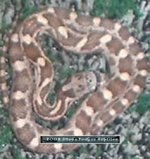
hehe My Texas Ratsnake is the same way. I might as well be reaching into his cage for the first time. LoL He has only bitten me twice and they were hunger bites, but he has all the other symptoms LoL I will attach a pic of my baby Texas Ratsnake. It is not a super good pic but maybe it will help you figure it out.
Attachments
Darin Chappell
Very Senior Hillbilly
I hate to disagree with everybody, but I absolutely think thta animal is a prarie kingsnake. I know for a fact it is not E.obsoleta, juvenile or otherwise.
Here is a pic of a prarie king (a dark animal):

That picture was taken by ClintSnakeman and posted on Kingsnake.com's gallery forum. It is a young prarie king that was caught under a board where he lives.
Here is the picture of an adult and a juvie prarie I posted in the other section:

This pic is from the Missouri Department of Conservation website. You can see that the young in the corner pic is much lighter at times.
All I can say is that I know what prarie kings look like, and that's it. It is not E.o.obsoleta, nor is it E.g.emoryi. I totally disagree about it being elaphe in any form, and I see nothing about the head to suggest otherwise. Prarie kings also have checkered bellies, so that prooves nothing. I'll keep looking for better prarie king pics to post . . .
Here is a pic of a prarie king (a dark animal):
That picture was taken by ClintSnakeman and posted on Kingsnake.com's gallery forum. It is a young prarie king that was caught under a board where he lives.
Here is the picture of an adult and a juvie prarie I posted in the other section:
This pic is from the Missouri Department of Conservation website. You can see that the young in the corner pic is much lighter at times.
All I can say is that I know what prarie kings look like, and that's it. It is not E.o.obsoleta, nor is it E.g.emoryi. I totally disagree about it being elaphe in any form, and I see nothing about the head to suggest otherwise. Prarie kings also have checkered bellies, so that prooves nothing. I'll keep looking for better prarie king pics to post . . .
Darin Chappell
Very Senior Hillbilly
BTW<
If I'm TOTALLY off base here ( and it has been known to happen! ), I'll be the first one to admit it! I just disagree . . .for now.
If I'm TOTALLY off base here ( and it has been known to happen! ), I'll be the first one to admit it! I just disagree . . .for now.
Darin Chappell
Very Senior Hillbilly
Phil Peak caught this adult in KY and posted its pic on kingsnake.com:

HMMM....
well guys what do i do? haha know one can figure out what i have but to be honest i really have know clue...
He matches the photos i've seen of both prarie kings and texas rat's and everyone has a diff. opion , any ideas on how i could find out for sure? the only reasson i'm swaying a little more to the texas rat is because he's aggresive as he is and i've heard there know for that. i understand him being stressed b/c new envirmoent and little human contact but i've had him for almost 2weeks and he's still as mean as the devil..lol
but i guess i may just have to wait untill he get's a little bigger
but thanks for all your help guys
richard
well guys what do i do? haha know one can figure out what i have but to be honest i really have know clue...
He matches the photos i've seen of both prarie kings and texas rat's and everyone has a diff. opion , any ideas on how i could find out for sure? the only reasson i'm swaying a little more to the texas rat is because he's aggresive as he is and i've heard there know for that. i understand him being stressed b/c new envirmoent and little human contact but i've had him for almost 2weeks and he's still as mean as the devil..lol
but i guess i may just have to wait untill he get's a little bigger
but thanks for all your help guys
richard
Horridus
Pantherophis my a**
Elaphe....
It's not the checkering of the belly, its the ventral shape, you can clearly see the "ventral ridge" along the sides of he scutes Lampropeltis are not shaped like this. I agree with you about it looking like a calligaster (attached is the photo of one of mine) I have bred them (normals and amels) for years. The most telling feature are the eyes, no Lampropeltis has eyes that large...ever even as an adult. The blotches are the wrong shape (but this is not as important as calligaster as as variable, even somewhat more so as far as shade and the striping mutation as emoryi are) Also look at the mask between the eyes calligaster lack this. BUT it would not be the first time a photo has fooled me. Simple answer look at the anal plate you will find it is divided. If not than I accept defeat
<img src=http://www.olddude.com/images/Rat_Head.jpg>
<img src=http://www.olddude.com/images/Elaphe_Head.jpg>
<img src=http://www.olddude.com/images/Calligaster_Head.jpg>
It's not the checkering of the belly, its the ventral shape, you can clearly see the "ventral ridge" along the sides of he scutes Lampropeltis are not shaped like this. I agree with you about it looking like a calligaster (attached is the photo of one of mine) I have bred them (normals and amels) for years. The most telling feature are the eyes, no Lampropeltis has eyes that large...ever even as an adult. The blotches are the wrong shape (but this is not as important as calligaster as as variable, even somewhat more so as far as shade and the striping mutation as emoryi are) Also look at the mask between the eyes calligaster lack this. BUT it would not be the first time a photo has fooled me. Simple answer look at the anal plate you will find it is divided. If not than I accept defeat
<img src=http://www.olddude.com/images/Rat_Head.jpg>
<img src=http://www.olddude.com/images/Elaphe_Head.jpg>
<img src=http://www.olddude.com/images/Calligaster_Head.jpg>
ok
ok i'm back i looked at the anal plate and it is devided. he's has single plates all the way and then he has 1 or 2 devided then the anal plate ich is also devided and of couse so are all the other one's thanks alot
now i don't have to sound like an idot trying to tell people what my snake is =)
Thanks for all your help
P.S do you think i should leave the thread here because i know rich dosn't like threads here that arn't dealing with corns what da ya think ?
ok i'm back i looked at the anal plate and it is devided. he's has single plates all the way and then he has 1 or 2 devided then the anal plate ich is also devided and of couse so are all the other one's thanks alot
now i don't have to sound like an idot trying to tell people what my snake is =)
Thanks for all your help
P.S do you think i should leave the thread here because i know rich dosn't like threads here that arn't dealing with corns what da ya think ?
Horridus
Pantherophis my a**
Anal Plate Divided=Elaphe
If it were a calligaster it would be single (undivided)
So, it is in fact a young Ratsnake. It could be a Texas
(lindhiemeri) or a Black (obsoleta) or they intergrade
over a wide area in Oklahoma so it could very well
be one of those. Thanks for looking. That was killing me
not to know for sure (Jeez, talk about neurotic)
the thread is ratsnake related...I don't know.....I thought it was an anerythristic corn at first glance does that count?
Horridus
(Bart)
If it were a calligaster it would be single (undivided)
So, it is in fact a young Ratsnake. It could be a Texas
(lindhiemeri) or a Black (obsoleta) or they intergrade
over a wide area in Oklahoma so it could very well
be one of those. Thanks for looking. That was killing me
not to know for sure (Jeez, talk about neurotic)
the thread is ratsnake related...I don't know.....I thought it was an anerythristic corn at first glance does that count?
Horridus
(Bart)
Last edited:
Darin Chappell
Very Senior Hillbilly
OK, Ok, ok . . .
UNCLE!!!
I give up. It cannot be a prarie kingsnake. It LOOKS like oneD), but if it's anal plate is divided, it cannot be.
I was wrrr . . . .
I was wrrroo . . . .
I was wrrrroonnggg!
(Those of you old enough to remeber "Happy Days" and the Fonz will appreciate that! )
UNCLE!!!
I give up. It cannot be a prarie kingsnake. It LOOKS like one
D), but if it's anal plate is divided, it cannot be.I was wrrr . . . .
I was wrrroo . . . .
I was wrrrroonnggg!
(Those of you old enough to remeber "Happy Days" and the Fonz will appreciate that! )