• Hello!

    Either you have not registered on this site yet, or you are registered but have not logged in. In either case, you will not be able to use the full functionality of this site until you have registered, and then logged in after your registration has been approved.

    Registration is FREE, so please register so you can participate instead of remaining a lurker....

    Please be certain that the location field is correctly filled out when you register. All registrations that appear to be bogus will be rejected. Which means that if your location field does NOT match the actual location of your registration IP address, then your registration will be rejected.

    Sorry about the strictness of this requirement, but it is necessary to block spammers and scammers at the door as much as possible.

Rat Snake noob help.

jbritvch

New member
Hello all,
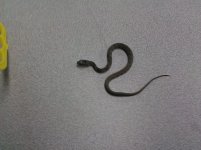
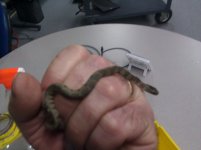
I don't know much about snakes so I am looking for some help. I found this little guy at work in one of the buildings. I live in Maryland, so its snowy and cold right now. I believe he is a baby black rat snake since we have them around here. I put him in a 10 gallon aquarium with a heater pad under it that I had for the kids hermit crabs (long gone). I gave him some water and I don't know what to give him for food. I plan to release him in the spring/summer. Any suggestions to keep him happy? BTW we are calling him Mr. Happy.
Thanks!
Joe
 

Attachments

  • IMG_20110126_143947_small.jpg
    IMG_20110126_143947_small.jpg
    72.1 KB · Views: 47
  • unknown_snake_small.jpg
    unknown_snake_small.jpg
    132.7 KB · Views: 48
I agree. For sure not a black rat (or any other North American rat snake I know of), but it looks a lot like a Northern Water Snake. Hopefully someone around here can give you good info on care; if not, the people over at http://www.thamnophis.com/, a garter snake forum, often know a good deal about water snakes.

I hope he does well for you!
 
I agree... definitely a water snake. They need a water area to retreat to for comfort, this can be as simple as a really big bowl or as complicated as a 1/2 land, 1/2 water tank.

It is easy to get them started eating rosy red minnows out of a bowl of water, but best thing is to get them onto f/t rodents ASAP. There are detailed instructions on how to convert garter snakes to rodents on Google. Check it out-- should also work for a water snake.

Know that they do get large and can be aggressive, snappy things once warmed up. Not a great handling pet, but very interesting to observe.
 
Yep I also vote water snake. I would make sure it's in a very secure cage (like a Critter Keeper) and then turn it loose once the snow melts (hopefully soon). It will hide and wait out the cold. Take it to a natural stream area, any nearby state park would be wonderful. I would not keep it to spring or try to convert it to mice...it won't eat many white mice in the wild. They can survive Maryland winters just fine.
 
What a beautiful snake! I just want to highlight what whippet said about diet. Don't try to feed it mice... minnows sounds like a good idea.
 
Sounds like some good advice since I last posted. The only extra input I have is to NOT use Rosy Red Minnows or, for that matter, gold fish. Both are high in the enzyme Thiaminase, which inhibits Thiamin (Vitamin B1) absorption. Thiamin deficiency can be deadly, especially in snakes such as your water snake, as they don't really have other ways to acquire the Thiamin they need--especially not enough to counteract the amount of Thiaminase in a minnow and/or goldfish diet.

Feeder guppies are a safer option for live fish. Garter snakes can and will feed on nightcrawlers--I would guess the same is true for water snakes, but you should confirm with a reliable source before taking my word on it! If you can get it to take thawed strips of fish, tilapia is safe, as are silversides. There's a few others... You can find a list or two (and a better explanation of the Thiamin/Thiaminase issue) over at the forum I linked in my last post. :)

On another note, I agree with Tara. It would be best to turn this one loose once the weather warms up enough. If you decide you really want a pet snake, it'll be a much better experience for you to go with a good, captive-bred beginner species (like a Corn snake!)... Of course, after plenty of research on proper care! ;)
 
Back
Top