
Zimmer
New member
I am very interested in these genes, and the identifying markers for them. We know RF is (co/incomplete)dominant with a super form. RF is said to affect only the ground color by enhancing/increasing red pigment. Also less certain but what I've seen and been told is that RF is not visible at hatch but develops with time. Also not certain about vental coloring on an RF.
On the other hand we have RC which is recessive, and seems to add a "layer" of red, if you will, to the entire snake, ventral included. It is clearly visible at hatch.
I feel like there is just not enough info out there on these genes, and what they can do, and how to ID them. I know they are both frequently confused and mislabeled. And the whole coral/salmon thing doesn't help. Lots of people are quick to say "maybe its red factor/coat" when a snake is just an extra red specimen... In fact they are so often called so many different things that I am not certain where I would even go to purchase an RC or an RF because how do I know thats even what it really is?
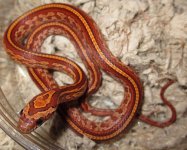
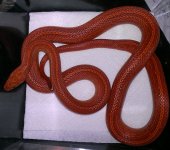
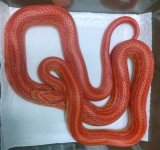
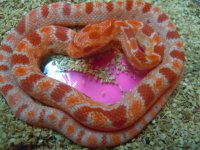
So what I'm asking is this: Can we see your ***PROVEN*** RED FACTORS and RED COATS?? Please?! At all ages, from all angles, and if possible state the breeding or lineage when known??
I would love to also hear any input, info, or history anyone might have on these genes??
On the other hand we have RC which is recessive, and seems to add a "layer" of red, if you will, to the entire snake, ventral included. It is clearly visible at hatch.
I feel like there is just not enough info out there on these genes, and what they can do, and how to ID them. I know they are both frequently confused and mislabeled. And the whole coral/salmon thing doesn't help. Lots of people are quick to say "maybe its red factor/coat" when a snake is just an extra red specimen... In fact they are so often called so many different things that I am not certain where I would even go to purchase an RC or an RF because how do I know thats even what it really is?
So what I'm asking is this: Can we see your ***PROVEN*** RED FACTORS and RED COATS?? Please?! At all ages, from all angles, and if possible state the breeding or lineage when known??
I would love to also hear any input, info, or history anyone might have on these genes??