• Hello!

    Either you have not registered on this site yet, or you are registered but have not logged in. In either case, you will not be able to use the full functionality of this site until you have registered, and then logged in after your registration has been approved.

    Registration is FREE, so please register so you can participate instead of remaining a lurker....

    Please be certain that the location field is correctly filled out when you register. All registrations that appear to be bogus will be rejected. Which means that if your location field does NOT match the actual location of your registration IP address, then your registration will be rejected.

    Sorry about the strictness of this requirement, but it is necessary to block spammers and scammers at the door as much as possible.

Substrateless Incubation Medium

qtken2

Oh you know!!!
I was just curious for those who use this method, has anyone ever used hydrogel for a medium? I've been incubating this way for years and have used a variety of materials; plain water, sponges, sphangnum moss, vermiculite, and hydroballs. I like the idea of hydrogel because it's sterile and doesn't splash water around in case I need to move the containers around. Any thoughts and/or opinions are welcome.
 
I haven't done substrateless, but I did buy two of those egg containers at Daytona, and am going to try one.

Do you use holes in your containers? I never have, but I use lettuce containers, which seem airtight. I open them and fan the eggs a couple times a week.

I was thinking I was probably going to use Hatchrite for the medium.
 
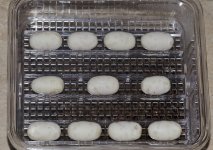
If you are taking about the S.I.M. containers, I have those. I got them when they first came out. Before I got those and sometimes still use my first ones. They are just clear plastic containers with a light diffuser cut to size.

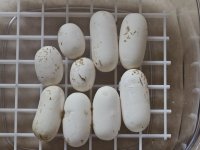
The one I made is smaller than the S.I.M. but is air tight.

This is the S.I.M. container
 

Attachments

  • image.jpeg
    image.jpeg
    207.1 KB · Views: 48
Hers is the one I made. This was before adding hydroballs that year.
 

Attachments

  • image.jpeg
    image.jpeg
    96.3 KB · Views: 48
I saw someone, somewhere, using the gel in a S.I.M and filed it away as something to try, but haven't attempted it yet. My one and only attempt at S.I.M incubation was not a success.

I was using one of the medium THG egg tray and a 128 ounce deli cup, that was recommended to go with it and it does not work well unaltered. The legs of the tray either need to be shorter or it needs to be placed into a much taller container.
I fought condensation, not even a lot, on the lid of the container through most of the attempted incubation and because it keeps the eggs practically in contact with the lid, it kept collecting on the eggs and pooling there. Drowned most of them as there was no way to keep it from doing that.
I just used a layer of wetter than normal vermiculite on the bottom in that case.
 
Oh, on my one S.I.M try, I did have quite a lot of small airholes in the lid. I was trying it with my 5th and thank god, final AHS clutch. They seem to need a lot more airflow and are more finicky than corn eggs on too much humidity, that kills them fast. So in all previous ones I was always fighting with the humidity, it was either too humid or too dry.
I really was hoping that the S.I.M. would work much better than it did. I might try it again if I ever breed the AHS again, though with a lot more modification, the eggs were already laid a few days by the time my tray got here and it was a harum scarum sort of effort at it. And I wasn't completely broken up to not have more hatchlings in all truth. Pissed that I couldn't nail the incubation but it was also kind of a relief.
 
I've only incubated corn and hog eggs with the S.I.M. with no problems so far. I haven't made any modifications to them either. I'm just not sure if hydrogel will keep the humidity up or not. I really don't have any testing clutches to use but I am going to use the first clutch that drops as a guinea pig though. Backups are ready just in case.
 
I found when incubating leopard geckos on substrate (eco earth, aka bed-a-beast, aka coco fiber) that I had larger, more robust hatchings than I did incubating via no-substrate. For my no-substrate I used mesh bar mat (similar to this... http://www.bottlesup.com/blackbarmatshelflinerplasticmesh24x40roll.aspx). I only did this for 1 season (2011 or 2012 I believe), but I split sibling eggs from multiple clutches for the test. Sadly I also did my Mexican hognose eggs no-substrate that year, which resulted in 1 stillborn and 3 successful hatches that then proceeded to never eat.

My assumption at that season was that even though this was done in the same incubator (igloo 120-qt cooler-bator), the eggs in contact with substrate seemed better hydrated. Most to all yolks were absorbed at hatching, whereas those on no-substrate had retained yolk and again seemed not as robust.

That said, lots of chondro breeders have had great success (Borat voice) in going no-substrate.

Damon Salceies' websites are down, but here's a rough idea of the coolerbator.

http://moreliaviridis.yuku.com/reply/168718/COOLERBATOR-PROJECT-PIC-HEAVY
 
Thanks all for the input. I read that multiple people use them. It even said water polymer crystals in the S.I.M. setup which are hydrogel.
 
Back
Top