• Hello!

    Either you have not registered on this site yet, or you are registered but have not logged in. In either case, you will not be able to use the full functionality of this site until you have registered, and then logged in after your registration has been approved.

    Registration is FREE, so please register so you can participate instead of remaining a lurker....

    Please be certain that the location field is correctly filled out when you register. All registrations that appear to be bogus will be rejected. Which means that if your location field does NOT match the actual location of your registration IP address, then your registration will be rejected.

    Sorry about the strictness of this requirement, but it is necessary to block spammers and scammers at the door as much as possible.

Tesseras from Super Tessera

Richard Hume

New member
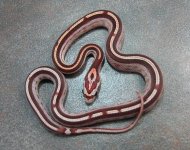
As most are aware, Vin Russo & I acquired the only known super version of the tessera morph to date. He had been bred for two successive years and sired tesseras only. Why he's the only one this relatively late in the tessera game is a mystery, but that's another discussion. This year, he again sired tesseras only on multiple females.

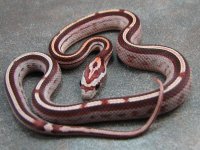
Anyway, we crossed him into a number of female corns, and the one we were looking forward to with the most anticipation was a pairing with my fire striped female (het anery and hypo). The eggs have hatched, and the hatchlings are truly amazing, they have quite a different look than normal tesseras. Maybe that lack of side pattern is from the bloodred, the stripe, or possibly from the father?

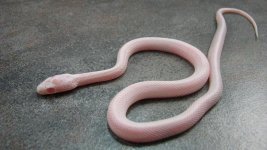
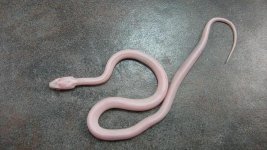
As a further surprise, we got one snow tessera in the bunch. Now, as far as we knew, this super tessera was het for nothing, so getting an amel (or an anery for that matter) was not anticipated. And why would there be only one amel when bred to a visual amel? Weird, although not something that hasn't happened before to people who do a lot of different breedings.

There's something unusual and odd about this super tessera, and hopefully we will start to figure it out over the ensuing seasons.

Thanks for looking!
Rich Hume
 

Attachments

  • IMG_6079.jpg
    IMG_6079.jpg
    71.7 KB · Views: 375
  • IMG_6082.jpg
    IMG_6082.jpg
    81.9 KB · Views: 375
  • IMG_6085.JPG
    IMG_6085.JPG
    56.7 KB · Views: 374
  • IMG_6086.JPG
    IMG_6086.JPG
    72.7 KB · Views: 374
I will say not as much congrats but good luck in getting the desired results next season. However you did come out with a couple really nice baby's
 
Beautiful babies!
however i dont think the father was a "super" tessera. I think tessera is dominant to normal and not allelic to it, that is why no one has seen a visual "super" looking morph.
Most tesseras are het for the normal gene... having the normal gene on one allele and the tessera on the other - showing only tessera due to it being dominant.
This is most likely why most people have gotten a mix of normals and tesseras when breeding tesseras... because, just like breeding a pair of normals het amel, you get some of the dominant gene and some of the recessive gene in the babies.
The father was most likely simply not het for normal, and thus created all tessera offspring, just like breeding a normal not het for amel wont give you amels.
all of the offspring are then het for normal and will produce some normals when bred to a normal.
This is my hypothesis... hope you can prove one way or the other with the offspring. :)
 
Beautiful babies!
however i dont think the father was a "super" tessera. I think tessera is dominant to normal and not allelic to it, that is why no one has seen a visual "super" looking morph.....

The father was most likely simply not het for normal, and thus created all tessera offspring, just like breeding a normal not het for amel wont give you amels.

That is the "concept" of super anything.....ball python, leopard geckos, carpet pythons, etc.; you've contradicted your agrument to some degree.

The super term has been traditionally linked to co-dominant and potentially incomplete dominant mutations. The result of the fully dominant mutations of these typically gives you some visual variation (in humans, blood type is a form of imcomplete dominance and is only "visual" in blood testing). In the case of the super tessera, it may just be a dominant mutation, but genotypically would still act as that of the super form of a co-dominant mutation. The difference between the 2 modes of genetics, thus far, is that the tessera hasn't proven co-dominant, thus phenotypically you get no visible "super" in fully dominant form.
 
Even though the word super has been used for the homozygous form of a gene that is different from the normal phenotype and the phenotype of the heterozygous form of that same gene (the homozygous form of a co-dominant gene), some people like to call proven homozygous forms of dominant genes supers. I don't think that people have excluded this specific scenario out of the super context even though it would make sense as it doesn't produce a second phenotype different from normal. I just don't think people have invented a word for it and they stick with super.
 
Note : as we know from human eye color, there are more types of inheritance than mendelian. Which suggests there may be even more types of inheritance not identified yet.

Fascinating, Rich.
Will be exciting to learn more on the subject from you brilliant breeders of morphs that fall outside of the normal distribution of the bell curve.
 
Beautiful babies Rich!! And good luck with unraveling the puzzle of your super teasers male. Genetics are fun! How have you been?
 
Back
Top