• Hello!

    Either you have not registered on this site yet, or you are registered but have not logged in. In either case, you will not be able to use the full functionality of this site until you have registered, and then logged in after your registration has been approved.

    Registration is FREE, so please register so you can participate instead of remaining a lurker....

    Please be certain that the location field is correctly filled out when you register. All registrations that appear to be bogus will be rejected. Which means that if your location field does NOT match the actual location of your registration IP address, then your registration will be rejected.

    Sorry about the strictness of this requirement, but it is necessary to block spammers and scammers at the door as much as possible.

'06 Stiped-Blood: Carol

Roy Munson

New member
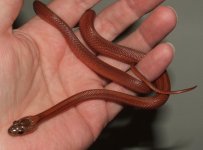
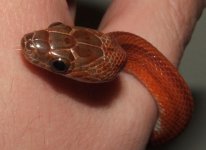
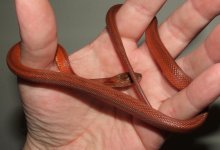
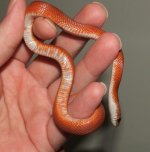
She's a tiny thing, even for a late '06. She only weighs 16g. She had a couple of non-consecutive regurges months ago, and I think I've been way too conservative in feeding her since. Her brother died (granite het stripe), which only made me more nervous. But she eats great, and she's very active, so I've put her on a 4-day schedule of mid-size pinks. She really isn't skinny either, she just isn't growing as fast as I think she should be. I really like how dark she is. I'm hoping she starts growing so she'll be ready in '09. :)

(Edited to actually attach photos. Haven't done that in a while.)
 

Attachments

  • 033007 carol (1).JPG
    033007 carol (1).JPG
    59.4 KB · Views: 278
  • 033007 carol (5).JPG
    033007 carol (5).JPG
    54.8 KB · Views: 277
  • 033007 carol (7).JPG
    033007 carol (7).JPG
    59.2 KB · Views: 275
  • 033007 carol (9).JPG
    033007 carol (9).JPG
    48 KB · Views: 275
I mentioned Cryptos when you posted about her brother - did you ever test her? I mean, she also regurged?!?
 
Menhir said:
I mentioned Cryptos when you posted about her brother - did you ever test her? I mean, she also regurged?!?

No, I haven't had her tested. The last of the two non-consecutive regurges was over three months ago. Both happened after prey-size bumps. Maybe you have access to inexpensive crypo testing, but I do not. I don't think I've had a regurge from any snake in '07, but I've had a few in the past. If I threw $300 at every regurge, I would have been out of the hobby long ago. I make a good living, but that level of diligence is definitely beyond my means. As a youngster, my '05 Serpenco hypo-blood had the most regurges (five) of any snake I own. This snake is a very healthy 390g now, and has had zero problems since these regurges. My '05 Serpenco caramel-mot had four regurges as a hatchling, and she weighs well over 400g now. :shrugs:

I've had discussions with this blood-stripe's breeder and with other breeders who own snakes from her line, and it seems that a number of hatchlings from her clutch and line are VERY slow growers. And as I mentioned, I think I've inadvertently been keeping her on a bare-maintenance diet, so there's a good possibility that this accounts for the slow growth. She weighs twice as much as the '06 rosy bloods that I just purchased, and they are probably about the same age as she is. Those maintenance diets can really stunt growth.

As I said in her brother's "obituary" post, I'm not denying the possiblity of crypto. She's still being kept under quarantine protocol. She's reacting well to increased feeding frequency, so I'm going to see how that goes. I'm betting that she turns out ok. I have an '05 Keys het cinder/Z/aneryC that was delivered to me exactly one year ago at 6.7g. She was probably about this snake's age at that time too. She is 180g now. It took me months to get her growth to really kick in.

Now will you stop scaring me with the "C" word? :grin01: I'm kidding, of course; I appreciate your insights. :)
 
One test costs about 35$... in Germany.
The thing is, as said, many US snakes come to us carrying Cryptos. The problem is, that not every animal dies, but it keeps infecting others. I often wonder how whole stocks still life having these Cryptos with an owner not caring about them.
I personally know one breeder with a larger stock than yous, who is now keeping about 20 snakes being the survivors after many animals started regurging and dying within a few months.
I just wanted to have said it, so that no one can say Menhir knows and didn't say anything. I wish you good luck and that the experiences I also made will not also be yours.
 
Having experienced a snake dying of crypt first hand, I can tell you that the regurge was constant for mine. She did not take food one week and digest it, and then puke it up the next week. My hatchling just kept puking. She'd take it down fast, and then three days later, on the dot... she would regurge. Little or no digestion taking place.

After having gone through this, I worry about the possibility of spreading crypt around. How do you quarantine for something that affects some snakes and does not affect others? (Who still go around spreading the stuff) Right now I just have the one snake and a few other miscellaneous herps, but maybe I'd like to breed eventually... that would entail more snakes. How do I handle that? The not knowing? And yes, in the US, the cost of testing for crypt at a vet is $300 a snake, which included the mandatory 3 negatives to ensure it's REALLY a negative. So it is expensive here. Don't know why that is....
 
Menhir said:
One test costs about 35$... in Germany...
I'll admit, I've been relying on anecdotal accounts concerning the price of the testing. I have NOT checked it out myself. I'm going to do that. If it's anything less than $75, I'll get this girl checked out just for piece of mind.
Menhir said:
The thing is, as said, many US snakes come to us carrying Cryptos. The problem is, that not every animal dies, but it keeps infecting others. I often wonder how whole stocks still life having these Cryptos with an owner not caring about them.
It's not shocking to me that many U.S. snakes come to Europe carrying crypto. It seems to be an unfortunately common parasite among American colubrids (especially corns and kings), and one to which these colubrids seem particularly prone. I have no doubt that there are collections where crypto is present, but what do you mean by the owner not caring about them? Are you saying that there are owners who know they have crypto in their collections, but are doing nothing about it? Or are you saying that it's irresponsible not to test an entire collection and each incoming acquisition for crypto? If the testing is $35, it would cost me over $2,000 to test my collection. If the testing is $300, as I've seen vet techs on here claim, then it would cost me around $18,000. :eek1: I can see owners not "caring" enough to spend tens of thousands of dollars in testing. I'm one of them. If the test is hundreds of dollars, and I'm not willing to test every snake, what do I do? I'm willing to spend about $3,000 max. Do I choose ten snakes, kill positives if found, then kill every other seemingly healthy snake I own that wasn't tested? I'm genuinely interested in your opinion on this.
 
I donno. It seems to me if Dean's snake has crypto and it is bad enough to cause regurging symptoms, it would also be displaying the mid body swelling. Which she does not show. A test for peice of mind is good, but sometimes you can figure some of this out by putting the puzzle peices together to see if they fit. From what I've read, crypto aslo causes distinct fecal samples.

Dean, I've tested for it before. You can do a fairly inexpensive fecal float to see if any coccidia are present. If you can get a few floats done with no coccidia are present I'd say you can dodge the acid fast stain. If there are some present, the stain will confirm if it is they crypto strain or not.

I was able to bring a sample of snakes in to a vet and have him check their health and interview me about my husbandry practices. Since this meeting, he will let me bring by samples for testing without having to make an appointment for that particular animal, which saves the cash for an office vist and helps a lot.

FWIW. :shrugs:
 
carol said:
It seems to me if Dean's snake has crypto and it is bad enough to cause regurging symptoms, it would also be displaying the mid body swelling.
Thats absolutely not true.

From what I've read, crypto aslo causes distinct fecal samples.
Not true in general, only true if the Cryptos are "active".
I once owned a male Silverqueen that lived for 4 years, growing to adultness, never regurging. When he moved to me, the Cryptos got active and he started regurging. I gave him smaller mice and some medication and he got better, but slowly got thinner over 1.5 years until I had to euthanice him. He never showed visibly Crypto signs until a few weeks before the end.

So, please stop telling me things about puzzles. Cryptos are currently not predictable in their behaviour and there are already a bunch of different forms out there, aggressive and less aggressive ones, showing different symptoms and signs.

From what I've read e.g. in the Love book, all "you" do is excluding animals that SHOW Crypto from the stock - but what about all the animals having them?
Dean, I know its expensive and I have spent much money in the past for tests. If I wouldn't have tested a little Bloodred male I got in September - who was in quarantine since without showing any symptoms - man, I would have brought an animal that is Crypto+++ (meaning highest degree) into my stock.
Strange, hmmm?
 
Thanks for the nice comments and thanks for the info Carol and Menhir. At the least, I need to develop a relationship with a decent herp-vet.
 
regurges

Well I know that alot of bloodreds seem to have the same problem,but I always thought that it has to do with stress :shrugs:
 
Menhir said:
Not true in general, only true if the Cryptos are "active".
Yes, so if the snake was regurging the Crypto would be active wouldn't it?

Also from what I understand, if crypto is not active, it's very likely the test will turn out negative whether or not the snake has Crypto. So what is the use of testing all your animals that are non symptomatic if the test will usually only show a positive in a sick animal? It's a false sense of security.

I am by no means "anti testing", I randomly test all my animals even though I RARELY see a regurge here. Out of 150 animals I'd say I might get one regurge a month and I can usually pin point a reasonable cause.

However, about 5 years ago I had a strain of coccidia go through my collection and it was a bear to get rid of. Thank goodness it wasn't crypto, but it still wasn't fun to treat that many snakes. However, it did teach me a lot about coccidia. Now I randomly test so just for peace of mind and so far, everyone has been clean for 4 years. However, testing all your animals is not exactly the solution you think it is. Also, just because what you have has been tested doesn't mean it's not still in your collection. It takes a lot of samples over time.
 
Mmmmm... she's lovely Dean & is that a little bit of white i see creeping up her sides...... :crazy02:
 
bribrian said:
Mmmmm... she's lovely Dean & is that a little bit of white i see creeping up her sides...... :crazy02:
Thanks Brian, and yes she does. They're not really creeping-- they've always been there; but they're there. :) I still calculate her chance of being pied-sided at about 0% though.
 
Menhir said:
Dean, I know its expensive and I have spent much money in the past for tests. If I wouldn't have tested a little Bloodred male I got in September - who was in quarantine since without showing any symptoms - man, I would have brought an animal that is Crypto+++ (meaning highest degree) into my stock.
Strange, hmmm?

Menhir, can you please tell me what type of test European vets use to detect crypto? When Cate died, I took her to the vet, who performed a necropsy on her. Her intestinal walls were swollen to some degree, though there was some error inherent in the fact that I froze her after death (I thought it best and did not know refrigeration was the way to go :( ). He then asked if I wanted to do the tests, and told me that they would cost $300 in testing fees and lab fees. At the time I said no, because regardless of the results, I would still have treated everything the same way- destroy all of the hides and climbs, ammonia the tank, etc.

I am looking to get two new snakes this year. I am very concerned about the possibility of introducing crypt into my stock. I do quarantine. But what good is quarantine alone against this disease? If there was a test that could be done, at a realistic expense, I'd be all for it. But $600 to test two snakes?? :shrugs: What's a hobbyist to do??

Edited to add:
Here is a link on Crypt from another CS Forum user. Crypt in jungle corn

When I read this thread, I think why bother?? This thing is so nasty that I don't see any hope for quarantining, and doing a "gastric lavage" can be so stressful on a hatchling snake that it may not recover. And even if the gastic lavage results are negative, are they REALLY negative?? :cry: Stuff like this makes me never want to buy another snake again, ever!

 
carol said:
Yes, so if the snake was regurging the Crypto would be active wouldn't it?

To some degree yes. But - I also know animals that only regurged without showing fecal symptoms. Thats especially true for the kind of Cryptos that are mainly in the stomach.

Also from what I understand, if crypto is not active, it's very likely the test will turn out negative whether or not the snake has Crypto.

I think you mix up differents tests. Testing via watching through a normal vet microscope will only make them visible if you animal is full, and I mean FULL, of them - and also this depends heavily on the vets experience and his equipment.
The "state-of-the-art" test for Cryptos is an IFT http://en.wikipedia.org/wiki/Immunofluorescence . The test nearly ensures, that you make Cryptos visible, IF they come out of the animal. Having an animal tested via its fecals and and flushing of its stomach (I don't know how to call that in english - the vet does this without any problems) gives you a very high rate of detecting Cryptos, no matter if they are active or not.

It's a false sense of security.

You mean like the controls at the airport? They are expensive too, so let's stop them cause we won't get 100% security. :eek1:
I know what you mean, but I think that the way of not caring and just separating animals will not bring us any further - only the way down of more and more animals having to deal with that ****.
 
Menhir said:
I know what you mean, but I think that the way of not caring and just separating animals will not bring us any further - only the way down of more and more animals having to deal with that ****.
It's not about not caring... The way I look at it, some hatchlings regurge just because they are weak, had a bad stroke of luck, or just because they weren't meant to grow at the rate we were pushing them at. Once a hatchling has regurged a few times in a short period, they are very weak and would not survive the stomach flush test. So if you are going go by, "If it hatchling has a bout of regurges it has to be tested with a stomach flush", you might as well just say it needs to be put down after a string of regurges because either way it won't make it. Which I'm not agreeing or disagreeing with that practice, it's a personal choice.

I guess a good second option would be to wait to see if the animal can be quarantined, nursed back to a point of health and keeping it's food down THEN get a stomach flush. However, I think that would kind of be silly because I really don't think a hatchling with crypto bad enough to cause several regurges would be able to be nursed back to health. You see the dilemma? I'm not arguing against testing, I'm just saying the options aren't that cut and dry. FWIW.
 
Back
Top