• Hello!

    Either you have not registered on this site yet, or you are registered but have not logged in. In either case, you will not be able to use the full functionality of this site until you have registered, and then logged in after your registration has been approved.

    Registration is FREE, so please register so you can participate instead of remaining a lurker....

    Please be certain that the location field is correctly filled out when you register. All registrations that appear to be bogus will be rejected. Which means that if your location field does NOT match the actual location of your registration IP address, then your registration will be rejected.

    Sorry about the strictness of this requirement, but it is necessary to block spammers and scammers at the door as much as possible.

any ideas?

fluffyboa

New member
hi,

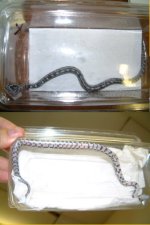
i have just had my first egg of this year hatch. enclosed is a photo of the hatchling. Looks motley anerythristic.....BUT it has markings on its underside. can anyone cast any views on this.
the parents were male motley snow and a normal female.
thanks in advance.
Mark

p.s. sorry for photo quality !
 

Attachments

  • snake.jpg
    snake.jpg
    40 KB · Views: 154
If I had to guess....

I'd say that is the first snake I've seen that has had the Motley gene separated from the plain ventral gene! The two have always seemed to be linked, but I have seen a few Motleys with a speck or two of ventral checkering.

That's a very large hatchling, Congrats!

Welcome to the wacky world or corn genetics!
 
This is interesting

I have an amel male that I posted a couple of posts earlier called "Opinions, Motley? Not Motley? Oddball Motley?".
Mine is the opposite of yours - his top is not motley looking but his belly has no checkers like a motley. So, maybe Serpwidgets is right and the motley gene has split itself into seperate top and bottom patterns now.
I would love to hear Serps take on this baby of yours.
By the way, that is a beautiful little one, congratulations!
 
Experiment

I've thought before that the plain belly genes could be totally separate from the pattern genes (motley and blood red) which they usually accompany. Genes can be "linked" to other genes - they appear on the same chromosome so close to another gene, that they rarely get separated. This would appear to be the case, based on the animals we're talking about now.

Anyway, I was curious about whether motleys and blood reds carry the same plain belly gene or two different ones, similar to hypo A and B. So someone could breed a blood red to a motley and see if the hatchlings come out with plain bellies. Well, someone has probably already done this, and I would be curious as to the results. :) My own blood red should be big enough to breed next year, I think, so I can do the experiment then.
 
The plainbellies on Bloodred and Motley are not alleles. This was tried a long time ago, and it's mentioned in the Manual that the offspring had normal belly patterns. :)

However, I wouldn't consider it a bad idea to breed a bloodred to a Motley. :D

As far as the above hatchling... I have no clue. I don't think there's enough to go on yet. How many babies hatched from that clutch? If that's a motley, then it should make the normal het for motley, or as per the previous "separation" theory, het for "Dorsal Motley." This means half the clutch (statistically) should come out expressing motley. (Or Dorsal Motley?)

If you got like 16 hatchlings and this is the only one of its kind, something needs to be looked into... If you get a bunch more with similar dorsal and belly patterns, it would also be interesting.

If you can, please post pics of the entire clutch (one dorsal, one belly for each individual) once it's done hatching out.

Nifty pattern whatever it is. :) More than Motley, it reminds me of the patterns on snakes coming from Lavender lines. From the small amount of observation I've done, it seems like the radii of the circles are much bigger on a Motley. In addition, it has that hint of zigging often found on lav outcrosses...

 
circlebackamel.jpg


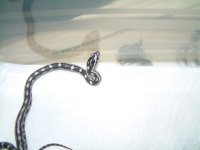
I hatched an amel like that last year.. here is a pic. She had a 'circle back' pattern but a normally checkered ventral. There were a few spots where the checkerboard belly pattern was 'missing' but other than that she appeared motley on top, normal on the bottom. Her parents were an amel motley male and an amel female (het anery and motley) The clutch consisted of all amels and amel motleys.
 
another aner

well, theyre finally all out. 3 normals, 2 amels, 2 snows, 4 aners.
cool.

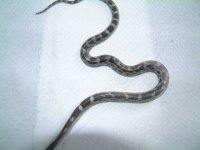
heres a photo of another one of the cool aners.
 

Attachments

  • picture 002.jpg
    picture 002.jpg
    26.1 KB · Views: 57
Kate,

I bred my bloodred to my amel motley this year, and all of the resulting babies had typical "outcrossed bloodred" belly patterns. Now, what will the F2 bellies look like? Will they be white with red creeping in from the sides, or will they have that uniform wash of a motley? I have no idea, but I'm looking forward to finding out!

:D
 
Thanks for letting me know. :) I'm thinking that it's going to be difficult to tell for sure whether you get blood red motleys in the F2. I hope they all have very indicative head patterns! Otherwise it'll be hard to tell the difference between a blood red motley and a motley with "blood red influence." Good luck!
 
Yeah, I'll probably have to breed them to other bloodreds the first year, just to make sure which is which. BUT onc I know for certain, I can then breed homozygous to homozygous and have smooth sailing all the way!

I mean that's the way it always works out in corn snake projects . . . Right?

:rolleyes:
 
Back
Top