slangenbroed
New member
maybe this wil help to
Genetics 101
By Randy Remington
Some aspects of an animal are determined by their environment, their experiences, their diet, or even accidents (perhaps during development) but many are determined by their genes.
With few exceptions, genes are found in pairs, with one member of each pair inherited from mom and the other from dad. There are a great number of different genes doing a great number of different things. Every now and then a mutation happens that changes what one of those genes does in such a way as to make a different (“mutant”) looking animal. With the huge number of ball pythons exported from their native Africa each year (as many as 150,000 some years) we have had the opportunity to discover quite a variety of mutant genes. We then breed these odd looking animals in captivity to confirm if the odd appearance is genetically reproducible and if so how it works and how it might combine with other mutant genes.
A few basic terms are helpful to describe the possible inheritance of an unusual ball python appearance:
Phenotype: The appearance type of an animal. Ball python phenotypes include normal/wild type (which can vary a lot), albino, pastel, super pastel, spider, and many many more. The phenotype doesn’t always tell you about an animal’s genes and in some cases some recognized phenotypes might not even have a genetic cause. For example, the recognizable classic jungle appearance might be caused by incubation environment – or it might be complex genetics we just haven’t figured out yet.
Genotype: The gene type of an animal with respect to one or more known genes. Remember that genes come in pairs (except for gender genes of the mismatched sex – females in snakes). One copy of each gene comes from each parent. We really only know ball python genes with respect to the mutations we have identified so far. As far as we know, there are only two versions of the gene at the location we refer to as the “albino locus” – albino mutant and normal for the albino gene (without the albino mutation). Depending on which version of this gene a baby ball python gets from each of it’s parents it has three possible genotypes for the albino locus– homozygous normal (two normal for albino copies), heterozygous albino (one normal and one albino mutant copy of the gene), or homozygous mutant (an albino mutant copy of the gene from each parent).
The genotype can be expanded to also include other gene locations, for example an axanthic gene. A double het for snowball python is both heterozygous for the albino gene (one albino and one normal for albino gene at the albino locus) and heterozygous for axanthic (one axanthic and one normal for axanthic gene at the separate axanthic locus).
Mutation Type: The third important concept for understanding ball python mutations is classifying the interaction between genotype (the genes) and the phenotype (the appearance). There are three basic categories of mutation types.
With recessive mutations (albino for example) just one normal copy of the gene is enough to compensate for one mutant copy of the gene. In a heterozygous albino the one normal for albino gene inherited from one of the parents covers the one albino copy of the gene from the other parent and makes the “het” albino look normal.
In a codominant or incompletely dominant mutation (there is a technical difference and debate continues on which is correct for certain ball python morphs) the one mutant copy in a heterozygous animal produces a visible mutant phenotype but the homozygous mutant version is a different (usually more extreme) phenotype. A heterozygous for pastel genotype ball python has the pastel mutant phenotype but a homozygous for pastel genotype ball has the super pastel phenotype.
A third mutation type is completely dominant. You will often see this type referred to as just “dominant” but I prefer to add “completely” to avoid confusion as “dominant” is also often used for the super category of all mutations that have been proven non recessive but may yet prove codominant. With the proven completely dominant mutation type, even one mutant copy would completely cover the normal version of the same gene. Some believe that Spider will prove to be completely dominant and that the homozygous spider genotype will have the same spider phenotype as the heterozygous spider genotype. If this is the case you can think of it as one spider gene dominating one normal copy of that gene and being enough to make the snake look just as fully spider like as one that has two mutant copies of that gene.
So, the quick and dirty definitions of the three mutation types are:
Recessive: The heterozygous genotype looks normal and only the homozygous genotype is a mutant phenotype.
Co-dominant/Incomplete Dominant: The heterozygous genotype is a visible mutant phenotype but the homozygous genotype is a different visible mutant phenotype.
Completely Dominant: The heterozygous and homozygous mutant genotypes are the same mutant phenotype.
As you start to consider predicting the outcome of increasingly complex combinations of varying mutation types I find it best to follow these steps:
•If starting with phenotypes – first convert to genotypes with the help of the mutation type to figure out what genotypes you are considering breeding. For example. You need to understand that the super pastel phenotype is the homozygous for the pastel gene genotype.
•Follow these simple genotype inheritance rules which are the same for all mutation types (except sex linked which we haven’t seen yet):
◦Homozygous normal X homozygous normal = homozygous normal. This is pretty basic but a good place to start as it heads off all of those “will my normals produce an albino” questions. If they do, it’s a good bet they where hets and you just didn't know it. A rare random mutation may have produced the first het (and perhaps some few later hets) but the first albino was almost certainly produced by two hets – probably distantly related to the first het albino.
◦Heterozygous mutant X homozygous normal = 50% chance heterozygous. Even dominant type morphs can produce possible het eggs. Once they hatch you should be able to eliminate the “possible” part unless the mutation is hidden by another mutation such as Leusistic.
◦Heterozygous mutant X heterozygous mutant = 25% chance homozygous mutant, 50% chance heterozygous, 25% chance homozygous normal. With a completely dominant mutation you couldn’t tell the homozygous from the heterozygous hatchlings by looking so you could lump them together as 33% chance homozygous. There is also a possibility we will some day identify a homozygous lethal mutation where the 25% of the clutch that should have been homozygous doesn’t hatch leaving 33% normals and 66% hets of ¾ sized clutches.
◦Heterozygous mutant X homozygous mutant = 50% chance heterozygous mutant and 50% chance homozygous mutant. Albino X het albino would be an example of this as would super pastel X pastel.
◦Homozygous mutant X homozygous normal = 100% heterozygous. Super pastel (homozygous for the pastel gene) X normal (homozygous normal) is an example of this producing 100% pastel phenotype (heterozygous pastel genotype).
◦Homozygous mutant X homozygous mutant = 100% homozygous mutant. If neither parent has a normal copy of a given gene all the babies will get the mutant copy from both parents and be homozygous for that gene too. Super pastel X super pastel = 100% super pastel just like albino X albino = 100% albino.
Chances are you already know these 5 breeding results from the recessive morphs you may well have learned about first. All you need to learn is to break the dominant mutant type phenotypes down to the correct genotype equivalents and you are ready to predict the outcome of crosses that will confound your friends who still think “het” only applies to recessive mutations!
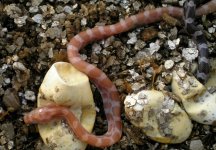
I self are breeding a "dominant" gene from 2001 now.And last year there is something born i can't figure out what it is.
Genetics 101
By Randy Remington
Some aspects of an animal are determined by their environment, their experiences, their diet, or even accidents (perhaps during development) but many are determined by their genes.
With few exceptions, genes are found in pairs, with one member of each pair inherited from mom and the other from dad. There are a great number of different genes doing a great number of different things. Every now and then a mutation happens that changes what one of those genes does in such a way as to make a different (“mutant”) looking animal. With the huge number of ball pythons exported from their native Africa each year (as many as 150,000 some years) we have had the opportunity to discover quite a variety of mutant genes. We then breed these odd looking animals in captivity to confirm if the odd appearance is genetically reproducible and if so how it works and how it might combine with other mutant genes.
A few basic terms are helpful to describe the possible inheritance of an unusual ball python appearance:
Phenotype: The appearance type of an animal. Ball python phenotypes include normal/wild type (which can vary a lot), albino, pastel, super pastel, spider, and many many more. The phenotype doesn’t always tell you about an animal’s genes and in some cases some recognized phenotypes might not even have a genetic cause. For example, the recognizable classic jungle appearance might be caused by incubation environment – or it might be complex genetics we just haven’t figured out yet.
Genotype: The gene type of an animal with respect to one or more known genes. Remember that genes come in pairs (except for gender genes of the mismatched sex – females in snakes). One copy of each gene comes from each parent. We really only know ball python genes with respect to the mutations we have identified so far. As far as we know, there are only two versions of the gene at the location we refer to as the “albino locus” – albino mutant and normal for the albino gene (without the albino mutation). Depending on which version of this gene a baby ball python gets from each of it’s parents it has three possible genotypes for the albino locus– homozygous normal (two normal for albino copies), heterozygous albino (one normal and one albino mutant copy of the gene), or homozygous mutant (an albino mutant copy of the gene from each parent).
The genotype can be expanded to also include other gene locations, for example an axanthic gene. A double het for snowball python is both heterozygous for the albino gene (one albino and one normal for albino gene at the albino locus) and heterozygous for axanthic (one axanthic and one normal for axanthic gene at the separate axanthic locus).
Mutation Type: The third important concept for understanding ball python mutations is classifying the interaction between genotype (the genes) and the phenotype (the appearance). There are three basic categories of mutation types.
With recessive mutations (albino for example) just one normal copy of the gene is enough to compensate for one mutant copy of the gene. In a heterozygous albino the one normal for albino gene inherited from one of the parents covers the one albino copy of the gene from the other parent and makes the “het” albino look normal.
In a codominant or incompletely dominant mutation (there is a technical difference and debate continues on which is correct for certain ball python morphs) the one mutant copy in a heterozygous animal produces a visible mutant phenotype but the homozygous mutant version is a different (usually more extreme) phenotype. A heterozygous for pastel genotype ball python has the pastel mutant phenotype but a homozygous for pastel genotype ball has the super pastel phenotype.
A third mutation type is completely dominant. You will often see this type referred to as just “dominant” but I prefer to add “completely” to avoid confusion as “dominant” is also often used for the super category of all mutations that have been proven non recessive but may yet prove codominant. With the proven completely dominant mutation type, even one mutant copy would completely cover the normal version of the same gene. Some believe that Spider will prove to be completely dominant and that the homozygous spider genotype will have the same spider phenotype as the heterozygous spider genotype. If this is the case you can think of it as one spider gene dominating one normal copy of that gene and being enough to make the snake look just as fully spider like as one that has two mutant copies of that gene.
So, the quick and dirty definitions of the three mutation types are:
Recessive: The heterozygous genotype looks normal and only the homozygous genotype is a mutant phenotype.
Co-dominant/Incomplete Dominant: The heterozygous genotype is a visible mutant phenotype but the homozygous genotype is a different visible mutant phenotype.
Completely Dominant: The heterozygous and homozygous mutant genotypes are the same mutant phenotype.
As you start to consider predicting the outcome of increasingly complex combinations of varying mutation types I find it best to follow these steps:
•If starting with phenotypes – first convert to genotypes with the help of the mutation type to figure out what genotypes you are considering breeding. For example. You need to understand that the super pastel phenotype is the homozygous for the pastel gene genotype.
•Follow these simple genotype inheritance rules which are the same for all mutation types (except sex linked which we haven’t seen yet):
◦Homozygous normal X homozygous normal = homozygous normal. This is pretty basic but a good place to start as it heads off all of those “will my normals produce an albino” questions. If they do, it’s a good bet they where hets and you just didn't know it. A rare random mutation may have produced the first het (and perhaps some few later hets) but the first albino was almost certainly produced by two hets – probably distantly related to the first het albino.
◦Heterozygous mutant X homozygous normal = 50% chance heterozygous. Even dominant type morphs can produce possible het eggs. Once they hatch you should be able to eliminate the “possible” part unless the mutation is hidden by another mutation such as Leusistic.
◦Heterozygous mutant X heterozygous mutant = 25% chance homozygous mutant, 50% chance heterozygous, 25% chance homozygous normal. With a completely dominant mutation you couldn’t tell the homozygous from the heterozygous hatchlings by looking so you could lump them together as 33% chance homozygous. There is also a possibility we will some day identify a homozygous lethal mutation where the 25% of the clutch that should have been homozygous doesn’t hatch leaving 33% normals and 66% hets of ¾ sized clutches.
◦Heterozygous mutant X homozygous mutant = 50% chance heterozygous mutant and 50% chance homozygous mutant. Albino X het albino would be an example of this as would super pastel X pastel.
◦Homozygous mutant X homozygous normal = 100% heterozygous. Super pastel (homozygous for the pastel gene) X normal (homozygous normal) is an example of this producing 100% pastel phenotype (heterozygous pastel genotype).
◦Homozygous mutant X homozygous mutant = 100% homozygous mutant. If neither parent has a normal copy of a given gene all the babies will get the mutant copy from both parents and be homozygous for that gene too. Super pastel X super pastel = 100% super pastel just like albino X albino = 100% albino.
Chances are you already know these 5 breeding results from the recessive morphs you may well have learned about first. All you need to learn is to break the dominant mutant type phenotypes down to the correct genotype equivalents and you are ready to predict the outcome of crosses that will confound your friends who still think “het” only applies to recessive mutations!
I self are breeding a "dominant" gene from 2001 now.And last year there is something born i can't figure out what it is.