• Hello!

    Either you have not registered on this site yet, or you are registered but have not logged in. In either case, you will not be able to use the full functionality of this site until you have registered, and then logged in after your registration has been approved.

    Registration is FREE, so please register so you can participate instead of remaining a lurker....

    Please be certain that the location field is correctly filled out when you register. All registrations that appear to be bogus will be rejected. Which means that if your location field does NOT match the actual location of your registration IP address, then your registration will be rejected.

    Sorry about the strictness of this requirement, but it is necessary to block spammers and scammers at the door as much as possible.

Color Question

CornCrazy

What's one more???
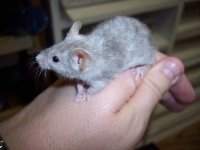
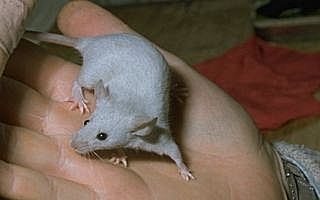
What would this color/pattern be called? I believe he is a frizzy, but I'm not sure about the color. I think he is either a merle or a brindle. He just spontaneously popped up in my collection. I also have some chocolate silkies that suddenly appeared. I'll try to get some good pics of them, too.
 

Attachments

  • Blue Merle Mouse.jpg
    Blue Merle Mouse.jpg
    52.4 KB · Views: 144
Last edited:
More Breeder Mice

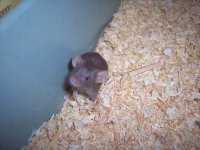
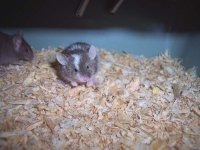
These girls are too cute to feed off!

They are (I believe...) a chocolate silky and a broken marked agouti.
 

Attachments

  • Chocolate.jpg
    Chocolate.jpg
    82.3 KB · Views: 143
  • BrokenMarkedAgouti.jpg
    BrokenMarkedAgouti.jpg
    77.2 KB · Views: 144
oh they are gorgeous, exactly why I picked red-eyed white mice for my breeder pair, I'd end up with too many cute keepers otherwise
 
diamondlil said:
oh they are gorgeous, exactly why I picked red-eyed white mice for my breeder pair, I'd end up with too many cute keepers otherwise
Well, I only have room for a certain number of colonies. I typically only pick the cutest ones to save when it is time to rotate stock (about every 6 months). On occasion, I do keep new colors, as well.
 
Last edited:
how much of a chance do you give baby-eaters, the mother mouse raised a healthy litter of 10 in the shop before I got her, with this young male they only had 7 and someone has eaten 3 already in 2 days. I need a pink for Lil!
 
It really depends on how good of a producer she is. If she produces a lot of babies, but has the tendancy to eat them, then I usually just cull all of the pinks when they are born. If she does not produce many babies, then she will get one chance. If she eats the babies in the second litter, then she becomes snake food.
 
thanks, at this point I'm not sure who ate babies, but as she raised her last litter ok I'm leaning towards the male being the culprit, I'll give them 1 more chance to improve, then decide
 
Color

CornCrazy said:
Well, I only have room for a certain number of colonies. I typicall only pick the cutest ones to save when it is time to rotate stock (about every 6 months). On occasion, I do keep new colors, as well.

That is exactly why I pick a lot of color variation. I don't have the space to keep mice that aren't breeding. If I have a colony that is all white I wouldn't know who's having the babies. I'd have to paint their toenails or something :D

-Tonya
 
MaizeCrazy said:
That is exactly why I pick a lot of color variation. I don't have the space to keep mice that aren't breeding. If I have a colony that is all white I wouldn't know who's having the babies. I'd have to paint their toenails or something :D

-Tonya

Hehe nice. at least mine i know them all by name and not colors. my rat however come when called by their name.....cept for monster. he's the new one who will probably never come when called.

I still think its cute my rats know when their in trouble with me from the tone of my voice lol
 
I THINK it may be a colour called "chinchilla"
Eye Black. The mouse shall be as near as possible to the colour of a Chinchilla with slate-blue undercolour and intermediate shade of pearl grey. Hairs to be evenly tipped with black. Colour of feet on inside white, with remainder of foot the same colour as body - as in the standard for Tans. Belly white

The Chinchilla was established as a variety in the 1930's and came from a laboratory. It is a useful variety as it enabled the production of other new vareities. For example, a Chinchilla crossed to a Black Tan reduces the Tan to white, giving the Black Fox.

Photograph by Eric Jukes

aov_chi.jpg


or it could also be "Pearl"
Eye Black. A pearl mouse shall be of the palest silver, shading to a whitish undercolour. Each hair shall be delicately tipped with grey or black and carried out top and belly.

Photographs by Eric Jukes

aov_pea.jpg


The Pearl is now one of the "rare" varieties of Fancy Mice. This is is a shame because a Pearl is a very attractive variety.

http://www.miceandrats.com/images/aov_peb.jpg/img]

When the fur is blown back, the white base of the Pearl can be seen. An ideal Pearl should be a little lighter than the Pearls shown in these photographs.
Varieties of Fancy Mice - AOV - Pearl

A Gem of the Mouse Fancy - THE PEARL By JOHN KELLETT - FUR & FEATHER - 5 July 1979

THE PEARL is one of the ticked varieties and is a fascinating mixture of delicate colour blending. The general outward appearance is a very light silver delicately tipped with grey or black but when the coat is blown open it reveals a whitish undercolour.

The Standard states: 'a Pearl mouse shall be of the palest silver shading to a whitish undercolour'. Note that the emphasis in the colour is the palest silver each hair delicately tipped with grey or black and carried on the top and belly and here the emphasis is on delicately not heavily tipped. The colour carries 30 points.

Various shades appear in the litters, as they do in most other varieties of the mouse family, but the lightest specimens are the ones required for exhibition, bearing in mind the words of the Standard-palest silver. The undercolour carries 10 points and this whitish undercolour gives the desired delicate shading. Evenness of blending carries 15 points and this is the factor that gives the final delicate colour.

Some of the darker heavily tipped specimens could, at first glance, be mistaken for Silver Greys but the undercolour would be wrong.

The Pearl was first introduced to the Fancy by Mrs Blowers, of St Albans, in 1933. It is a very attractive variety and, generally speaking, has no more faults than most other varieties and is really deserving of a greater popularity.


it may also be showing signs of "Frizzie" as [url]http://www.afrma.org[/url] call it...

FRIZZIE - Frizzie mice may be shown in any recognized color or markings. The coat should be tightly waved or frizzed over the entire body, very dense, with guard hairs of somewhat harsh texture, protruding slightly beyond the normal length of coat. This is more pronounced in young mice, and should not influence the placement. Frizzies may also be long haired. Whiskers are to be curly. Frizzie mice are normally cobbier in body type.

hth

Nerys

 
np..

mouse genetics are hugely involved i have found... thankfully over on the forum i spend a lot of time on, we have two mouse genetics wizzards!

i seem to have almost every colour mouse under the sun these days!

Nerys
 
I've been doing some searches and keep seeing the description "silver agouti" (of course there were no pics!). Do you think that's a possibility, too?
 
Back
Top