
vanderkm
New member
I have heard suggestions that the emoryi influence produces a distintive belly pattern in creamsicles and other crosses - clear in the central area with just the edge of the checkers along the sides of the belly.
I find it a bit hard to notice in my creamsicles because the belly checkers are so light, but I got a few photo of our yearling rootbeers and the three we kept back all have quite a different pattern from my normal corns. These are a cross of creamsicle corn to great plains ratsnake.
Thought I would post a few pics for people to consider -
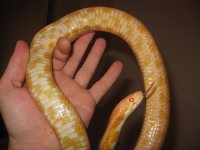
the great plains ratsnake mom of rootbeers - girthy snake - a bit distorted by being closer to the camera than my hand - but she is a big girl - she seems to me to have similar checkers to what I see on my corns,

rootbeer yearling
saddle pattern

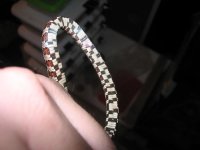
belly pattern - only a very thin black line along the side of the belly scales and faint tan checkers that barely extend onto the abdominal scale. They are this pattern full length and all from this clutch are similar.

Is this something that others have noted - especially with crosses that have a high percentage of emoryi (aren't too diluted with cornsnake)?
thanks for looking,
mary v.
I find it a bit hard to notice in my creamsicles because the belly checkers are so light, but I got a few photo of our yearling rootbeers and the three we kept back all have quite a different pattern from my normal corns. These are a cross of creamsicle corn to great plains ratsnake.
Thought I would post a few pics for people to consider -
the great plains ratsnake mom of rootbeers - girthy snake - a bit distorted by being closer to the camera than my hand - but she is a big girl - she seems to me to have similar checkers to what I see on my corns,
rootbeer yearling
saddle pattern
belly pattern - only a very thin black line along the side of the belly scales and faint tan checkers that barely extend onto the abdominal scale. They are this pattern full length and all from this clutch are similar.
Is this something that others have noted - especially with crosses that have a high percentage of emoryi (aren't too diluted with cornsnake)?
thanks for looking,
mary v.