• Hello!

    Either you have not registered on this site yet, or you are registered but have not logged in. In either case, you will not be able to use the full functionality of this site until you have registered, and then logged in after your registration has been approved.

    Registration is FREE, so please register so you can participate instead of remaining a lurker....

    Please be certain that the location field is correctly filled out when you register. All registrations that appear to be bogus will be rejected. Which means that if your location field does NOT match the actual location of your registration IP address, then your registration will be rejected.

    Sorry about the strictness of this requirement, but it is necessary to block spammers and scammers at the door as much as possible.

First time owner with some questions!

Nastassja

New member
Hi there!

I'm new to corn snakes, and reptiles in general. Over this past week I've been deeply researching this forum and all over the internet about anything and everything concerning corns and proper care, just to make sure that my new little boy settles in with me happily.

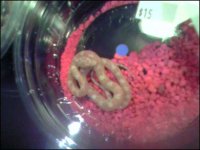
He's a little hatchling that is going to be shipped out to me by a friend who is currently at the reptile expo in Florida right now (I'll tack the picture he sent me from his camera phone at the bottom of the post). I have a few concerns about his care that I am recieving conflicting information about... My friend Mike who's sending me the snake has been caring for and collecting reptiles for years, he's got a herp license and everything, so I want to trust his judgement. Here's the questions I have:

1.) Tap water vs. bottled water. He tells me that water from the tap will be okay, I'm not sure why. A change in water for my puppy was enough to make her sick, so I'm not going to give a tiny little snake tap water. But, I'm wondering if after the snake gets to a certain size, that it may eventually be alright to give him water from the tap once he is bigger and stronger?

2.) Thermometers. He says that as long as I have an UTH for the vivarium, I shouldn't need a thermometer. How necessary is a thermometer?

3.) Humidity/Temperature. This snake is arriving to me from Florida... I live in Iowa. Iowa winters here are extremely dry... I'm worried that the temperature and humidity in my apartment may upset him. Will I need to humidify the tank in some way to avoid problems with him shedding? I have a water dish for him that's big enough for him to immerse himself in, and when he gets bigger, I'll upgrade his dish. Is the water dish enough?

4.) I plan on putting him in a small enclosure, a "critter carrier" that's about 4" x 8". His substrate will be white paper towel, he's got a little dish in the corner of the box, and a paper towel tube cut to size for him to hide in. I understand that this should be fine for him to exist in.. for now. At what size should I move him to a larger enclosure?

5.) His little aforementioned box is made of clear plastic. Will this upset him? Should I keep a towel draped over his cage?

6.) I understand that I should not handle him until at least 3 days. After that, how much should I handle him? When I ask that, I mean... including any kind of gradual holding, to how much I should probably/probably not hold him or have him out of his viv at any point in his life.

Whoo, that's a lot of questions! Sorry for the long windedness. Mike tells me that I'm totally overthinking this, but I just want to make sure that he'll be a very happy and well-adjusted snake. Any and all input is appreciated.

And now for the low-quality phone capture! Oh, by the way, I decided to name him "Frostbite". :)
 

Attachments

  • babyfrostbite.jpg
    babyfrostbite.jpg
    34.4 KB · Views: 140
Ill try and answer what I know.....

A thermometer is VITAL. A UTH is a "under tank heater".....what good is a heater if you dont know what the temperature is right? The other thing, heat wise you need a thermostat, here is an example of one.

http://www.reptilesupply.com/product.php?products_id=75

The thermometer should have a probe, the probe you want to touch the glass and tell you the temperature of the glass is...... and the thermostat will turn the UTH off when it gets to a certain degree (85 is ideal) You cant just leave the UTH on all the time without a thermostat, the temp will sore to 120 degrees.

The water dish isnt enough for humidity and honestly the snake will probably never go in it. Mine shed about every 6-8 weeks....when your snakes is in "blue" hes going to look very pale, sort of like he rolled in flour, and his eyes will be cloudy. Pick up an empty spray bottle and mist his tank/viv and cover half the top, thatll make it nice and humid in there. Thats what I do when mine are in blue and Ive never had shed problems. If he isnt about to shed, dont worry about humidity. You can also do a search here on "humid hide", people have some neat contraptions for humid hides and their very simple.


I use a conditioner to neutralize the chlorine in my tap water for my snakes, but alot of people dont so thats up to you.

6.) I understand that I should not handle him until at least 3 days. After that, how much should I handle him? When I ask that, I mean... including any kind of gradual holding, to how much I should probably/probably not hold him or have him out of his viv at any point in his life.


Do you mean when you first get him? Ive always waited 7 days, especially if hes coming by mail.......leave him alone for 7 days, dont pick him up or do anything but change the water. Certainly dont feed him for 7 days. After that, handle him for a few minutes at a time and see how he handles that. Just dont handle him when he is digesting (the 48 hours after hes eaten)

I dont know much about critter carriers cause I use tanks for my snakes...........hopefully someone else can help you with that one.


Oh and make sure you have lots of hide, one at least on the cool side and warm side.....


Good luck!
 
Only a newbie myself, but i'll offer what I can. As far as water goes I think it can actually be quite dangerous to give your snake bottled water, tap water is the safest option (Check this as i say I am new myself).
Hides in his tank, make sure there is one on the warm and one on the cold side so the snake isn't forced to hide in a temp that he doesn't feel comfortable in.
For shedding I always offer my snakes a sauna(just a plastic pot with a hole for them to climb in, place damp tissue inside & place half over the heat mat. My snakes love this and spend loads of time curled up in the sauna. I also offer them a bath as soon as they go clear after the blue stage(thay then shed normally within 24 hrs)
Humidty & Temp. I have a little thermometer & humidity reader in my tank, this way I always know if all is set right. I also mist the tank with a water bottle if the humidity is not right.
Great little snake & loving his name.
 
Nastassja said:
1.) Tap water vs. bottled water. He tells me that water from the tap will be okay, I'm not sure why. A change in water for my puppy was enough to make her sick, so I'm not going to give a tiny little snake tap water. But, I'm wondering if after the snake gets to a certain size, that it may eventually be alright to give him water from the tap once he is bigger and stronger?
Save your money. Tap water is fine, but if you feel you need to do something with it then you can treat it with a liquid water conditioner like you'd do for a fish aquarium. I used to live downtown where I had treated city water and it was fine for all of my snakes. Now I'm out in the country and I have well water. When I turn my shower on, it smells like a volcano, and the water gradually turns my shower bright orange. It still hasn't harmed my snakes, and I don't treat the water with anything.

Nastassja said:
2.) Thermometers. He says that as long as I have an UTH for the vivarium, I shouldn't need a thermometer. How necessary is a thermometer?
As the others said, it's absolutely necessary. You can get a probe thermometer with a humidity reading on it for $10-20 at Wal Mart, Lowes, Home Depot, etc. If you can't afford a thermometer, you can't afford the snake, and you certainly can't afford the vet and medication bills when the snake gets a respiratory infection from having improper temperatures. I adopted a burmese python this spring from a lady who didn't use a thermometer (she kept the snake in her barely-insulated trailer with a kerosene heater) and I sunk over $200 into medication for her to clear it up. I got her in March. She's just now well enough that she wants to eat.


Nastassja said:
3.) Humidity/Temperature. This snake is arriving to me from Florida... I live in Iowa. Iowa winters here are extremely dry... I'm worried that the temperature and humidity in my apartment may upset him. Will I need to humidify the tank in some way to avoid problems with him shedding? I have a water dish for him that's big enough for him to immerse himself in, and when he gets bigger, I'll upgrade his dish. Is the water dish enough?
The temperature in your apartment can be monitored and fixed once you get the thermometer, and in the winter you'll have to find some way to up the humidity in the winter. A lot of that has to do with substrate. Aspen doesn't do as well in my opinion when it comes to misting for humidity. I use cypress mulch and it works great. It doesn't mold and it holds humidity well. It's very easy to spot clean, and 2 cubic feet of it will cost about $3 at Wal Mart.

Nastassja said:
4.) I plan on putting him in a small enclosure, a "critter carrier" that's about 4" x 8". His substrate will be white paper towel, he's got a little dish in the corner of the box, and a paper towel tube cut to size for him to hide in. I understand that this should be fine for him to exist in.. for now. At what size should I move him to a larger enclosure?
A general rule is to upgrade when the snake's length is 1/4 to 1/3 longer than the longest part of the enclosure...or about 10" in your case. A 20-long aquarium is fine for an adult corn snake. As far as your UTH. It'll be hard to heat something that small with a UTH...the best thing is to have a gradient in the winter (I have all my heat off now), but with an 8" cage that'll be next to impossible so you may want to up it to a 10g aquarium this winter for that reason.

Nastassja said:
5.) His little aforementioned box is made of clear plastic. Will this upset him? Should I keep a towel draped over his cage?
Maybe for a couple of days keep the cage a little protected, but eventually you can take the towel off once he's settled in. It's a lot more interesting to look at a snake than a cage covered in a towel in the middle of the room. Is the cage going in a high traffic area? if so, I'd cover it for a couple of days, but if it's just going in your bedroom or something you probably don't need to. You may want to put a second hide in there though so he has plenty of places to go.

Nastassja said:
6.) I understand that I should not handle him until at least 3 days. After that, how much should I handle him? When I ask that, I mean... including any kind of gradual holding, to how much I should probably/probably not hold him or have him out of his viv at any point in his life.
I make sure I include this in all of my reptile shows. There is no such thing as a domesticated reptile. Some are just more tolerant of being handled than others. So it doesn't matter how much you handle him, you're never going to "tame" the snake. I'd be more worried about over handling him, especially a hatchling. Don't handle him for 2 days after he eats (you may find he's ok with sooner as he gets older. I can handle my adult corn the day after without problems, but a hatchling has higher stress levels usually). Let the snake dictate how much handling is too much. He'll let you know as long as you can interpret body language.

Hope it helps.
 
Nastassja said:
Okay, I'll look into getting a thermometer as soon as possible. The snake won't be arriving until Thursday, so I have some time still to prepare.

For info on "critter carrier", here's a picture from the internet.. I'll try and take a photo of the container that is mine with what I have set up for him tomorrow.

http://www.petsmart.com/media/ps/images/products/detail/large/January05/lg_8047_42de3.jpg


The only problem Id see is if its plastic, Im not sure if you can stick a UTH to plastic? :shrugs:
 
Honestly you should just go out and get the 10 gallon aquarium now. It's only $12 bucks for a tank and it'll last you a lot longer.
Something so small will be virtually impossible to keep stable.
 
TrpnBils, thanks so much for the detailed information. I have another friend who is getting a corn snake at the same time as I am, so I'm going to be relaying all of this information to him as stuff he needs to know.

I guess I'll be sticking with tap water for him then, and I'll also invest in a larger container. I read somewhere that if hatchlings are dropped into environments that are too large, they get stressed out and may refuse to eat, which is why I picked up the little box. It was only 5 dollars, so I'll just get myself a nice big tank that he can grow into and hopefully stay in forever..!

Oh this is all so very exciting, I can't wait for him to get here. I have always wanted my own snake, but my mother is one of those types that gives reptiles a 5 foot berth and has the misconception that they are slimy, and most importantly, that nice little girls should never ever play with creepy crawlies :p Despite her attempts to influence me, I'm still a tomboy!
 
Hi Nastassja,
Grats on the new snake. Most of the questions that you had were already answered and I can only give you a "me, too!" on most of them. Quick question...you mentioned you were having him shipped out from Florida. Have you considered buying one locally instead? While shipping corns isn't a massive amount of stress on them (ideally), for a first-time snake owner I'd think it would be easier to buy a locally bred one rather than deal with a hatchling that's traveled across the country.
 
Nastassja said:
TrpnBils, thanks so much for the detailed information. I have another friend who is getting a corn snake at the same time as I am, so I'm going to be relaying all of this information to him as stuff he needs to know.

I guess I'll be sticking with tap water for him then, and I'll also invest in a larger container. I read somewhere that if hatchlings are dropped into environments that are too large, they get stressed out and may refuse to eat, which is why I picked up the little box. It was only 5 dollars, so I'll just get myself a nice big tank that he can grow into and hopefully stay in forever..!

Oh this is all so very exciting, I can't wait for him to get here. I have always wanted my own snake, but my mother is one of those types that gives reptiles a 5 foot berth and has the misconception that they are slimy, and most importantly, that nice little girls should never ever play with creepy crawlies :p Despite her attempts to influence me, I'm still a tomboy!


I remember how excited I was LOL

What you can do with your tank, because its true hatchlings dont like wide open spaces, is put alot of hides and greenery in there, like silk plants. Thatll give him more of a secure feeling, and lots of places he can hang out in, even in the plants......If your using a tank, make sure to pick up a screen lid and lots of clips to hold it down....
 
And I can't help but be a little concerned that your friend told you you don't need a thermometer. :-/ They're absolutely crucial to keeping your snake healthy.
 
uberalice said:
Hi Nastassja,
Grats on the new snake. Most of the questions that you had were already answered and I can only give you a "me, too!" on most of them. Quick question...you mentioned you were having him shipped out from Florida. Have you considered buying one locally instead? While shipping corns isn't a massive amount of stress on them (ideally), for a first-time snake owner I'd think it would be easier to buy a locally bred one rather than deal with a hatchling that's traveled across the country.


Well, my friend Mike said that he could probably get the snake I wanted for MUCH cheaper at the reptile show than I could anywhere else... Based on prices I've seen on the internet, I kinda believed him. He got my snake for 15 dollars! Plus, he's sending me a year's worth of frozen food for him. Where he's at, frozen mice are 25 cents a piece... The closest store where I can buy pinkies is a Petsmart that's a 45 minute drive from here, and they sell 6 frozen pinkie mice for 10 dollars. Whoa! :\
 
uberalice said:
And I can't help but be a little concerned that your friend told you you don't need a thermometer. :-/ They're absolutely crucial to keeping your snake healthy.


Yeah, I'm not so sure about that either. He said that corn snakes are really hardy snakes and that I would have to try really hard to upset it. He said as long as I have a heated area for him to warm up and a cool area for him to cool down that I should be fine.. He told me to keep the UTH underneath the cage on one side for "ambient heat" and that it shouldn't get so hot that it would cause him problems. :shrugs:

I've also been talking to my ex about it who's also kept snakes and lizards before... He also reacted the same way about my concern, he thinks I'm extremely overthinking this. But poo-pooh on all of them, I want to make sure little Frostbite is as happy and healthy as a snake can be!
 
Well, while the temperature gradient (having the cool side/warm side) is extremely helpful, you will still need to have a thermometer to make sure it's not getting too hot or cold. UTHes do have a tendency sometimes to overheat so it's important to check it every so often. Your ambient temp is actually the temperature of the air inside the tank; I usually measure mine at the cool end, in the middle, and at the warm end to make sure there's a good gradient going on.
Corns are pretty hardy and they're a great beginner snake but they can still get stressed. Too much heat is a major stressor on them, as is too much or way too little humidity. (A hygrometer is also an important purchase as well. ;) )
I don't think you're overthinking this at all. You want to make sure that everything is in line. It's better in my book to overthink it than underthink it and end up with a sick snake.
Good luck!
 
The thing with long-time herpetoculturists like your friend is they have so much knowledge and experience they can tell right away if there's something wrong. And they're so used to providing correct care that it becomes second nature. It's not that easy for us noobies. :)

I couldn't be so cavalier as to go thermometer-less in my viv. I'm always freaking out about it. :grin01: Then again, it's been over 100 degrees every day for the past week or so here.
 
For the sake of not opening up a new thread, I'm continuing with my progress to complete the perfect home for Frostbite.

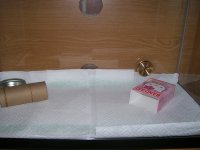
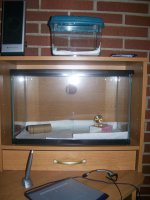
I went out and purchased a 10 gallon tank and a metal screen top to fit over it (It currently doesn't have any clip/locks for it... I plan on substituting with heavy, not-in-use college textbooks until I can get the clips). I also purchased a thermometer and a "repti-therm" 10-20 gallon under tank heater for the setup. I also produced a second hide for him to use, and have decided to keep his little "critter keeper" cage for his feeding tank.

How does this setup look to you guys? Later on, I'll be replacing these simple hides with more elaborate things like big wood branches and special reptile hides.

I can't wait until he's here... two more days! *atwitter with excitement*
 

Attachments

  • frostbitestank2.jpg
    frostbitestank2.jpg
    258.1 KB · Views: 43
oops... had to compress the file size >_> *feels like teh nub*
 

Attachments

  • frostbitestank1.jpg
    frostbitestank1.jpg
    124 KB · Views: 42
Oh, another question.

The undertank heater I applied to the bottom of the tank... What happens if my thermometer registers a temperature that is too high? Do I unplug the heater? How do I keep the tank from getting too hot..?
 
You can attach a rheostat to the UTH. It's like a light dimmer switch that controls how hot the pad gets. They run around $20-25 in most pet stores, there are also instructions on the site somewhere for making your own rheostat for about $7.
 
Back
Top