Serpwidgets
New member
I posted this on another forum, but I thought it would be fun here, too. Last year I took pics of all of my hatchlings, and I also got good head shots of two full clutches.
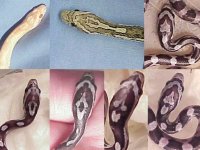
Here are the parents of one clutch. The Male normal has lots of "freckles" and a sloping angle on the front of the spearpoint. The female snow has a very thin head pattern, very thin connection between the front and back half of the pattern, and a long thin spearpoint on the front. Her features tend to dominate the clutch. (BTW, this clutch is the same pairing that produced the the carotene brothers)

Notice the following features in common amongst 9 out of the 11 hatchlings:

The two outlined in red are the ones that are different. Notice how much they instead resemble the father's head pattern in shape, and they are freckled like his.

The second clutch also has a lot of resemblance, and looks different than the first. The pics aren't as good, but the male amel has a simple "V," a broken center, and the rectangle on the neck. Notice the normal mother's freckling, shape of the front part, and the little "spikies" on the front and at 45's.

Out of 11 hatchlings, again 9 of them are very similar, with a couple of anomolies.

Interesting stuff, IMO.
Here are the parents of one clutch. The Male normal has lots of "freckles" and a sloping angle on the front of the spearpoint. The female snow has a very thin head pattern, very thin connection between the front and back half of the pattern, and a long thin spearpoint on the front. Her features tend to dominate the clutch. (BTW, this clutch is the same pairing that produced the the carotene brothers)
Notice the following features in common amongst 9 out of the 11 hatchlings:
The two outlined in red are the ones that are different. Notice how much they instead resemble the father's head pattern in shape, and they are freckled like his.
The second clutch also has a lot of resemblance, and looks different than the first. The pics aren't as good, but the male amel has a simple "V," a broken center, and the rectangle on the neck. Notice the normal mother's freckling, shape of the front part, and the little "spikies" on the front and at 45's.
Out of 11 hatchlings, again 9 of them are very similar, with a couple of anomolies.
Interesting stuff, IMO.