• Hello!

    Either you have not registered on this site yet, or you are registered but have not logged in. In either case, you will not be able to use the full functionality of this site until you have registered, and then logged in after your registration has been approved.

    Registration is FREE, so please register so you can participate instead of remaining a lurker....

    Please be certain that the location field is correctly filled out when you register. All registrations that appear to be bogus will be rejected. Which means that if your location field does NOT match the actual location of your registration IP address, then your registration will be rejected.

    Sorry about the strictness of this requirement, but it is necessary to block spammers and scammers at the door as much as possible.

hom. bloodred?

ascottlaw

Member
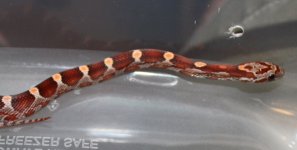
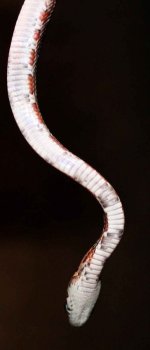
These pictures are of a recent hatchling that should be a bloodred. As you can see, it has the grey head, and other than the first inch or two, there are no belly checkers. Is it possible that this is simply a very strong expression of a bloodred het, or just a weak example of diffusion? There are several from this clutch that have similar patterns on the head and belly and several more that have typical signs of being het for bloodred.
 

Attachments

  • IMG_0320.jpg
    IMG_0320.jpg
    166 KB · Views: 65
  • hatchling2.jpg
    hatchling2.jpg
    28.9 KB · Views: 65
That grey head doesn't look much more grey than a regular normal to me. Some more, maybe, but I wouldn't call it a bloodred grey head. I would say it's the het showing. Those checkers on the neck are very "there," and you can still see checks all the way down the photo you posted. They're just on the sides, but they're there. Check out this het bloodred I just hatched out. Pretty similar to yours, but with less belly checks.

http://cornsnakes.com/forums/showthread.php?t=70785&highlight=Phaethon
 
I agree, it looks like a normal to me. And I see belly checkers on him too. He might be het blood though. :)
 
You say it should be bloodred...are both parents bloodred and has the female been bred before to a non-bloodred (het blood counts) or even been in contact with anything not bloodred?
 
These pictures are of a recent hatchling that should be a bloodred.
As Susan stated, should it be a Bloodred because it's the result of a Bloodred X Bloodred pairing OR should it be a Bloodred because the person you bought it from said it's a Bloodred. :shrugs:

If it's the first case, and you produced it, then yeah, it's definitely an odd occurence. If it's the second case, then my opinion would be that it doesn't quite appear to be a Bloodred.

More information could help!
D80
 
Allow me to rephrase the question: I hatched this little guy from a pair of triple hets. I said "should be" based on percentages and the thought that he is as close to a bloodred as any from this clutch of 18. I think he is either a very weak example of diffusion/bloodred, or a strong example of a het, maybe an example of the Masque gene. the belly checkers are throwing me off since the visible checkers are faint and only there are a couple of inches of the belly. (I photoshoped the pictures so the checkers were more visible so there could be no doubt and cropped the picture to only show the checkers, the rest of the belly is clear). Last years clutch produced 2 bloodreds that were typical bloodreds, this years clutch has at least 3 with this pattern. I was essentially looking for confirmation that I am dealing with Masque, but didn't want to ask a leading question. I should also point out that I have not sexed the entire clutch and am only assuming this is a male.

 
Well then I would say het Blood. Just like in sports, odds can be upset, believe me, I'm a Browns/Indians/Cavs fan.

Last year I had a 1.1 het Lav Blood with 3/16 odds of producing Lavenders and 3/16 odds of producing Bloodreds. I got 7 Bloods and 0 Lavenders.
 
Back
Top