• Hello!

    Either you have not registered on this site yet, or you are registered but have not logged in. In either case, you will not be able to use the full functionality of this site until you have registered, and then logged in after your registration has been approved.

    Registration is FREE, so please register so you can participate instead of remaining a lurker....

    Please be certain that the location field is correctly filled out when you register. All registrations that appear to be bogus will be rejected. Which means that if your location field does NOT match the actual location of your registration IP address, then your registration will be rejected.

    Sorry about the strictness of this requirement, but it is necessary to block spammers and scammers at the door as much as possible.

I am thinking of a world first

slangenbroed

New member
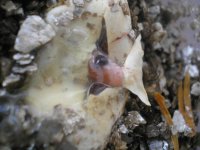
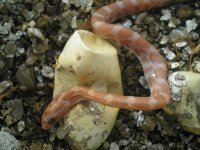
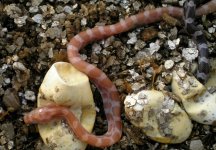
, but what it really is, I do not know to tell with certainty. Because there is, the odds as much as possible, and because there is still no clear what this gene is or really does. If you followed this a bit, you may need to understand why I am yet again exposed this to the world. From the animals I have grown from Orange (Buf amel) x Phantom came this year a handful of 8 eggs. These are hatching the last few days , so from a buf hetero amel-hypo-charcoal x buf hetero amel-hypo-charcoal. The first living creature was like a hypo this was very clear, and without problems to recognize, the second young was a wild color, also should not experience any problems, the third living creature a buf and also should not experience any problems, at least for me to recognize clearly. But now comes the fourth young an orange, but this animal is completely different from all the orange animals bred, the animal is much lighter, and the fifth animal is????????
I suspect a hypobuf, having regard to the color of the eyes not a amel like animal that's for sure, so I have to find it in charcoal or hypo, seems to me that this is not a charcoalbuf while I would not know how this should look like! So I suspect a hypobuf, and if so then this is the first and only animal in the world.
( sorry i forgot my cameracable, so i will post the pic tomorrow.But i had this typed so i post it )
 
the pictures

Yesterday he piped and today he ore she was out of the egg and liveless
FFFFFFFFFFFFFFFFF.................................k
But we still have the pictures and the parents
 

Attachments

  • hypobuf3.jpg
    hypobuf3.jpg
    50.4 KB · Views: 139
  • hypobuf2.jpg
    hypobuf2.jpg
    71 KB · Views: 139
  • hypobuf.jpg
    hypobuf.jpg
    125.1 KB · Views: 139
Slangenbroed, I am still relatively new and learning, but in general I know the markers or singular characteristics one uses to call a snake hypo;...or amel;...and/or maybe even hypo-amel.
But for me, would you please describe narratively in your own words (in english) what markers/characteristics you would use to describe a snake that is homozygous :
1) simply homo buf
2) buf amel (orange is a 'color' in the english language, and vague and subjective)
3) buf hypo amel
4) buf hypo (or hypo buf, as you say)

I realize anything homozygous amel is going to have unmistakably red amel eyes. (And the hatchling above is very light but does not seem to have amel-like eyes.)
I also think I understand that the snake pictured above did not survive and live. Right?
I also realize that often it is only after the second shed that one can positively begin to describe some characteristic markers that can be identifiable into adulthood.

I have read all of your previously posted material, and although I am no genius, I AM curious enough to continue to try to follow your work.
Congratulations on another year in the business.
Thanks,
Eric
 
Oh no! It looks like it sure could have been a hypo buf. I'm so sorry this little one died.
 
Slangenbroed, I am still relatively new and learning, but in general I know the markers or singular characteristics one uses to call a snake hypo;...or amel;...and/or maybe even hypo-amel.
But for me, would you please describe narratively in your own words (in english) what markers/characteristics you would use to describe a snake that is homozygous :a homozygous animal show the colour that it is
1) simply homo buf
2) buf amel (orange is a 'color' in the english language, and vague and subjective)
3) buf hypo amel
4) buf hypo (or hypo buf, as you say)

I realize anything homozygous amel is going to have unmistakably red amel eyes. (And the hatchling above is very light but does not seem to have amel-like eyes.)
I also think I understand that the snake pictured above did not survive and live. Right?
I also realize that often it is only after the second shed that one can positively begin to describe some characteristic markers that can be identifiable into adulthood.

I have read all of your previously posted material, and although I am no genius, I AM curious enough to continue to try to follow your work.
Congratulations on another year in the business.
Thanks,
Eric

Buf is a dominant gene and homo buf exist ok.
Orange is a homo buf- amel it shows buf and amel together ,like a butter is a cramel-amel.
This latest animal what i called a hypo buf showed in my opinion buf and hypo,the eyes are not red but a little like rubi, so i think there is no amel in it.
But to be honest its dif for me becouse i have no example to messure it ,maybe the buf gene chanced some things i don't now.
look at www.slangenbroed.nl button buf than klik on the little book
 
Slangenbroed, I am still relatively new and learning, but in general I know the markers or singular characteristics one uses to call a snake hypo;...or amel;...and/or maybe even hypo-amel.
But for me, would you please describe narratively in your own words (in english) what markers/characteristics you would use to describe a snake that is homozygous :
a homozygous animal show the colour that it is
1) simply homo buf
2) buf amel (orange is a 'color' in the english language, and vague and subjective)
3) buf hypo amel
4) buf hypo (or hypo buf, as you say)

I realize anything homozygous amel is going to have unmistakably red amel eyes. (And the hatchling above is very light but does not seem to have amel-like eyes.)
I also think I understand that the snake pictured above did not survive and live. Right?
I also realize that often it is only after the second shed that one can positively begin to describe some characteristic markers that can be identifiable into adulthood.

I have read all of your previously posted material, and although I am no genius, I AM curious enough to continue to try to follow your work.
Congratulations on another year in the business.
Thanks,
Eric
I understand the "homozygous principle", I just wanted you to explain the technical differences, as you see them, in your own words, in items 1), 2), 3), and 4), that I mentioned above. In hatchlings. Pre-shed as well as after a couple of sheds.
Buf is a dominant gene and homo buf exist ok.
Orange is a homo buf- amel it shows buf and amel together ,like a butter is a cramel-amel.
This latest animal what i called a hypo buf showed in my opinion buf and hypo,the eyes are not red but a little like rubi, so i think there is no amel in it.
But to be honest its dif for me becouse i have no example to messure it ,maybe the buf gene chanced some things i don't now.
look at www.slangenbroed.nl button buf than klik on the little book
My error, I admit. That is why I put recessive(?) above. I was not sure about how you defined it (the 'buf' gene), precisely.
And thanks for that post number 9. Seriously and sincerely.
How, in your own words, would you describe a homozygous 'buf'...not homozygous anything else?

I gather you mean this...very helpful :
http://home-3.wolmail.nl/~sb085434/Bufengels.html
 
I understand the "homozygous principle", I just wanted you to explain the technical differences, as you see them, in your own words, in items 1), 2), 3), and 4), that I mentioned above. In hatchlings. Pre-shed as well as after a couple of sheds.

My error, I admit. That is why I put recessive(?) above. I was not sure about how you defined it (the 'buf' gene), precisely.
And thanks for that post number 9. Seriously and sincerely.
How, in your own words, would you describe a homozygous 'buf'...not homozygous anything else?

I gather you mean this...very helpful :
http://home-3.wolmail.nl/~sb085434/Bufengels.html
No what i ment is that little book at the right of the page klik on it and let me now what happend
a homo buf yea when it is born it has golden yellow saddles instead of orange, and when they are growing they become lighter every shed until one year but there is diffenrence so as there is difference in al normals.
The rest i don't understand what you want sorry
 
No what i ment is that little book at the right of the page klik on it and let me now what happend
a homo buf yea when it is born it has golden yellow saddles instead of orange, and when they are growing they become lighter every shed until one year but there is diffenrence so as there is difference in al normals.
The rest i don't understand what you want sorry
I forgot one thing it makes red into orange, so it could be a hypo thing.
I think you can see this in the hypobuf to, it reduched the red pigment,
what wil happend if there comes bloodred in the game?????????????
I have a paring in the planning orange het lavender x hypoblood het lavender
ore buf het amel-hypo-charcoal x hypoblood het lav.I think to made this gene
at it best you must have red pigment in the game.Just like caramel the better colours are the mix with amel-hypo-ultramel ect.
a butter-amber-golddust looks mutch better than a caramel.
 
Wow, that little guy looked so amazing. I do hope you try the cross again to see if you can obtain a living specimen to work with. I look forward to more of your work. As I am new to all of this, it is very exciting and educational to me. Thank you for your deffinition of what a buf looks like as a hatchling and how it changes as it grows. If you have any progression records in photographic form I hope you will share it. I would love to see photos of a buf and an orange from hatchling to present.
 
Back
Top