Detriclysmic
New member
Hello, first time posting on this forum so I'd like to start off by saying that I'm happy and glad and excited to meet you all and hope these questions aren't embarrassingly novice!
Well, I "rescued" my corn, Nona, from a pet store in my home town, and after doing thorough research i've decided that the pinky that they had been giving her weekly was definitely not enough for her to maintain growth and good health. I promptly bought her a few fuzzies, and on feeding day she was reluctant to eat at first with all of the moving around and the new home and whatnot, but upon braining the mouse was able to take meals very well! Needless to say i was super proud and showered her with verbal praise after this astonishing victory! I felt like myself and my girl were going to get along great and she'd be an excellent feeder, a relief for me.
The next week I decided that I would weigh her in so that I could compare her weight and weight of her prey to the various feeding charts posted online. She weighed in at a whopping 54 grams(although considering the fact that she is approx. 2 feet long, this is probably fairly light...darn pet stores)! After more research, I decided that these 4-6.5 mice i had were simply not enough to stimulate growth and good health, and decided to give her two mice. Worked like an absolute charm, and since i did slice and brain the mice, she was able to digest perfectly in a normal 40 hours or so. Upon learning that it is generally better to feed a snake one mouse instead of multiple, I went out and got the next size up. Hoppers. They seemed to be the perfect weight and while about 1.5 times her width or so, I figured Nona would be able to handle it considering how well she had done in the past.
No dice. I've offered her two hoppers now and she simply refuses to eat at all, takes hardly any interest in them and honestly seems to want to get out of the small tub I feed her in, but i have also noticed her curled up around the mouse with seemingly no intention of eating it. I am not handling her for at least 24 hours prior to feeding, and since this predicament began have hardly been handling her at all to reduce stress, she's very inquisitive and gentle and I don't fear a strike in this regard.
She is currently weighing in at over 60 grams, she is in a 15 gallon tank with two hides and a leafy branch thing covering most of the back portion of her viv, I keep my room at 20 degrees celsius, so her cool end is 20 and her warm end is about 25-26, and honestly she does seem to prefer the cool end. She is not very active and much prefers hiding and burrowing to exploring, I have a notion that this might be due to the fact that it is winter.
Now that we have the story out of the way, ON TO THE QUESTIONS!
1. I learned today of a method of feeding where you put a head mat down and let it warm up, put a paper towel over it, and place a tub or pot or something with a hole cut in the top for the snake to enter, with a brained mouse inside of the tub. This method was described for use with fussy baby snakes, would this work well for mine who I believe might be a yearling?
2. I have learned that snakes can be intimidated by some prey, and these hoppers are white, apparently causing trouble for some snakes, but the fuzzys she ate were white as well and she had no trouble with them. The hoppers have fur that is quite long for a mouse and she might be misinterpreting the true size of her prey. Would removing the hair from the hoppers be worth a shot? i figure this might make her more comfortable eating them if the coloration is an issue, and might help her realize that she really can take one down.
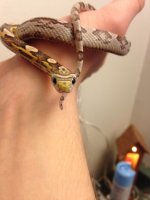
3. Would any of you guys have any idea's as to her morph? would love to know the yellow on the sides of her head and neck seem to be extending a little bit with her bigger meals, but it might just be her getting a little longer, unsure on that!
Any and all advice and input is appreciated, my most dear and precious hobbits!
-D
Well, I "rescued" my corn, Nona, from a pet store in my home town, and after doing thorough research i've decided that the pinky that they had been giving her weekly was definitely not enough for her to maintain growth and good health. I promptly bought her a few fuzzies, and on feeding day she was reluctant to eat at first with all of the moving around and the new home and whatnot, but upon braining the mouse was able to take meals very well! Needless to say i was super proud and showered her with verbal praise after this astonishing victory! I felt like myself and my girl were going to get along great and she'd be an excellent feeder, a relief for me.
The next week I decided that I would weigh her in so that I could compare her weight and weight of her prey to the various feeding charts posted online. She weighed in at a whopping 54 grams(although considering the fact that she is approx. 2 feet long, this is probably fairly light...darn pet stores)! After more research, I decided that these 4-6.5 mice i had were simply not enough to stimulate growth and good health, and decided to give her two mice. Worked like an absolute charm, and since i did slice and brain the mice, she was able to digest perfectly in a normal 40 hours or so. Upon learning that it is generally better to feed a snake one mouse instead of multiple, I went out and got the next size up. Hoppers. They seemed to be the perfect weight and while about 1.5 times her width or so, I figured Nona would be able to handle it considering how well she had done in the past.
No dice. I've offered her two hoppers now and she simply refuses to eat at all, takes hardly any interest in them and honestly seems to want to get out of the small tub I feed her in, but i have also noticed her curled up around the mouse with seemingly no intention of eating it. I am not handling her for at least 24 hours prior to feeding, and since this predicament began have hardly been handling her at all to reduce stress, she's very inquisitive and gentle and I don't fear a strike in this regard.
She is currently weighing in at over 60 grams, she is in a 15 gallon tank with two hides and a leafy branch thing covering most of the back portion of her viv, I keep my room at 20 degrees celsius, so her cool end is 20 and her warm end is about 25-26, and honestly she does seem to prefer the cool end. She is not very active and much prefers hiding and burrowing to exploring, I have a notion that this might be due to the fact that it is winter.
Now that we have the story out of the way, ON TO THE QUESTIONS!
1. I learned today of a method of feeding where you put a head mat down and let it warm up, put a paper towel over it, and place a tub or pot or something with a hole cut in the top for the snake to enter, with a brained mouse inside of the tub. This method was described for use with fussy baby snakes, would this work well for mine who I believe might be a yearling?
2. I have learned that snakes can be intimidated by some prey, and these hoppers are white, apparently causing trouble for some snakes, but the fuzzys she ate were white as well and she had no trouble with them. The hoppers have fur that is quite long for a mouse and she might be misinterpreting the true size of her prey. Would removing the hair from the hoppers be worth a shot? i figure this might make her more comfortable eating them if the coloration is an issue, and might help her realize that she really can take one down.
3. Would any of you guys have any idea's as to her morph? would love to know
the yellow on the sides of her head and neck seem to be extending a little bit with her bigger meals, but it might just be her getting a little longer, unsure on that!Any and all advice and input is appreciated, my most dear and precious hobbits!
-D