• Hello!

    Either you have not registered on this site yet, or you are registered but have not logged in. In either case, you will not be able to use the full functionality of this site until you have registered, and then logged in after your registration has been approved.

    Registration is FREE, so please register so you can participate instead of remaining a lurker....

    Please be certain that the location field is correctly filled out when you register. All registrations that appear to be bogus will be rejected. Which means that if your location field does NOT match the actual location of your registration IP address, then your registration will be rejected.

    Sorry about the strictness of this requirement, but it is necessary to block spammers and scammers at the door as much as possible.

satins!

Thanks D! (Sorry, I can't remember your real name!)
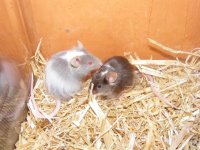
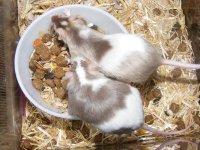
From my original PEW mice and the patched black/white mice I introduced after a couple of generations, I was getting plenty of nice healthy litters. The life-span and breeding rate dropped after the generation I got from the bought males which had tan/white patches. So I'm guessing the tan/white strain carried some bad genetics. Here's the last 2 from that line, looking very ropey and soon to be euthanised as they're losing condition.
The satin producing female had raised 9 babies that I bought with her, and had 12 in this litter, so she really was a lucky find as a feeder breeder. She's black/tricolour, but is obviously carrying lots of different colours because she's now produced ivory, dove/white, cinnamon/white, tricolour and now the chocolate satin too :)
 

Attachments

  • 56.jpg
    56.jpg
    74.1 KB · Views: 122
I've got satins showing up everywhere now, even spotted black/white and brown/white satins.

Anyone know anything about the spotting genes? I have some with distinct patches, look like the normal "cow mice" others have posted here. I also have some with a blurry, sort of faded spotting. Might even be a poor brindle I guess. I have 2 females like that and they are also much more tame than any of the others.
 
I do know that some strains of patched mice have a tendancy towards liver and GI problems. I've been wondering if the spotted gene from the brown/white males I bought was what caused such a drop in production.
 
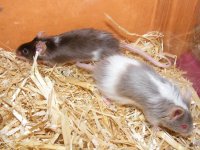
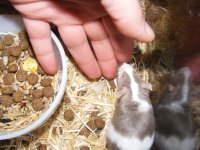
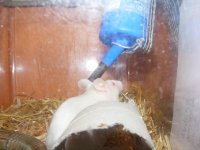
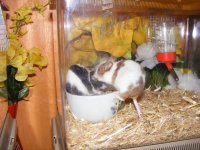
The inevitable has happened, two of the satin mice have made the transition from the happy mouse farm into pethood! My youngest boy has claimed this pair. They're probably both girls, I cant see any 'equipment' under their tails. I have been handling the satins more than I did the previous patched mice, because they are much friendlier and less jumpy right from hopper stage, so taming them is easy :) He hasn't decided their names yet, probably Naruto themes
 

Attachments

  • 65.jpg
    65.jpg
    75.7 KB · Views: 109
  • 68.jpg
    68.jpg
    78 KB · Views: 112
  • 67.jpg
    67.jpg
    70.9 KB · Views: 110
  • 70.jpg
    70.jpg
    92.8 KB · Views: 109
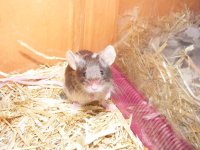
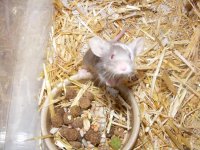
Back to the mini-farm in my bedroom, the original satin pair are producing @ 15 per litter, and the first pairs of keeper breeders should be producing soon. The dove/white trio did produce a litter but ate them, I've separated them into a pair and put one female with a new male to give them another chance at breeding.
 

Attachments

  • 75.jpg
    75.jpg
    88.2 KB · Views: 110
  • 76.jpg
    76.jpg
    74.4 KB · Views: 110
  • 77.jpg
    77.jpg
    47 KB · Views: 111
The first pair have another litter of @12 little 5 day old squeakers, and the dove and cinnamon pair produced their first litter last night. I don't want to disturb them but I think there are 6 reds in the nest. The other pairs can't be too far behind :)
 
The pets my boys claimed had to be separated after revealing that they had family jewels hidden under their tails after all! Marty and Randall now live in the front room and entertain the cats by teasing them from the safety of their little tanks.
 
The pets my boys claimed had to be separated after revealing that they had family jewels hidden under their tails after all! Marty and Randall now live in the front room and entertain the cats by teasing them from the safety of their little tanks.

Poor cats....
 
I went to a big feed store yesterday, and was after a 'lab block' type pelleted food. Instead of which, I came out with a giant bag of pig pellets! After comparing the nutritional analysis with all the various sheep, chicken etc feeds, one of the workers there recommended the pig pellets because they have some rat breeders that use them. I put a small handful in with each of the mice and they've definately been eating them :)
 
Some real beauties!

I gave the mice breeding thing a good try but found them way to messy in my tiny quarters. I was cleaning them twice a week but still lots of odors. I really wanted this to work but they just loved to make a mess! I did spare one as a pet for a friends daughter since I had the cage, wheel, snap down water dish all brand new.
I did end up with some very costly feeders by the time you figure $6.50 each times 3 plus the $50.00 or so of equipment.
Guess I will stick to small mice at $1.10 each if you buy ten and even less if you go to 20 at a time.
Don't mean to be mean but people really should know what there getting into before the make the investment!
Bill
 
It's not that much of an investment if you go about it the right way. Buying equipment at a pet store is the worst thing you can do.

I paid $5 each for used lab breeder tubs with wire tops and water bottles. Bedding is $4 for 40 lbs of wood stove pellets. Feed is $18 for 50 lbs. and lasts a long time with mice.

Back on topic, I've got all kinds of satins now, solids and spotted. I crossed them with my albino which produce large litters and am getting litters of about 15-18 out of my satins.
 
I've had another chocolate satin appear, and would have got a picture of the little beauty if it hadn't decided to make a bid for freedom. It shot up out of my hands and behind a wardrobe. I want it for a breeder, so have just had an exciting game of mousehunt, involving much furniture moving, crawling around and cursing for over an hour before I finally caught the little darling. I didn't risk sexing it, just pooped it back in with the rest of the litter before collapsing gratefully. Boy or girl, Dangermouse is a keeper!
 
I want it for a breeder, so have just had an exciting game of mousehunt, involving much furniture moving, crawling around and cursing for over an hour before I finally caught the little darling.

Nice exercise program, perhaps it's not a good idea to breed the smart escape artist types?
 
I agree. No matter the color or other genetics, I never breed any that are overly frightened, escape artists, or biters.

As for the satins, I've got long hairs and satins popping up everywhere now. Lots of cow-patterned satins in brown, black, tan, fawn, light brown. Brindle longhair satins. At least I think they're brindle, its sort of a faded striped spotting.
 
Maybe little Dangermouse will make me regret it, but I'l get a picture later to show why I can't cull him!
 
Can a litter be escape artistes by genetics? I have a nightmare. 2 of Dangermouse's siblings are free-range in my bedroom, resisting attempts to recapture them, so I'm off to buy some mousetraps before they chew through any electrical wires:rofl:
 
Hurrah for chocolate spread! Both caught in a humane trap baited with it within an hour. They are now inside Calamity and Butch. Dangermouse and his/her remaining sibling are probably destined for the same fate if they don't calm down. All the other satins have been so easy to tame that I'm perplexed by the wild character of this litter.
 
No idea if it is a genetic trait or a learned one.
The way I see it, once they have tasted freedom, they are no good to me as breeders any more.

I want nice docile, content breeders :grin01:

So where's the pic of this guy?
 
Back
Top