• Hello!

    Either you have not registered on this site yet, or you are registered but have not logged in. In either case, you will not be able to use the full functionality of this site until you have registered, and then logged in after your registration has been approved.

    Registration is FREE, so please register so you can participate instead of remaining a lurker....

    Please be certain that the location field is correctly filled out when you register. All registrations that appear to be bogus will be rejected. Which means that if your location field does NOT match the actual location of your registration IP address, then your registration will be rejected.

    Sorry about the strictness of this requirement, but it is necessary to block spammers and scammers at the door as much as possible.

Shedding Question?

BetaConcept

New member
So this is my first corn snake, and she hasn't gone through her first shed with me yet, but I have a question about when she does start. When her eyes start clouding up, is that when I'm supposed to put the box full of moist moss in the tank for her to crawl around in, or is that at another stage? Also, how often to I keep the moisture box in the vivarium, and how often do I spray the box to keep it moist? I'm really confused with the whole shedding concept, so if anyone could just run through it with me, that'd be great! :) Thank you!
 
You probably won't even need to offer her any help at all. I live in an extremely dry climate and my snakes never have problems shedding on their own.

However, it won't hurt to give her a humid hide. You can even just put some damp moss in one of the hides she already has. I would make one once you see her start looking dull. You can just check it every now and then to see if it's still damp and re moisten it when it gets dry. And you don't want the moss to be sopping wet, just damp, so really wring it out when you wet it. You can leave the box in with her full time and then remove it once she's done shedding.
 
So should I refrain from handling her during shedding? And how long should shedding take from the day her eyes start clouding? Thanks.
 
It won't hurt her to be handled during shedding, but she would normally spend that time hiding in the wild, so she probably won't appreciate being handled during that time. She will probably rattle her tail at you if you disturb her during blue. The whole process can take different amounts of time for different snakes, but I would say the average is about 10 to 14 days. Babies usually have a shorter cycle and adults usually have a longer one.

And you probably already know this, but it's best not to feed her in blue.
 
It won't hurt her to be handled during shedding, but she would normally spend that time hiding in the wild, so she probably won't appreciate being handled during that time. She will probably rattle her tail at you if you disturb her during blue. The whole process can take different amounts of time for different snakes, but I would say the average is about 10 to 14 days. Babies usually have a shorter cycle and adults usually have a longer one.

And you probably already know this, but it's best not to feed her in blue.
Why is it not advisable to feed while blue?
 
Why is it not advisable to feed while blue?

Many snakes will refuse food while in blue, while others will eat it but then are prone to regurgitating it - shedding appears to interfere with the appetite and digestion of some snakes.

Having said that, I have always fed my male while he's in blue, to no ill-effect whatsoever. He's a dream feeder outside of his yearly hunt for females in the breeding season, and he eats just as well while in shed at any other time.

My usual policy is to offer snakes food while in shed at first. If they never seem to want food while in shed, I give up offering, and if any were ever to regurge after feeding in shed (hasn't happened yet, thankfully) I would of course not offer food while in blue again.

I also handle two of mine while in shed, but not my little KSB - he stresses too easily and is prone to bad sheds if stressed. It's all about figuring out what works best for an individual snake :)
 
From what I've heard, regurges during blue are most likely to happen if a snake is fed during the 'clear' phase near the end of the shed. I think it's because of two reasons: one, the snake well have to move around a lot to get the shed off and that means it won't be sitting on a heat spot digesting properly, and two, I think the snake may sometimes not be able to get the shed around the lump of food in its belly.

I generally do not offer any of my snakes food in blue. It won't hurt them to miss one meal and I'd rather not risk a regurge.
 
I find this a pretty interesting topic. However, Giga hit it on the NOSE by stating "It's all about figuring out what's best for an individual snake."

I've had snakes that have no problem eating while in blue and others who will hide and don't wanna be bothered while in that phase, but almost ALL of my corn snakes have eaten if offered food while they were in blue. I was ignorant of the dangers just a little over a year ago, prior to finding this website, actually. Now, after reading about it, I would rather wait a few days rather than take a chance on a regurge, no matter how small the chance.

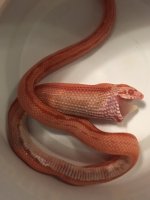
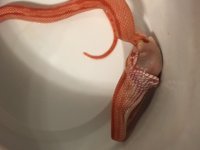
About 2 years ago, when I placed all of my adult corns in their feeding tubs, I gave a rat (almost 70 grams) to my largest corn, Bozo, who can get up to 950 grams and is about 5' long. Since he is a snow with red eyes, I can almost NEVER even TELL when he's ready to shed. He eagerly disposed of the rat and after swallowing it besides for looking a little thicker than he already IS around his lower half, you couldn't really TELL that he had eaten by just looking at him! But as I was going to pick him up to place him back in his enclosure, I noticed that he started to rub his snout against the edge of the tub where the cover snaps onto. He kept rubbing his snout like they sometimes do after eating and I initially thought nothing of it, UNTIL. . . I saw a little flap of skin peeling off of his snout by his mouth and first thought it was just a piece of skin which had peeled off due to the relatively large rat he had just swallowed, like maybe a loose scale (not that I had ever SEEN that before, but it looked almost typical, the way he did it!)? But as I looked closer, the flap kept peeling further and further back! Then, after one more rub, the flap turned into what was the beginning of a SHED!! I saw the flap get pulled FURTHER AND FURTHER BACK AS HE RUBBED ON THE TUB!! After peeling back past his neck, he just seemed to slowly shimmy his way slowly out of the rest! It wasn't until he was just about DONE that I regretted NOT filming that whole process with my cellphone!!! (I actually caught one of my other adult corns, Chili-Pepper, my motley bloodred, shedding, but only caught the last half of the shed on film, but it was cool enough to upload to YouTube anyway!!).

In any event, maybe Bozo shed BEFORE his digestive process had really begun by shedding IMMEDIATELY after eating a large meal which was probably going to take quite some time to digest? For whatever reason, it WAS one of the coolest things I EVER witnessed one of my snakes doing!!

 
I keep a lot of different amel snakes and have made the mistake of feeding them while in shed. Just recently a 6g snow hatchling and and 100g albino beauty yearling both ate during their clear phase of a shed cycle. The snow hatchling shed with no issues where the beauty snake regurgitated the most awful foul smelling mess while shedding.:puke01:
I thanked the snake goddess that the snow made it through the shed cycle after eating with no issues. Why ? With a hatching a regurge can be fatal !! Their virgin digestive and intestinal track systems have not developed fully the necessary bacteria and can not recover it quickly if a regurge occurs. This is why Nutra Bac was invented. There is probably a 100 threads on here from keepers that had hatchlings regurge and they LOST the battle to get the snake to recover! Their hatchlings died!
IT IS NOT WORTH TAKING THE CHANCE WITH HATCHLINGS ! ( Capitals for dramatic effect :p ) Seriously tho with a sub adult or an adult it probably won't be an issue BUT with hatchlings it is NOT worth taking the chance! :)
 
:toiletgra
I keep a lot of different amel snakes and have made the mistake of feeding them while in shed. Just recently a 6g snow hatchling and and 100g albino beauty yearling both ate during their clear phase of a shed cycle. The snow hatchling shed with no issues where the beauty snake regurgitated the most awful foul smelling mess while shedding.:puke01:
I thanked the snake goddess that the snow made it through the shed cycle after eating with no issues. Why ? With a hatching a regurge can be fatal !! Their virgin digestive and intestinal track systems have not developed fully the necessary bacteria and can not recover it quickly if a regurge occurs. This is why Nutra Bac was invented. There is probably a 100 threads on here from keepers that had hatchlings regurge and they LOST the battle to get the snake to recover! Their hatchlings died!
IT IS NOT WORTH TAKING THE CHANCE WITH HATCHLINGS ! ( Capitals for dramatic effect :p ) Seriously tho with a sub adult or an adult it probably won't be an issue BUT with hatchlings it is NOT worth taking the chance! :)


Hey there Daddio! How ya been? :p

Thanx for stating what I should already know but didn't even think about, Especially at a time when I'm facing the challenge of feeding a brood of hatchlings who have a core group of cute but seemingly EVIL little critters who behave as if it's their role on their new planet to refuse all attempts by their keeper to eat anything, almost as if it was OUR fault that they were born as animals who have a very specific dietary requirement that includes a food source that will definitely challenge every cell in their neck & head if they EVER do try to swallow it!* Newborn hatchlings CAN be one of the most challenging components to snake keeping and anyone even entertaining the thought of breeding their little sneaky ones for the purpose of producing offspring should definitely consider this aspect of this wonderful hobby!

Don't know if I threw this off-topic slightly and if it did, I apologize, but it was definitely important!

*(Illustration of a small runt-sized hatchling successfully attempting to swallow a pinky that was just TOO big for it to follow in the next post -I HOPE!) :crazy01:
 
As promised, here's a picture of the only amel stripe hatchling in a clutch of snows (16 total) who hatched from 7/11 to 7/18. (Some of you may know the well-documented story of this clutch in other threads). This little guy happens to be the 1.5 gram runt of the bunch with a small kink in his tail, appropriately named "Kinky!" He successfully swallowed the pinky in this picture after almost 20 minutes of struggling! Thankfully, he did not regurge the rodent.
 

Attachments

  • image.jpeg
    image.jpeg
    86.9 KB · Views: 23
Glad some folks appreciated Kinky's first meal!! :crazy02:

(I actually HATE posting pix as it entails me having to email them to myself and re-saving them at a smaller size. Wish the pics were resized automatically as they are in the album sections! Does anyone know of a way to link pics from the albums to this part of a thread?).

Anywho, I think Daddio's point about NOT feeding hatchlings while in blue is a good one! Did you see how Pinky's head looked as if it was literally gonna EXPLODE? :blowup:

Imagine Pinky had to shed AFTER a meal like that! It would be like stuffing 5 pounds of baloney into a 1 pound bag and then trying to peel the outer layer of the bag off without ripping it afterwards!!! :eek:
 
Back
Top