• Hello!

    Either you have not registered on this site yet, or you are registered but have not logged in. In either case, you will not be able to use the full functionality of this site until you have registered, and then logged in after your registration has been approved.

    Registration is FREE, so please register so you can participate instead of remaining a lurker....

    Please be certain that the location field is correctly filled out when you register. All registrations that appear to be bogus will be rejected. Which means that if your location field does NOT match the actual location of your registration IP address, then your registration will be rejected.

    Sorry about the strictness of this requirement, but it is necessary to block spammers and scammers at the door as much as possible.

Sun-Kissed Lava (big pic files)

Taceas

USW = UB313
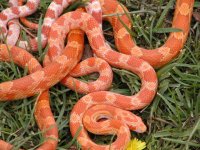
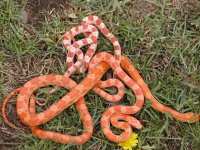
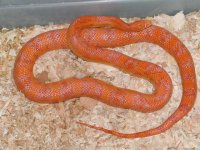
These guys are so beautiful in the sunshine it's just hard to take pictures, you just want to sit there and watch them move and the colors come out. =D

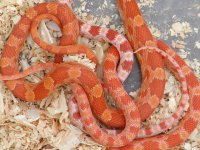
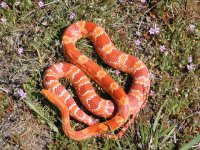
These guys are a pair of 2003's from Joe. I just love their colors. The female is more of a brickish red and the male more tangerine orange. The male also seems to be retaining more black spots on him than the female.

They're great eaters and grow quite quickly. When I got them they were on large pinks, and now they're on crawler mice (fully haired but eyes closed).

They just shed yesterday so I thought I'd share their fresh colors, enjoy!

Lavas1.jpg


Lavas2.jpg


Close-up of the male's saddles:
Lavas3.jpg


Close-up of the male:
Lavas4.jpg


Close-up of the female:
Lavas5.jpg


Both entertwined:
Lavas6.JPG
 
wow
very pretty looking!!!

I really like those lavas that Joe produced!!

They are just great looking..
and I don't know...your lava looks huge compared to mine~~
 
Sun-Kissed Lava

I wasn't aware that Joe had produced anything he knew was homozygous for sunkissed and lava. Are you saying they are homozygous for sunkissed and lava? Het for both? Lava het sunkissed? A really, really lovely lava?

Just curious.
 
WOW! Great photos Misty. I am so glad to here that they are doing good for you. This is always very welcome news. Your photos are perfect examples of why I went with the Lava name. They really do look like flowing hot lava and are not transparent after all.

I think she meant kissed by the sun, because the photos were taken in the sunlight. There are no Homo Sunkissed/Lavas yet, at least none that I have produced. The first hets Sunkissed/Lav that I produced where in 2003. I saved 2.6 and they are growing fast and I am optimistic that I will produce some Homo Sunkissed/Lavas in 2005. I am not so sure they will look much different than a Lava, but who knows. I say I don’t think they will look much different than a Lava instead of Sunkissed, because the Lavas have more of an extreme expression of hypo. Some of the Sunkissed have some different looking yellowish/Greenish areas on their head and blotches, so the combo could make something weird or pretty. Amel Lavas look a little different than amels, so why couldn‘t Sunkissed Lavas look a little different too. I wouldn’t want to try to pick 5 Amel Lavas out of a bucket with 10 Amels mixed in, but I may be able to do it. They have a soft look to them. The two that I am raising from 2003 started out looking like baby Amel Burmese Pythons and still look very different than my other amels. Soft is about the only way I can describe them, except they may have a pastel look to them. Pastels are softer colors aren’t they.

I am partial to the Lavas for obvious reason, but some of the Sunkissed Okeetees are absolutely beautiful too. The combo could really produce a beautiful hypo and have locality links as well.
 
Joe is correct, I was merely doing a play on words with the sun kissing them outside. The natural sunlight really brings out their true colors more so than indoors lighting can. =)

I can imagine the amel lava would be a very pretty snake indeed. Maybe you could share a couple of pictures from your two. ;)

Anyway, the lavas are still doing great. Eating like horses and growing like weeds. I fed them on Friday morning and took the pictures on Saturday afternoon and you can barely discern a lump in them anymore. And those were live crawlers they ate. Very high turnover rate.

I'm interested in getting them up to breeding size so I can work on a few crosses with lava myself. I'm kind of curious as to what a Bloodred Lava would look like. ;)
 
2003 Amel Lava photos

Here are a few photos of the suspected Amel Lavas. Remember, this is only a theory of mine, base upon the looks alone compared to clutch mates. I began my photo session in doors with a flash and soon moved outside to try Don S’s secret ingredient for photos. They came out fairly well. I also started off with a comparison photo between a lava and Amel Lava and they almost looked the same so, I threw in a Red Amel and the differences are more clear. Hopefully, it will be obvious which is which. The photos contain, and Amel Lava?, Lava and Red Amel.
 

Attachments

  • p4180020.jpg
    p4180020.jpg
    72.9 KB · Views: 111
This photo shows better why I labeled them Amel Burmese? on their lid. It was much more dramatic when they were born. They looked like Candy Corn. I only kept them because I knew there was something different about them. They came from an Amel Okeetee X Amel Okeetee breeding. Both were poss het Lava. The entire clutch looked like Amel Okeetees except for two of them.

I know that other amels look very simular, but all of the amels from this line are very red and not orange at all. It seems that the orange coloration in these amels is caused by the Lava gene.
 

Attachments

  • p4180013.jpg
    p4180013.jpg
    69.5 KB · Views: 107
The mother of these Amel Lava looks like this female. It could be her, but I have quite a few of these Amel Okeetees from this line and I took this photo last year.
 

Attachments

  • albino okeetee trans line.jpg
    albino okeetee trans line.jpg
    79.4 KB · Views: 105
This is an adult Amel Lava? The faded areas in her blotches ard just an added bonus and not caused by the Amel gene. It is most likely caused by a high amount of black on the blotch if it was in normal phase.

I have two adult female Amel Lavas?. I bred both of them to Lavas to check out my theory this year.
 

Attachments

  • p3260002.jpg
    p3260002.jpg
    64.6 KB · Views: 23
Back
Top