• Hello!

    Either you have not registered on this site yet, or you are registered but have not logged in. In either case, you will not be able to use the full functionality of this site until you have registered, and then logged in after your registration has been approved.

    Registration is FREE, so please register so you can participate instead of remaining a lurker....

    Please be certain that the location field is correctly filled out when you register. All registrations that appear to be bogus will be rejected. Which means that if your location field does NOT match the actual location of your registration IP address, then your registration will be rejected.

    Sorry about the strictness of this requirement, but it is necessary to block spammers and scammers at the door as much as possible.

Ultra vs. Hypo vs. Strawberry vs. Lava vs. Sunkissed?

iculatr

NO...WIRE...HANGERS!!!
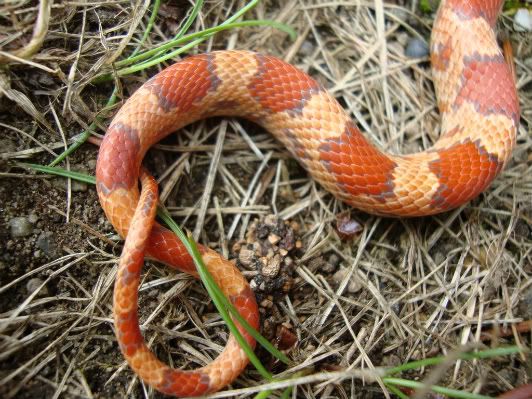
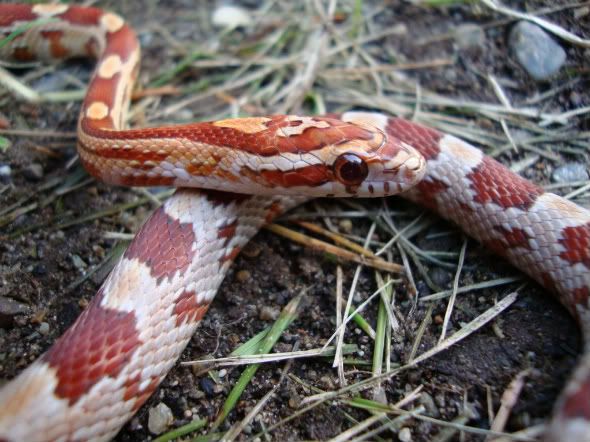
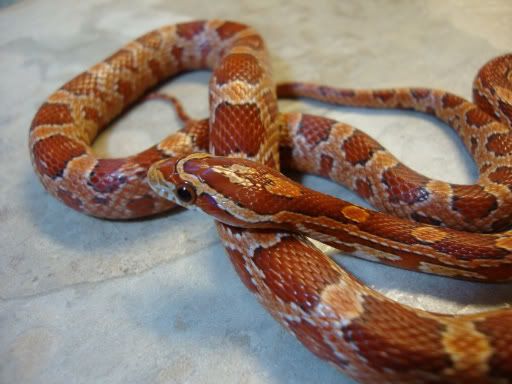
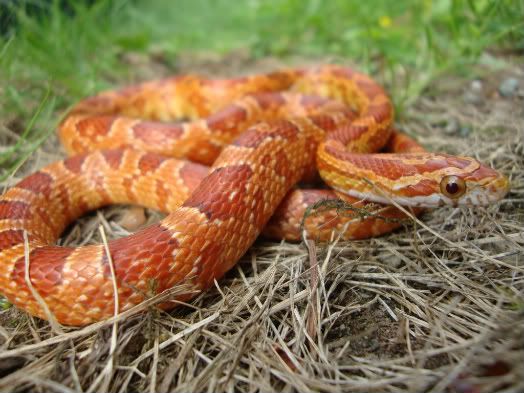
Very basic question...what is the easiest way to distinguish these morphs from each other (especially as babies) and/or if there is some combination of hets involved? Going from lightest to darkest colored, would it be ultra as the lightest, followed by hypo, then strawberry, then Lava, then sunkissed? Or is there some sort of "melanistic" and/or pattern difference between these?
 
Excellent question, iculatr. I have spent hours looking at pics, like on http://iansvivarium.com/cornsnakemorphs.php.
I think I could fairly accurately tell one (single trait) adult morph from another.
But at this time of year, when little ones are hatching, I defer to the pro's.
I hope they will post.

And welcome to the forum.
 
After a while, the difference becomes quite noticeable. I suggest purchasing the Morph Guide written by Charles Pritzel as he defines these morphs in multiple ways (all the way down to the macroscopic level).

I will point out some subtly different ways that I use to distinguish some of these morphs. The saddles, color hue and most especially the eyes are substantially different per each morph.
Note that these morphs can vary greatly and will not always be so easy to distinguish.

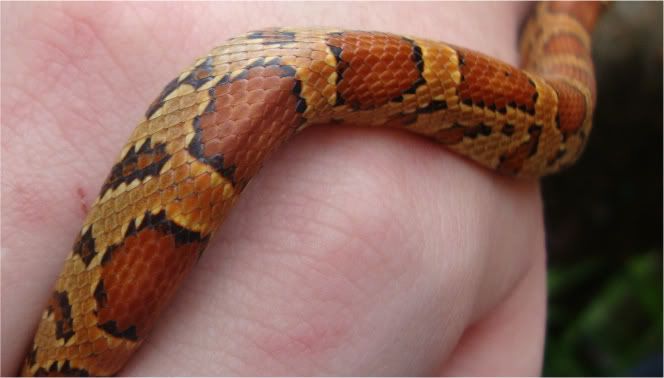
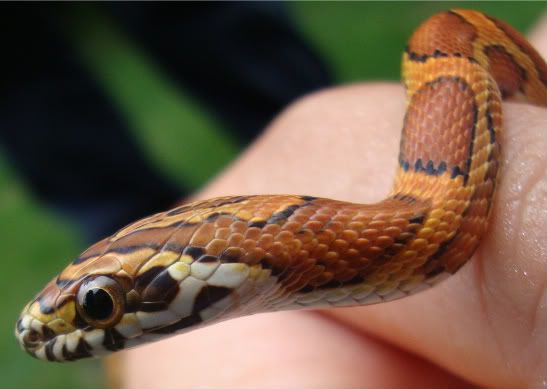
The following is a sunkissed. Sunkisseds are pretty easy (probably the easiest imo) to distinguish because of the (usually) strong blackish melanin bordering surrounding the saddles. They almost always have very unique head & facial patterns (although this is not always the case).

Typical Sunkissed pattern:
DSC02935-1.jpg


Typical Sunkissed head pattern:
DSC03006-1.jpg


Sunkissed tend to vary greatly in hue and saddle shape & bordering as the morph originated in the Okeetee lineage and will tend to lean more towards the Okeetee look, although due to out-crossing they are starting to change greatly.
 
Lava

Next, in the lava you can see the different in the eye coloration. Lavas have the red pupil and red iris. Not as light Amelanistic but not dark either. Lavas are also usually more rich in color (red).

Here is a typical Lava look (one of my males):
DSC03333-1.jpg


And typical lava head & eye:
DSC03345-1.jpg


And One of my females for comparison on variation:
DSC03213-1.jpg


One thing I really notice (besides the eyes) about the lava is the purplish melanin bordering around the saddles, which is very distinct in my opinion.
 
The general over all Hypomelanistic A style can vary so greatly due to hets that, in my opinion, there is no 'common' look to them. They pupils are black and the iris color can vary between different shades or red/red-gold/gold.
Usually in between the saddles is much lighter than the other morphs in comparison.

Here is a picture of one of my Hypo As but he is NOT a very good example, as he is 100% het for about 5 other traits.

Hopefully someone else will be able to link better Hypos for comparison.

My male hypo:
DSC01532-1.jpg
 
Strawberries can vary greatly and the 'look' still has not been completely hammered out. Although the trait has been around a long time, it is now finally beginning to be understood and separated out of the normal Hypo A trait (which it is allelic to).
I purchased quite a few strawberries from Mr. Soderberg and am planning on doing some work with the gene down the road. Someone who has been doing A LOT of work with the strawberry gene is Marsha from Poppycorns.

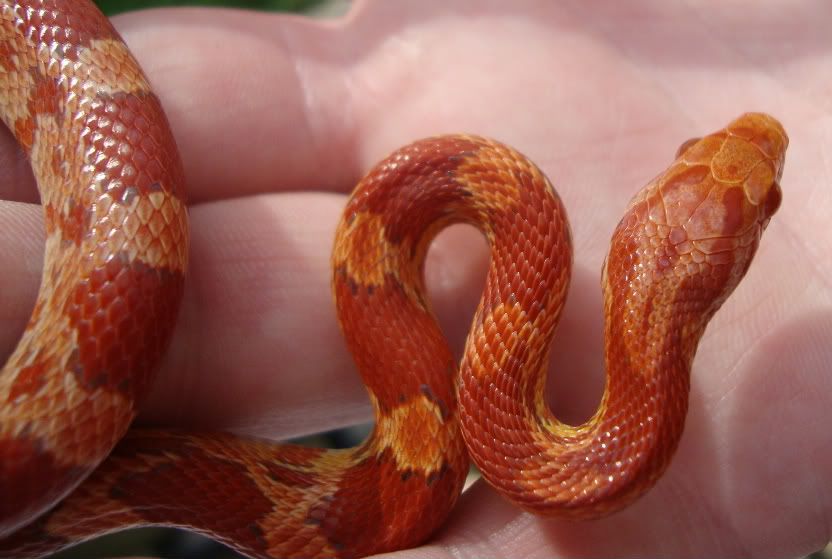
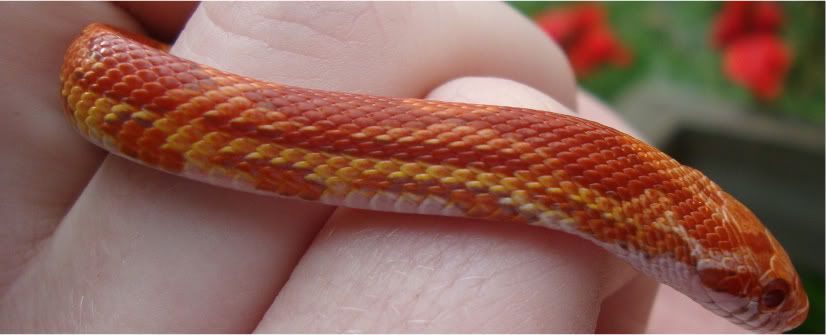
Below are some pictures of a few of the strawberries I have, I believe they are siblings- so you can see how much they vary in color although they do have the basic Dark pupil and red-gold hue to the iris. As you can see the saddles are usually a deep red with a much noticeable inflection of red in between the saddles as well.

Strawberry female (sister to the others):
DSC02595-1.jpg


Strawberry male (brother):
DSC03409-1.jpg


Strawberry male (another brother):
DSC01313-1-1.jpg
 
Ultras....

As for Ultra- I do not have any plain ultra or ultramel. I DO have a couple of gold dusts (and a few other morph combination).

What I tend to notice the most about ultras, is the very uniquely shaped saddles, the noticeably greyish melanin around the saddles and the way the coloration on the scales is very 'salt and pepper' like (sporadic). I don't know how else to explain it.

Maybe someone else will have pictures of their Ultras and/or Ultramels for comparison.

I linked a few gold dust pictures to show the unique saddle and melanin look.

Female gold dust:
DSC02845-1.jpg


DSC02868-1.jpg
 
Great thread, with great questions though!!!

I hope others add pictures for comparison. I would also like to hear others' perspectives on key looks and distinguishing features.

Thanks for starting this :)
 
Thanks so much for the replies, Tara! They were very interesting to read and view the pictures together.
 
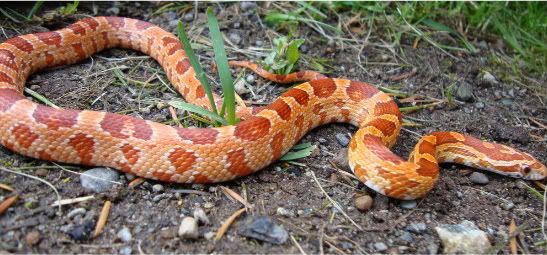
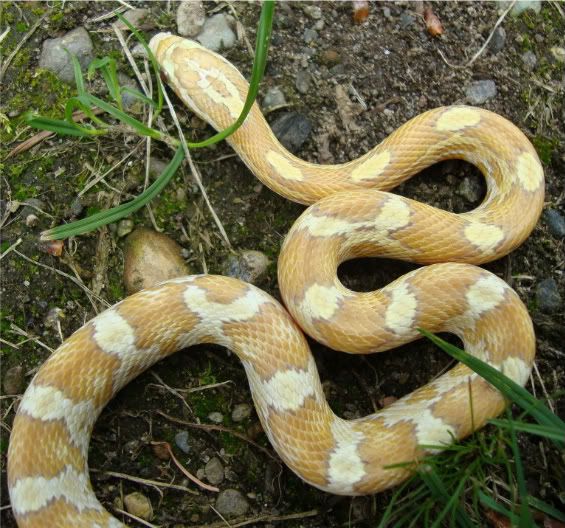
Wax32, the female in the first picture looks just like my Ultramel poss het motley, diffused, lavender! The second picture looks kinda like a golddust? Is the mother het Caramel?
 
Both of those ultramels are het caramel and charcoal. They are from Gold Dust x Blizzard breeding.
 
Bumping up to see if anyone has any input regarding the visual differences of the Ultra and Ultramel genes, especially combined with other genes. For example, does anyone have a comparison of an Ultra Anery vs. an Ultramel Anery?
 
Bumping up to see if anyone has any input regarding the visual differences of the Ultra and Ultramel genes, especially combined with other genes. For example, does anyone have a comparison of an Ultra Anery vs. an Ultramel Anery?

Theoretically, an ultramel is supposed to have a phenotype halfway between the two genes (ultra and amel) when they are in homozygous form. However, due to the natural variation seen in every morph, it can often be very difficult to distinguish an ultra from an ultramel without a breeding trial. Some breeders say they can tell the difference in a clutch that should have both ultras and ultramels, but it wouldn't surprise me that they get that one hatchling in the clutch that could go either way.
 
Theoretically, an ultramel is supposed to have a phenotype halfway between the two genes (ultra and amel) when they are in homozygous form. However, due to the natural variation seen in every morph, it can often be very difficult to distinguish an ultra from an ultramel without a breeding trial. Some breeders say they can tell the difference in a clutch that should have both ultras and ultramels, but it wouldn't surprise me that they get that one hatchling in the clutch that could go either way.

And this is why they would be labeled as "Ultra/Ultramel Anery" because it is not known until the breeding test?
 
Back
Top