-
Hello!
Either you have not registered on this site yet, or you are registered but have not logged in. In either case, you will not be able to use the full functionality of this site until you have registered, and then logged in after your registration has been approved.
Registration is FREE, so please register so you can participate instead of remaining a lurker....
Please be certain that the location field is correctly filled out when you register. All registrations that appear to be bogus will be rejected. Which means that if your location field does NOT match the actual location of your registration IP address, then your registration will be rejected.
Sorry about the strictness of this requirement, but it is necessary to block spammers and scammers at the door as much as possible.
You are using an out of date browser. It may not display this or other websites correctly.
You should upgrade or use an alternative browser.
You should upgrade or use an alternative browser.
What morph is this?
- Thread starter lucia
- Start date

Darin Chappell
Very Senior Hillbilly
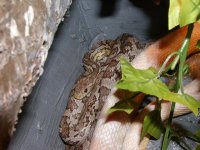
Well, I see no evidence of the animal being a pewter, and given that you are in Europe, if you didn't buy it as a pewter (which it seems you did not), the chances of you accidentally receiving one are very slim, as I'm sure you realize.
As to the difference between the black albino (anerythristic) and the ghost corn, the difference is that the ghost is an anerythristic animal that is ALSO homozygous for hypomelanism. That is the only difference.
The problem is that it is very hard to tell the difference between darker ghosts and lighter anerythristics, especially as adults. As hatchlings, it's much easier, but even then it can be difficult, given the wide variation of the anerythristic gene in corns.
In point of fact, the ONLY way to determine whether that animal is a ghost is to breed it to a known hypomelanistic animal. If the resulting babies are hypo, your animal is ghost. If not, then the babies will all be non-hypos.
Of course, you have to take into account the possibility that the two parents (your animal and the one to which you breed it) are actually both hypos, but that they are homozygous for different, incompatible forms of hypomelanism. It is said to happen here in the States quite often, but I am unaware of how pervasive the problem is in other parts of the world. Are there multiple strains of hypomelanism known to be Sweden?
Rgardless, it is a nice looking animal, and I'm sure you enjoy having it very much! Good luck with it!
As to the difference between the black albino (anerythristic) and the ghost corn, the difference is that the ghost is an anerythristic animal that is ALSO homozygous for hypomelanism. That is the only difference.
The problem is that it is very hard to tell the difference between darker ghosts and lighter anerythristics, especially as adults. As hatchlings, it's much easier, but even then it can be difficult, given the wide variation of the anerythristic gene in corns.
In point of fact, the ONLY way to determine whether that animal is a ghost is to breed it to a known hypomelanistic animal. If the resulting babies are hypo, your animal is ghost. If not, then the babies will all be non-hypos.
Of course, you have to take into account the possibility that the two parents (your animal and the one to which you breed it) are actually both hypos, but that they are homozygous for different, incompatible forms of hypomelanism. It is said to happen here in the States quite often, but I am unaware of how pervasive the problem is in other parts of the world. Are there multiple strains of hypomelanism known to be Sweden?
Rgardless, it is a nice looking animal, and I'm sure you enjoy having it very much! Good luck with it!

lucia
New member
Ok, thanks for the answer!
I got it from a woman who didn´t know what to do with it, and to me it looks lika a ghost corn.
He is 3 years old and very small, in the past he was only given "pinkies".
Too shame with a beautiful snake. I hope he will be alright here with me and my other snakes.
I got it from a woman who didn´t know what to do with it, and to me it looks lika a ghost corn.
He is 3 years old and very small, in the past he was only given "pinkies".
Too shame with a beautiful snake. I hope he will be alright here with me and my other snakes.

red_dragon
Senior member
nopp
i see that snake has yellow, sinds a pewter is a anery B bloodred, and has not got any yellow from the B type anery, youre snake coulnt be a pewter, no chance..
i see that snake has yellow, sinds a pewter is a anery B bloodred, and has not got any yellow from the B type anery, youre snake coulnt be a pewter, no chance..
Darin Chappell
Very Senior Hillbilly
It is true that I have never seen a pewter that has any yellow on it like that snake has. However, it is not true that anery b animals cannot have yellow on them.
That was one way that was THOUGHT to be an indentifying factor between the two forms of anery at one time. However, it has since been shown that there are some anery a animals with no yellow at all, and some anery b animals with the yellow coloration.
You simply cannot tell anery a from anery b by the existence or absence of yellow on the chin/neck region. I wish it were that easy, but it isn't.
That was one way that was THOUGHT to be an indentifying factor between the two forms of anery at one time. However, it has since been shown that there are some anery a animals with no yellow at all, and some anery b animals with the yellow coloration.
You simply cannot tell anery a from anery b by the existence or absence of yellow on the chin/neck region. I wish it were that easy, but it isn't.
red_dragon
Senior member
and i was just thinking to be smart...lol
so, tell me, how can i identify a anery B? breed it to a A type and i will get normals i know, is there another way to simply SEE it?
so, tell me, how can i identify a anery B? breed it to a A type and i will get normals i know, is there another way to simply SEE it?
Darin Chappell
Very Senior Hillbilly
Sometimes it is very difficult to tell by sight alone. There are some GENERAL rules, but I think it coming to the point that breeding trials are about the only SURE way there is to know.
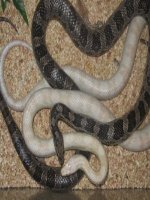
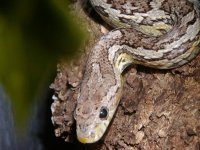
1) As a GENERAL rule, charcoals have must less instances of having yellow on their chin/neck areas (some do have the yellow, but in smaller percentages than anery a animals).
2) As a GENERAL rule, charcoals are darker than anery animals, but again, this is often not the case in specific individuals from
BOTH sides of the equation.
3) As a GENERAL rule, the ground color of a charcoal is much more closely aligned with the saddle coloration, giving the animal that "smudged piece of charcoal" look for which the cultivar was named. Anery a animals are usually found to have more contrast between their saddle and ground coloration.
4) As a GENERAL rule, ... charcoal's cost a little more!
That's about it ... hope those items help a little bit (well, except for that last bit of silliness)!
1) As a GENERAL rule, charcoals have must less instances of having yellow on their chin/neck areas (some do have the yellow, but in smaller percentages than anery a animals).
2) As a GENERAL rule, charcoals are darker than anery animals, but again, this is often not the case in specific individuals from
BOTH sides of the equation.
3) As a GENERAL rule, the ground color of a charcoal is much more closely aligned with the saddle coloration, giving the animal that "smudged piece of charcoal" look for which the cultivar was named. Anery a animals are usually found to have more contrast between their saddle and ground coloration.
4) As a GENERAL rule, ... charcoal's cost a little more!
That's about it ... hope those items help a little bit (well, except for that last bit of silliness)!

red_dragon
Senior member
i really wouldnt have a clue sinds Darin's story, sorry, (but if Darin woudnt have told that, i would tell you wrong )
grtz
)grtz