
-
Hello!
Either you have not registered on this site yet, or you are registered but have not logged in. In either case, you will not be able to use the full functionality of this site until you have registered, and then logged in after your registration has been approved.
Registration is FREE, so please register so you can participate instead of remaining a lurker....
Please be certain that the location field is correctly filled out when you register. All registrations that appear to be bogus will be rejected. Which means that if your location field does NOT match the actual location of your registration IP address, then your registration will be rejected.
Sorry about the strictness of this requirement, but it is necessary to block spammers and scammers at the door as much as possible.
You are using an out of date browser. It may not display this or other websites correctly.
You should upgrade or use an alternative browser.
You should upgrade or use an alternative browser.
cali king
- Thread starter bataco
- Start date

CALIVIK
New member
Not sure, I have one he is creamed banned. Had no idea there are two kinds. He maybe white, he hasn't had a shed since I got him 3mths ago & he is brumating on his own. Still learning about these guys, I know there are a other posters here who own them.
Sorry I wasn't much help.
Sorry I wasn't much help.

Nanci
Alien Lover
I read the coolest article about Cali Kings, which of course I can't find at this moment, but all those different looks are actually localities. Take my Chocolee, for instance, she is the Coastal locality.
Snippet from VMS: Throughout most of their range, California Kingsnakes are boldly banded in dark brown and creamy white or yellow. So-called ‘Desert Phase’ animals are colored a very high contrast black and white, with breeders selecting for solid blacks and purest whites. In scattered locations, these animals may lack all traces of bands, instead possessing a full length light mid-dorsal stripe about two scales wide.
Snippet from Pro Breeders:
50-50 DESERT CALIFORNIA KINGSNAKES - Display bright white banding at least as wide (mid-dorsally) as the dark black bands or blotches. The combination of high band count (typical of desert phase California Kings), broad expansion of the white bands, and intense contrast of the white and black coloration results in one of the most striking and unique forms of kingsnakes. The wonderful ‘look’ and the confident, docile nature of 50-50s make them a particular favorite of ours. We began the development of this project in 1988 from a portion of the original founder stock (a pair of extremely rare wild caught 50-50 specimens from the Mojave Desert and their offspring). This original stock unlocked the genetically controlled trait for expansion of the white banding. We have accomplished subsequent outbreeding to the finest quality specimens available native to Joshua Tree, California; Clark County, Nevada; and San Felipe, Baja California (these 3 localities are known for the most extreme white and black color intensity in the wild) to continue perfecting the extremes of color intensity and immaculate white banding. Through four generations of selective breeding the percentage of white pigment continues to increase. A limited number of stunning 60 to 80% white hatchlings in banded or blotch phases will be available this year.
GOLDEN-YELLOW CALIFORNIA KINGSNAKES - Individual specimens are from 75 to 95% lemon-yellow color on the dorsal surface with almost no pattern. This strain has been developed and refined since 1965. It began with wild stock from Vista (a banded individual with unusually wide lemon-yellow bands) and California City, California. Aberrant forms found in Newport Beach, Long Beach, Whittier and Los Angeles Airport areas were later introduced into the strain. Golden-Yellows have been derived from over ten generations of selective breeding, with the emphasis of this breeding program being to concentrate the genes responsible for expanding and intensifying the yellow color. As a result of this process, a small number of extreme version 95% golden-yellow progeny have been produced in the last few years.
From Split Rock:
Blue-Eyed Blond Phase
An interesting phase of the ever popular California kingsnake. These animals in their homozygous state exhibit a rare form of hypomelanism. This reduction of melanin turns the chocolate ground color of these Coastal Phase Cal kings to lighter Blond color and also accentuates the lemon yellow banding. As these animals reach adulthood the iris surrounding the pupil of the eye also transforms in a nice shade of midnight blue.
Snippet from VMS: Throughout most of their range, California Kingsnakes are boldly banded in dark brown and creamy white or yellow. So-called ‘Desert Phase’ animals are colored a very high contrast black and white, with breeders selecting for solid blacks and purest whites. In scattered locations, these animals may lack all traces of bands, instead possessing a full length light mid-dorsal stripe about two scales wide.
Snippet from Pro Breeders:
50-50 DESERT CALIFORNIA KINGSNAKES - Display bright white banding at least as wide (mid-dorsally) as the dark black bands or blotches. The combination of high band count (typical of desert phase California Kings), broad expansion of the white bands, and intense contrast of the white and black coloration results in one of the most striking and unique forms of kingsnakes. The wonderful ‘look’ and the confident, docile nature of 50-50s make them a particular favorite of ours. We began the development of this project in 1988 from a portion of the original founder stock (a pair of extremely rare wild caught 50-50 specimens from the Mojave Desert and their offspring). This original stock unlocked the genetically controlled trait for expansion of the white banding. We have accomplished subsequent outbreeding to the finest quality specimens available native to Joshua Tree, California; Clark County, Nevada; and San Felipe, Baja California (these 3 localities are known for the most extreme white and black color intensity in the wild) to continue perfecting the extremes of color intensity and immaculate white banding. Through four generations of selective breeding the percentage of white pigment continues to increase. A limited number of stunning 60 to 80% white hatchlings in banded or blotch phases will be available this year.
GOLDEN-YELLOW CALIFORNIA KINGSNAKES - Individual specimens are from 75 to 95% lemon-yellow color on the dorsal surface with almost no pattern. This strain has been developed and refined since 1965. It began with wild stock from Vista (a banded individual with unusually wide lemon-yellow bands) and California City, California. Aberrant forms found in Newport Beach, Long Beach, Whittier and Los Angeles Airport areas were later introduced into the strain. Golden-Yellows have been derived from over ten generations of selective breeding, with the emphasis of this breeding program being to concentrate the genes responsible for expanding and intensifying the yellow color. As a result of this process, a small number of extreme version 95% golden-yellow progeny have been produced in the last few years.
From Split Rock:
Blue-Eyed Blond Phase
An interesting phase of the ever popular California kingsnake. These animals in their homozygous state exhibit a rare form of hypomelanism. This reduction of melanin turns the chocolate ground color of these Coastal Phase Cal kings to lighter Blond color and also accentuates the lemon yellow banding. As these animals reach adulthood the iris surrounding the pupil of the eye also transforms in a nice shade of midnight blue.

Jrgh17
Are we there yet?
a guy is selling me a cali but his bands are not completely white but i want them white! should I wait to find one?
Most snakes will "color up" a bit with age. If you want a whiter specimen, ask to check out the parents, and try to get the whitest hatchling you can.


bataco
Daniel
lol yeah they look like cookie dough hahaha
well... there is no selection... I have to search a lot so I can find this snakes at a good price, if a go to a conventional store it would cost me 200 dlls -.- and that is the only snake that guy has atm.... I prefer them black/white, you have calis right nanci?
well... there is no selection... I have to search a lot so I can find this snakes at a good price, if a go to a conventional store it would cost me 200 dlls -.- and that is the only snake that guy has atm.... I prefer them black/white, you have calis right nanci?

Nanci
Alien Lover
I just have one- Choco. My favorite of all my snakes. She comes out nearly every night, for an hour or more. We watched Twin Peaks last night together. I even got musked with chunky urates, because I recently discovered if I stroked Choco in a special way, down near her tail, I could set her off into a frenzy of tail-rattling, which was pretty amusing to me, until I got musked...It's still amusing enough to take the risk.

Corny Noob
Proud Momma
You keep asking everyone else what they think :shrugs:
Get what YOU want, we can't tell you what you'll like better.
Get what YOU want, we can't tell you what you'll like better.
bataco
Daniel
You keep asking everyone else what they think :shrugs:
Get what YOU want, we can't tell you what you'll like better.
yeah you're right :uhoh: the decision is mine =S I'll go with the white banded thou hehe
CALIVIK
New member
WOW the Gold bands are beautiful, if you really want white than wait.
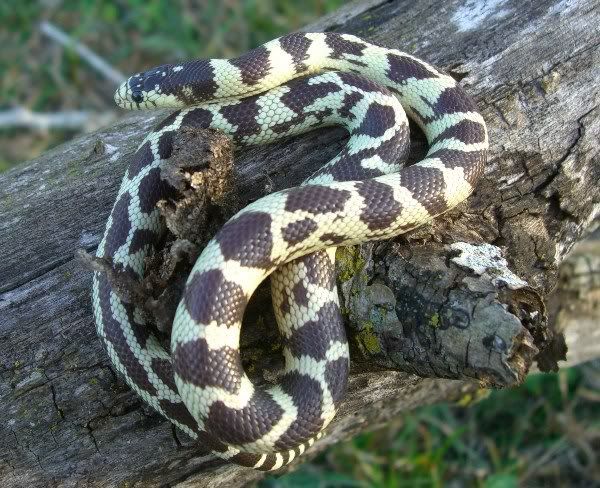
Here is some pics of my little guy Shine like Nanci said they are just wonderful snakes! I just love his personality.
Here he is when I first got him at 2mths old he looks creamy to me.

And here he is at 4mth old


Here is some pics of my little guy Shine like Nanci said they are just wonderful snakes! I just love his personality.
Here he is when I first got him at 2mths old he looks creamy to me.
And here he is at 4mth old
