• Hello!

    Either you have not registered on this site yet, or you are registered but have not logged in. In either case, you will not be able to use the full functionality of this site until you have registered, and then logged in after your registration has been approved.

    Registration is FREE, so please register so you can participate instead of remaining a lurker....

    Please be certain that the location field is correctly filled out when you register. All registrations that appear to be bogus will be rejected. Which means that if your location field does NOT match the actual location of your registration IP address, then your registration will be rejected.

    Sorry about the strictness of this requirement, but it is necessary to block spammers and scammers at the door as much as possible.

Is anybody good at spider ID?

ghosthousecorns

Well-known member
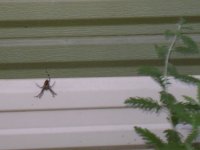
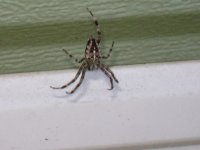
This gimpy 7 legged spider lives outside my house. I tried to google and find out what kind it is and my best guess is it's a garden orb weaver of some kind.
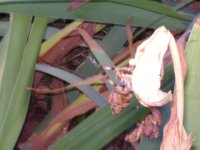
I like spiders. There is another one in my garden I wanted to photograph, but it is seldom in the middle of its web. It hides in a dried iris flower during the day and just keeps a couple of legs on the web to monitor it. I took a pic anyway -can you see it in the last pic?
 

Attachments

  • DSC04348.JPG
    DSC04348.JPG
    141.5 KB · Views: 37
  • DSC04356.JPG
    DSC04356.JPG
    142.2 KB · Views: 37
  • DSC04353.JPG
    DSC04353.JPG
    142.7 KB · Views: 37
That is really cool Jen. That is a Spotted Argiope. Or at least that is the only common name I have ever heard for it. Argiope argentata. The males of this species are very small, only ¼” long. The females can grow up to 1” in length. Females have whitish spots down the center of the cephalotorax and the 1st abdominal segment. Most of the abdomen black to brownish yellow.

Female rests with head down with forward four legs outstretched. In autumn female attaches a sac containing several thousand eggs to a leaf or branch. Spiderlings soon hatch and disperse around the area of the mother’s web. The female then emits a pheromone that attracts crickets and roaches, its favorite prey. As the insects begin to converge on the web the female quickly dispatches them with her venom, but leaves them for her offspring to consume.

This spider does not pose a threat to humans but is of particular concern for dogs and cat. Once bitten the venom travels to the nervous system of the animal and ultimately causes complete destruction of the lower spinal cord. First symptoms are a dragging of the hind legs.
 
That is really cool Jen. That is a Spotted Argiope. Or at least that is the only common name I have ever heard for it. Argiope argentata. The males of this species are very small, only ¼” long. The females can grow up to 1” in length. Females have whitish spots down the center of the cephalotorax and the 1st abdominal segment. Most of the abdomen black to brownish yellow.

Female rests with head down with forward four legs outstretched. In autumn female attaches a sac containing several thousand eggs to a leaf or branch. Spiderlings soon hatch and disperse around the area of the mother’s web. The female then emits a pheromone that attracts crickets and roaches, its favorite prey. As the insects begin to converge on the web the female quickly dispatches them with her venom, but leaves them for her offspring to consume.

This spider does not pose a threat to humans but is of particular concern for dogs and cat. Once bitten the venom travels to the nervous system of the animal and ultimately causes complete destruction of the lower spinal cord. First symptoms are a dragging of the hind legs.


Wade whats the range?..it looks like the baby spiders that I have seen here...


~~'manda
 
Cool. Thanks Wade! Glad someone knew what it is. I still want to try and get a pic of the other one, I think it's a different kind. I hope having just seven legs doesn't shorten her life span.
 
That is really cool Jen. That is a Spotted Argiope. Or at least that is the only common name I have ever heard for it. Argiope argentata. The males of this species are very small, only ¼” long. The females can grow up to 1” in length. Females have whitish spots down the center of the cephalotorax and the 1st abdominal segment. Most of the abdomen black to brownish yellow.

Female rests with head down with forward four legs outstretched. In autumn female attaches a sac containing several thousand eggs to a leaf or branch. Spiderlings soon hatch and disperse around the area of the mother’s web. The female then emits a pheromone that attracts crickets and roaches, its favorite prey. As the insects begin to converge on the web the female quickly dispatches them with her venom, but leaves them for her offspring to consume.

This spider does not pose a threat to humans but is of particular concern for dogs and cat. Once bitten the venom travels to the nervous system of the animal and ultimately causes complete destruction of the lower spinal cord. First symptoms are a dragging of the hind legs
.


I just made up the red part. I thought it needed a little spice.
 
ROFLOL!!! I was LOOKING for where the false part would begin! Having fallen for your little "tricksey" posts before, I was on the lookout. :) Too funny!
 
Back
Top