• Hello!

    Either you have not registered on this site yet, or you are registered but have not logged in. In either case, you will not be able to use the full functionality of this site until you have registered, and then logged in after your registration has been approved.

    Registration is FREE, so please register so you can participate instead of remaining a lurker....

    Please be certain that the location field is correctly filled out when you register. All registrations that appear to be bogus will be rejected. Which means that if your location field does NOT match the actual location of your registration IP address, then your registration will be rejected.

    Sorry about the strictness of this requirement, but it is necessary to block spammers and scammers at the door as much as possible.

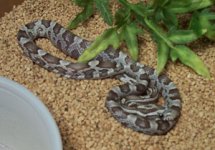
6 month old ghost?

Joje126

New member
This is my new baby ghost. Fittingly her name is Boo. My question is whether or not you think she could be 6 months old. The breeder said that she was born August 12, but it seems to me she should be a bit bigger by now if that were the case. (Shes about 9in long, but skinny)

Shes spunky, healthy, and isnt a fussy eater.

Any input?

:uhoh:
 

Attachments

  • boo.jpg
    boo.jpg
    32.4 KB · Views: 150
dont think

I have some corns that are 6 months and 24 inches long but I would say 18 inches would be about normal
 
Well, if the breeder kept her on a maintenance feeding schedule, then I think she could be 6 months old. It's not typical for one to be that small, but it is definitely possible.

I have some snakes that are rehabilitated non-feeders that are over 6 month olds. They aren't much bigger than that. They have only recently started to show quite a bit of growth even though they have been eating regularly for a couple of months or so.

By the way, how often were you told to feed her? And did you get feeding records from the breeder?
 
I was at a herp "show-and-tell" and this guy had 3 corn snakes at his table. They were small but looked too big to be that years hatchlings, so I asked if they were hatchlings.

I response I got was that they were 3 years old!

When I showed him my 3' two year old, he then accused me of power feeding. I was mighty put off because I do not power feed and it blatantly looked as if he was guilty of starving his snakes, as they couldn't have been over 15 inches long.

This goes to show that the length of a snake really does depend on how much you feed it. Your snake could definitely be 6 months old.
 
Feeding

Actually a friend of mine got her for me at a reptile show in New York from a breeder he knows. According to my friend, when he purchased her the breeder pulled out a stack of index cards, on which he had their entire feeding schedules for the last month. The breeder said she had always "eaten like a champ." But I dont know myself what kind of feeding schedule he had.

My older snake eats a f/t mouse once a week, but I was thinking about feeding her every four to five days because shes so small. Does this constitute power feeding? Could somebody explain to me what power feeding actually is (I have a general idea) and why its bad? The guy I got my first snake from thought that power feeding was a good thing, but hadnt actually done it to the snake I got.
 
It seems as if ost everyone on this site is against power feeding. It is simply a way of accelerating the snakes' growth rate so that they will be big enough to breed at an earlier age. Power feeding is simply feeding the snake larger meals and/or feeding more often than needed.

I don't know all of the side effects of power feeding, but I do know that breeding a snake at an early age can shorten it's lifespan. Power feeding can also lead to obesity which causes a lot of other problems. Hopefully someone else can add to this answer...

I typically feed my little snakes (if they are on pinkys) every 5 days. After I switch them to fuzzies, they only get fed once a week. My adults get fed every 7-14 days depending upon their needs.
 
Obesity

So how exactly do you know when your snake is obese?

My friend has an amel who is probably around the same age as my "normal" (we dont know for sure what his genetics are) but his snake isnt always fed on a regular schedule. Mine is bigger around than his, but still is very healthy. He has teased me about having a "fat" snake, but how do I really tell?

:confused:
 
In my opinion feeding your baby every 4-5 days is not power feeding. It will help speed up the growth of your little one. I have yet to see an overweight juvenile snake. They tend to grow as fast as you want to feed them. I don't think you should feed them any sooner then the 4-5 days, they need time to digest and poo.

As far as "power feeding" I can't seem to get a firm definition of what this means. It seems to mean different things to different people.:D I also can't seem to find any studies or scientific evidence to support the theories that abound.

Over feeding adult snakes can lead to obesity so you need to scale back once their growth slows down.

I have several adults that grew up on a 4-5 day feeding schedule and they are not over weight:)
 
Individual snakes can vary quite drastically. I have some snakes that hatched out big and grow like gang busters. I've got a few others that feed OK but are VERY small. One line is Miami/Candycane that the hatchlings are not much larger then average newly hatched snakes right now at nearly 7 months.

Try not to make comparisons too closely to the way other snakes develope. As I said, individuality will vary greatly. If the snake feeds well, try to set a schedule that fits the snake. I've got a range of feeders, some will eat whenever offered, some will only eat every two weeks.

Power feeding is only possible with snakes that feed all the time. It puts undue stress on the snake and usually just makes it obese. Fat snakes are not healthy snakes.

My .02
 
Re: Obesity

Joje126 said:
So how exactly do you know when your snake is obese?

My friend has an amel who is probably around the same age as my "normal" (we dont know for sure what his genetics are) but his snake isnt always fed on a regular schedule. Mine is bigger around than his, but still is very healthy. He has teased me about having a "fat" snake, but how do I really tell?

:confused:

An obese snake will have skin showing between the scales and also may not be able to coil up properly. Of course this would be at the extreme end. Some snakes get a bit chubby and need to be cut back. The feeding schedule that Terri mentioned works well for most Corn snakes. I'm sure you will find one that fits yours:D
 
This snake was thought to be gravid and left with me to help with the laying, incubation and hatching process.

She ended up just being FAT. She went back home and was put on a diet. I haven't seen her since.

joni1
 
i have a non 8 month old non feeder smaller than that...
another one of that age is just a little bit bigger
 
Clint...

Unfortunately, she looks a lot like the two of mine that I posted about recently. They both suddenly put on TONS of weight after last year's breeding season. I think part of it was because I didn't have as much time to get them out due to school and work so theie exercise levels decreased. I also think they hit that age where they simply needed less food. I, being new to owning snakes still, did not recognize this until they had both gained quite a bit of weight.

These are two of the ones who now get fed every 2 weeks, and they only get a weanling mouse. If they don't start taking some weight off, then I will space their feedings out even further.

Here are pictures of them...
This is Sizzlin. He weighs a little over 1000 grams and is about 5/12 feet long. He's the biggest of the two.
LRsizzlin-tree.jpg

Sizzlin-9-5-03b.jpg


This is Marshmallow. She weighs 864 grams and is about the same length as Sizzlin.
Marshmallow-tree2.jpg

marsh-grass.jpg


To be honest, I feel terrible about the fact that I let this happen. I am posting this because I want everyone to know that it doesn't take long for a snake to get fat. I also want to point out that what you think is a little bit of food, may in fact be WAY more than was needed. Both of these snakes were getting one small weanling rat every 7-10 days.

Needless to say, I monitor the feedings and weights of all of my snakes quite closely now. I stick to the feeding schedule I posted earlier in this thread, and none of my snakes get a meal that is larger than a rat pup or adult mouse. I refuse to let any more of them go through this...

 
Back
Top