Tula_Montage
It's Jager time!
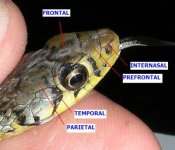
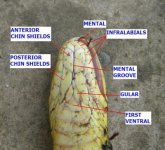
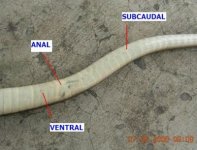
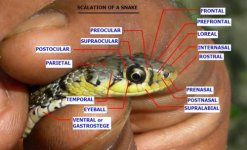
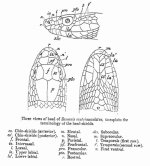
Whilst looking into "keeled scales" I came across these diagrams which I found rather fascinating. The snake in question is a Buff-striped Keelback Amphiesma stolata (a common grass-snake of South Asia).
Apparently the position/shape/size of these scales have actually been used to reclassify snake species and are commonly used to identify "mystery snakes" when it comes to bites from venomous snakes. For example, in relation to venomous snakes of Myanmar, the distribution of snakes permits the use of the presence or absence of loreal scales to distinguish between relatively harmless Colubrids and lethally venomous Elapids.
The rule of hand for this region is that the absence of a loreal scale between the nasal scale and pre-ocular scale indicates that the snake is an Elapid and hence lethal. All very fascinating if you ask me!
Ventral scales correspondant to the vertebrae can also be used to count the ribs without dissection.... Gee I didn't know scales could be so important to the science of snakes.
Apparently the position/shape/size of these scales have actually been used to reclassify snake species and are commonly used to identify "mystery snakes" when it comes to bites from venomous snakes. For example, in relation to venomous snakes of Myanmar, the distribution of snakes permits the use of the presence or absence of loreal scales to distinguish between relatively harmless Colubrids and lethally venomous Elapids.
The rule of hand for this region is that the absence of a loreal scale between the nasal scale and pre-ocular scale indicates that the snake is an Elapid and hence lethal. All very fascinating if you ask me!
Ventral scales correspondant to the vertebrae can also be used to count the ribs without dissection.... Gee I didn't know scales could be so important to the science of snakes.