• Hello!

    Either you have not registered on this site yet, or you are registered but have not logged in. In either case, you will not be able to use the full functionality of this site until you have registered, and then logged in after your registration has been approved.

    Registration is FREE, so please register so you can participate instead of remaining a lurker....

    Please be certain that the location field is correctly filled out when you register. All registrations that appear to be bogus will be rejected. Which means that if your location field does NOT match the actual location of your registration IP address, then your registration will be rejected.

    Sorry about the strictness of this requirement, but it is necessary to block spammers and scammers at the door as much as possible.

cremecicle??

boagrl1970

New member
Hello to all.....
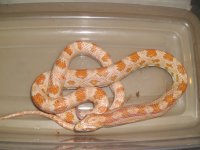
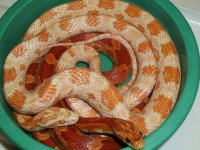
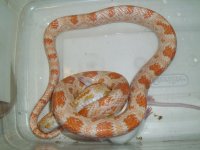
I have a corn that i don't know the genetics of, (rescue) amel, looks like he has okeetee in him, but looks like cremecicle, but other times he looks like a bubble gum because he turns a shade of pink, saddles, not background. I have tried to capture the pink phase but my camera won't capture the color. He's more white than most cremes i have seen. can any one help me try to figure out what he may be.:)
 

Attachments

  • 086.JPG
    086.JPG
    179.3 KB · Views: 119
  • 012.JPG
    012.JPG
    233.7 KB · Views: 119
  • 023.JPG
    023.JPG
    157.8 KB · Views: 119
Welcome to the forums!

Could be a creamsicle indeed, but some pure amel corns might look like that too. Impossible to be sure what he is. Do you know the genders of your snakes?

I feel I need to tell you that most American corn keepers are very much against co-habitating, e.g. keeping more then one corn in a viv. There are several reasons, which you can find on the forum if you search for 'co-habbing'. I'm pretty sure you will be strongely adviced to separate them quite soon and by multiple people, so I hope you won't feel too overwhelmed when that happens. Over here in Europe many people do keep multiple (mostly 2-3) (sub)adult corns together. When subadult both males and females are kept together by gender. When adult some males tend to fight other males, especially in breeding season so they are kept separately if they start making trouble.
 
I agree with what Barbara has said.

Your snake is, definitely, an Amel.
However, although it does look like it could be a Creamsicle, it could be pure Corn instead. There is no way to be certain without knowing its lineage (family history).
 
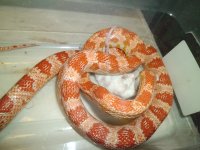
In response to snake around, yes, i know the gender of my snakes, the ones in the bowl are male, and I have a female whom i will be pairing up with very soon, here she is!!!
Plus in all my years of keeping corns, i have never had a problem with housing 2 or more males together.
 

Attachments

  • 040.JPG
    040.JPG
    194.2 KB · Views: 106
o_o Two or more?
I'm just gonna tap out of this thread after saying that I too kept two males together before I knew the dangers of cohabbing. They were always sitting together, the one would follow the other every where, and twitch anytime he smelled his scent.. I never knew that those behaviors were fighting behaviors and that my anery was so much smaller (after starting at the same size) because he was bullied by the other- despite the fact they were eating without issues..

But to answer the original inquiry, I would guess that it is a normal amel. They come in such a huge variety of colors. What was it sold to you as?
 
in response to alicat, all my corns are rescues and the genetics are unknown, I have 2 amels, 2 hypos and 1 hypo stripe, one of the hypos and the stripe are babies.
 
Good for the little anery!

Well, I'd say that cohabbing is something for people with some experience who do recognize 'bullying' and other stuff going on that indicates a particular snake or combination of snakes does not do well co-habbed. Of course if you have the space a spacious viv for each snake would be ideal but many do not have that. Many American breeders/keepers prefer tubs and racks to keep more snakes on the same floor space, many European counterparts prefer co-habbing in larger vivs.
 
Back
Top