• Hello!

    Either you have not registered on this site yet, or you are registered but have not logged in. In either case, you will not be able to use the full functionality of this site until you have registered, and then logged in after your registration has been approved.

    Registration is FREE, so please register so you can participate instead of remaining a lurker....

    Please be certain that the location field is correctly filled out when you register. All registrations that appear to be bogus will be rejected. Which means that if your location field does NOT match the actual location of your registration IP address, then your registration will be rejected.

    Sorry about the strictness of this requirement, but it is necessary to block spammers and scammers at the door as much as possible.

Genetics and Anery A's??

Drizzt80

Dakota Corns
I've become increasingly curious about the Anerythristic A snakes lately as it relates to their genetics. My moments of deep thought started as I began looking at more and more pics of ghost corns (Anery A and Hypomel). I've done searches on the forums for previous threads on the topic of Anery's, but everything is still muddy to say the least. (I don't intend to get a crystal clear picture, obviously, but would like to start some more discussion on the topic)

My quesitons/thoughts:
1. It's been stated by Rich and others that maybe Anery A isn't really a lack of red, but some other mechanism. What are the thoughts on what this mechanism might be?

2. I understand anerythrism to be lack of red genetically, and therefore would be a visual description of the animal as well. I guess I view brown as a dirty red. Is this accurate? Are there any art majors out there that can either confirm or deny this?

3. What has been the breeding experience of people with anery's? Does a perfect black (no brown tones) pairing of anery's create the same perfect black hatchlings, or does brown creep in. Or similarily, with a brown anery pairing, do all the hatchlings display the brown tones, or can/do black hatchlings creep in.

4. Ghost corns! A ghost corn is an anery hypomel. Which should mean reduced black anery. Where does the orangish/peach/brown color come from? I would view Rich's silver queens as what a true ghost corn should look like genetically.

5. Even though this genetic type has been proven out as a simple recessive trait, could there be another influence that creates the brown tones?

I end this initial discussion with the statement that I know corn genetics is not a black and white issue right now (will it ever be?!). Note the discussions on Bloodreds currently! I would just like to try and sort this one out a little bit. I may just have to settle with it's how it happens, who knows. I just can't get the idea out of my head recently that there is still a red color influence in with that brown.

D80
 
--black vs brown, etc--

Melanin produces black, red, brown, tan, and even blues. The entire spectrum of human skin tones and eye colors, for example, is a result of melanin. (Even my baby blue eyes.)

Melanin is simply a big chain of "Tyrosine" (an amino acid) which is put together with the help of the enzyme Tyrosinase. (Thus "T+ and "T-" albinos)

There are two main types, eumelanin and pheomelanin. Basically the "color" produced depends on the way the stuff is chained, on a molecular level.

Try a web search for those two terms, and also the "Tyndall effect," and you'll find some interesting reading. :)
 
1. It's been stated by Rich and others that maybe Anery A isn't really a lack of red, but some other mechanism. What are the thoughts on what this mechanism might be?
I dunno exactly what he said, and I won't put words in his mouth, but I do agree with the sentiment/feeling I had gotten from those comments. (I personally wouldn't say "not a lack of red" I would prefer the wording "a different way of getting rid of the red.")

My version, anyway, is that one is possibly a "pattern" trait, whereas the other is a "color" trait.

I should say though, that "color" traits versus "pattern" traits is more of a conceptual distinction, rather than an exact black and white issue. They're just different ways to understand "how they work" in our mind's eye.

It's interesting to note that anerys, snows, and ghosts will often have red freckles on them. I don't recall this same thing happening on anything expressing charcoal (but that also doesn't mean it doesn't happen.)

Also, compare Pewter to anery Bloodred, and Blizzard to Snow. Something simply isn't right. ;-)

It could very well be that one of the traits is not simply a "don't make any red" trait, but instead redirects all the red production into black production. Or, one that redirects the red to be replaced with melanin, and iridophores.
 
Thanks Serp, that does help a bit. I will search those other terms soon.
Have you had any indication from breeding trials showing a relationship between the blacks and browns? I know I have seen at least one pic of your anery that is the straight black.

D80
 
She was bred to three different males, two of them het anery, one of them her own son, and all the anery offspring have been "brown." :(
 
Just wanted to say Thanks ~~~~~~:~

I really enjoyed your site. It's amazing to see Cornflake's mom and dad, she has NO red in her at all. I am so intrigued by the genetics I could listen all day. Sam ~~~~~~~~~~:~
 
Also, compare Pewter to anery Bloodred, and Blizzard to Snow. Something simply isn't right. ;-)

That is a very interesting arguement. I hadn't thought of it in those terms. Could that be indicative of the order in which different colors "stack" with in a scale??
 
Serpwidgets I don't know whether to thank you or cuss you out! :)

After doing a search on those terms you gave me I found a ton of interesting information. Obviously you were right with your explanation of pheomelanin and eumelanin. What was interesting though is that eumlenanin is either black or brown, but never both at the same time. (Most of the pages I got refered to horses, goats, etc., but I would assume there is the same function here) Pheomelanin on the other hand is responsible for red to brown and yellows. I found that rather interesting, and started searching for erythrin as a color pigment. I confused myself here, as I could not find a reliable page that said anything more than that erythrin was a red pigment. No mechanisms, discussions etc. as can be found for melanin. (Do I dare ask you to lead me in the right direction here??!!)

So my conclusions so far:
1. Brown/Black is normal for the Anery A corns since eumelanin controls this. But, what is producing the grays in the background? I think I know, but am not certain.

2. What role does this pheomelanin play in the production of reds in the normal corn, and how does it relate to erythrin. Would/could this indicate that the Anerythristic snake is in fact mislabeled as has been suggested before. Could it possibly be Anpheomelanistic? (Even more of a mouthful I know, and I wouldn't even suggest any kind of name change, just need it for my own categorizing!)

I also found this interesting bit of info at one site which began my quest for info on erythrin. No mention of erythrin in these colors:

"If for a moment we leave the mammals and descend along the philogenetic scale we find very beautiful colours both for their variety and their tonality. It is interesting at least for the biologist and the taxonomist, to note that to all these colours and colourations correspond a number of pigments, that is to a limited number of chemical structures, as can be seen in the following table:

YELLOW (carotinoids, pterins, flavins, uranidines, zooxantines)
ORANGE (carotinoids, pterins, ommocromes)
RED (carotinoids, pterins, ommocromes, porphirins, naftoquinones, anthraquinone)
GREEN (schemochromes, bile pigments, carotenoproteins, clorocruorins, pheophorbides)
BLUE (schemochromes, bile pigments, carotenoproteins)
VIOLET (carotenoproteins, ommocromes, naphtoquinones)
RED-BROWN (pheomelanine, melanin, copolymers)
BROWN (pheomelanine, melanin, copolymers)
BLACK (melanin)
GREY (melanin, mixture of black and white)
WHITE (schemochromes, refraxtion and reflection of light)

The intensity of the colour of the skin depends mainly on the colour and the form of the granules of pigment, on their number and on the way in which they are distributed in the keratinocytes.

http://www.tightrope.it/nicolaus/link3.htm"

This website had a huge discussion on all the facets of melanin, and its roles in art, the lithosphere, space, and biology, among others.

Would the idea of Epistasis be in play here as was discussed at this horse color site? http://www.mhref.com/color/genetics/tour/basic5.html

D80
 
Lastly . . .

One last bit of information I found very interesting, was this site's information. I wonder if this is the function we are seeing in those snows/anerys/etc that are showing spots of red as they mature. Obviously this is a discussion of mice colors, but the description sounds identical to what is happening with these corns.

"Animals inherit genes from their parents. Mammals have a special gene that determines the presence of tyrosinase in cells. Geneticists call it the TYR gene. If an animal is born with an altered or damaged TYR gene instead of a normal or whole one, melanin cannot be reliably made. The animal will become an albino.
The TYR gene can be altered in many ways. More than 50 ways have been discovered in humans and 33 in mice. In all-white, light-eyed albino animals, the TYR gene does not work at all, producing no tyrosinase and no melanin pigmentation. In other albino variations, the TYR gene may cause tyrosinase "leaks" that cause small amounts of melanin to accumulate as the albino grows. These albinos will still have light eyes, but will show some color on their fur as they become older.
http://www.dnr.state.mn.us/young_naturalists/coloroncoloroff/index.html"

Once again Serp I would like to actually thank you for pointing me in the right direction to find this information. I would still like to continue this discussion as needed here with hearing your thoughts on what I've posted so far, and also with more leads to finding info on erythrin and xanthin and their mechanisms.

D80
 
I have precious little to add to the mix here. Serp is the bona fide genetics wizard around here, and I am but one of those who echo what little they know on the subject. :D

However, I do study Koine Greek, and the suggested term for what you all are discussing, "Anpheomelanistic" would not be quite accurate. In Greek, the prefix "An" is used to denote the negative of a word beginning with a vowel (ie: not erythristic = Anerythristic), and the prefix "A" is usually used in words beginning with consonants (ie: not melaninistic = Amelanistic).

So, I would suggest you new found designation be listed as "Apheomelanistic" instead. Just my lame little attempt at trying to contribute to a great discussion! ;)

Continue . . .
 
I'm still reeling from the huge post... wow, that's what it's like to other people when they read my giant essays. ;)

As far as Erythrin and Xanthin, I've run into the same problem. I've tried a lot of sources and the most "descriptive" ones just simply say "they're made from carotenoids." (ARRGH, and that's it? You guys suck! LOL)

I think you've definitely hit a major point when you mentioned "leaks" in the pigment production process. The same mechanism has been suggested as an explanation behind the new "paradox" albinos. IIRC, any of these are supposed to be T+ albinos. (IOW it's not the TYR gene causing albinism, if I'm understanding all of that correctly. But the question is, is "paradox" caused by the same mutant as our regular amels, or is this a new, but linked trait?)

The other thing I've wondered about, but never heard of yet, is "what if some other gene mutates and turns it into a functional TYR gene?" If this were to happen to the right gene (one that happens to be activated in melanin-producing cells), there would presumably be Tyrosinase again, and the result would be an "anti-albino" gene. ;)

Anyway... I'm straying from the Erythrin thing. Someone mentioned "layers," which is another thought a few of us have tossed around, but AFAIK nobody has come to any solid "conclusions" about how to figure it out...
 
Darin:
Thanks for catching that for me. I posted that mess of info quickly between jobs, and knew I would mess up something.

Serp:
Glad I was able to return the favor! ;) I've waded through several of your longer posts. Trying, as I'm sure you do, to put this stuff in some kind of recongnizable order. The Bloodred debate is very interesting. I haven't had enough variety of corns for long enough to really get in to some of your discussions, but I'm getting there!

I think most of this is bordering on needing scientific trials in the laboratory etc. Cuttin' up skins and checking for layers etc. Something I do not see myself getting into anytime soon. Anyone know any grad students needing a thesis project??! (genome project for corns?)

I'd really like to find out more about erythrin - even in discussions of other animals, but that doesn't seem likely if you haven't been able to find anything either.

Thanks again for the insight and discussion.
D80
 
Another thought

Still had stuff floating around in my brain!

With ghosts, I only have four myself, and three of them exhibit the peachy saddles that I see so often, and the other one is kinda brownish but young yet. (Not what I would expect from their genetic descriptioin of Anery/Hypo) Would/should/could this indicate the presence of the pheomelanin (red to yellow producer)? Does anyone have pics of proven ghosts that don't have the peachy saddles, or would that be Rich's Silver Queen ghosts?

D80
 
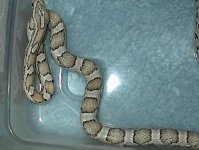
Here is Cornpuff, My Ghost~~~~~~:~

This is an 02 Ghost. When I look at her I don't see any peachy colors, just shades of browns and tans. Sam ~~~~~~~~:~
 

Attachments

  • dsc00003.jpg
    dsc00003.jpg
    93 KB · Views: 30
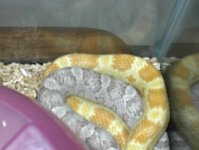
And My Silver Queen ~~~~~~~:~

Here is Beanie and Barbie, 01s A Butter and Silver Queen. Sam ~~~~~~~:~ Hey no head shots! They move pretty fast.:D
 

Attachments

  • dsc00009.jpg
    dsc00009.jpg
    92 KB · Views: 28
Back
Top