
ForkedTung
Serpent Mound Monk
Pretty cool lil guys!
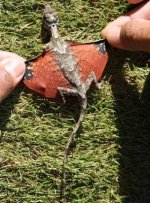
February 16, 2009 -- The creature in this photo may appear to be a miniature version of a mythical dragon, but this little guy is actually a gliding lizard.
Adult gliding lizards, which belong to the genus Draco and total more than 45 species, range in size from 7-15 centimeters (about 2.8-6 inches) in length and are native to Southeast Asia.
WATCH VIDEO: Fire ant attacks are forcing fence lizards to evolve to survive. James Williams takes a look at what's going on.
This particular specimen appears to be Draco beccarii, according to Jimmy A. McGuire, curator of Herpetology in the Museum of Vertebrate Zoology and associate professor in the Department of Integrative Biology, University of California, Berkeley. However, without seeing the dewlap (a fold of loose skin that hangs from the neck) of this specimen, McGuire couldn't be certain.
As expected, one of the primary functions of the lizards' wings, called "patagia," is to allow these creatures to glide. These lizards are arboreal, and their wings allow them to travel from tree to tree. If the lizards fall to the ground or are forced to get a move on, their wings allow them to make a quick getaway from other gliding lizards -- males are very territorial -- or potential predators.
"There are no data on Draco predation, but we assume the primary predators are arboreal snakes (including the flying snakes in the genus Chrysopelea) and birds such as raptors and kingfishers. Other, larger lizards like Varanus (monitor lizards) probably take them as well," McGuire wrote in an e-mail to Discovery News.
The wings not only allow the lizard to get around, but also are used to attract a mate. Males use their vibrantly colored wings and dewlap to gain the attention of a female.
Photo credit: Imgur.com