• Hello!

    Either you have not registered on this site yet, or you are registered but have not logged in. In either case, you will not be able to use the full functionality of this site until you have registered, and then logged in after your registration has been approved.

    Registration is FREE, so please register so you can participate instead of remaining a lurker....

    Please be certain that the location field is correctly filled out when you register. All registrations that appear to be bogus will be rejected. Which means that if your location field does NOT match the actual location of your registration IP address, then your registration will be rejected.

    Sorry about the strictness of this requirement, but it is necessary to block spammers and scammers at the door as much as possible.

Halo or super halo

mh542

New member
Hello everyone
Im new to this and am currently working with a halo ERO female n a RO green bloctch/ halo male n hope to have some amazing little ones. When i ran the generics it says that 50% would be halo and 50% chance of super halo. My real question is how would u tell the difference? Is there a difference or are they all just halo?
 
They are all "just" Halo, meaning they all visually exhibit the gene. The term "super" was borrowed from the Ball Python crowd and it refers to the homozygous form of a Dominant gene. The "super" Halo might exhibit more of the Halo gene's visual effects or it could have no effect at all visually. In corn snakes Red Factor in it's homozygous form enhances the the intensity of the red exhibited but a homozygous Tessera looks the same as it's heterozygous sibling. From what I have seen, Halo that are labelled Super/Homozygous tend to be better examples of the expression of the gene. It will be fun to see a whole clutch at one time and then trying to pick out which ones are "supers". It would be appreciated if you come back and share some photos with us.
 
Thank u that dose help me.
Im excited to start working with this gene. I have also have heard that some believe yellow could be the homozygous n the green heterozgyous. Im hoping to be able to work more with the green but this seams like its going to be difficult.
Ill definitely update with pics
 
Hello and merry Christmas

What r ur thoughts on bringing the rat genes i to corns. Im wanting to keep the corns , corns. There seams to be the rat genes in so many corns now. I know the scaleless, ultramel, n creamsicle r some. So many corns have one of these in their line. Is this frowned apond? I would assume it would be to a true corn snake breeder but i dont understand the reason why so many breeders have crossed the two.

The reason i came up with this question is because after looking for halo snakes that might not have been identified by their owners as halo. I came across an ultramel that showed to be halo but im not really looking to mix thr rat into my project now.

Then I was wondering if the halo would show up in the scaleless.
From what i can tell the halo is in the scale so im not sure if it could show on the skin. Just a few thoughts to get ur mind thinking
Thanks everyone
Hope to hear your thoughts

Micah
 
They are all "just" Halo, meaning they all visually exhibit the gene. The term "super" was borrowed from the Ball Python crowd and it refers to the homozygous form of a Dominant gene. The "super" Halo might exhibit more of the Halo gene's visual effects or it could have no effect at all visually. In corn snakes Red Factor in it's homozygous form enhances the the intensity of the red exhibited but a homozygous Tessera looks the same as it's heterozygous sibling. From what I have seen, Halo that are labelled Super/Homozygous tend to be better examples of the expression of the gene. It will be fun to see a whole clutch at one time and then trying to pick out which ones are "supers". It would be appreciated if you come back and share some photos with us.
I've paired GB to Halo and Halo to Halo several times and that's not quite correct. There is a definite difference between Halo (1 copy) and Green Blotch (aka Super Halo; 2 copies). It is not always easy to see when combined with Tessera, and is nearly impossible to see if melanin is involved, but in normally patterned Snow, Halo (i.e., 1 copy) just colors the blotch borders green/yellow. In a Green Blotch (2 copies) the entire dorsal blotch/saddle and its border are green/yellow. Of course, the green/yellow colors don't show up in some individuals for as long as 18-24 months, so it can be a fun waiting game to see what you have.
 
I would love to pick ur brain a little
Im pairing a halo ERO with a green blotch ERO male. Im hoping to keep expanding the saddle border in hopes of a getting a nearly complete green blotch.
My male has green blotch on belly, all saddle borders n along his side there are green blotches that i will call side saddles that have no orange in them like the dorsal saddle. This goes into the belly scales almost giving a low pie side.
I was under the impression that halo yellow was one gene and green was 2 but if i understand u correctly this can be halo or super halo in either color. Is that correct?

Could i ask the outcome of your halo/halo pairing? Were they all halos?
Have u ever paired 2 green blotch together?
Im super excited to be getting back into corn after about a 15 year break.
So much has changed.
Thanks
 
Apologies for the slow response... busy time of year :).

In my experience, there seem to be at least 2 "flavors" of Halo/GB, a key lime green one and a more subtle yellow one. This may just be natural variation. IDK. From what I've seen, both "flavors" of Halo (1 copy) and GB (2 copies) tend to have yellow/green colored dorsal blotch borders, lateral blotches, and belly checks. The difference is that while Halo only colors the dorsal blotch borders in an Amel or Snow (where they can be seen), GB colors the border and the center of the dorsal saddle/blotch. However, there are definitely examples of GB in my collection that have "frosting" in the center of the dorsal blotches. Of course there are also GB with no frosting that have completely solid yellow/green dorsal blotches. So you should not have to line breed to get individuals with solid green blotches, just make pairings that will produce GB without frosting. Also perhaps worth noting, as it can be confusing IMO... I have an Extreme Okeetee Coral Halo Snow that has such thick borders that it was difficult to tell at first, whether he was a Halo with crazy thick borders or a GB with some frosting (took a couple test breedings). Happy to try to answer questions if you have any :).
 
Sounds like its a little more difficult then just looking to see what it is.
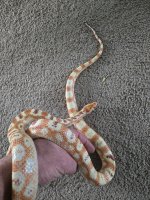
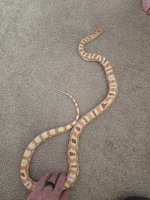
My female n was calling halo but sounds as if she could be a green blotch with frosting or a thick border halo. I purchased her as nothing but a ERO.
Here is a few pictures of her.
 

Attachments

  • 20251231_144837.jpg
    20251231_144837.jpg
    2.9 MB · Views: 5
  • 20251231_144935.jpg
    20251231_144935.jpg
    2.5 MB · Views: 5
Back
Top