• Hello!

    Either you have not registered on this site yet, or you are registered but have not logged in. In either case, you will not be able to use the full functionality of this site until you have registered, and then logged in after your registration has been approved.

    Registration is FREE, so please register so you can participate instead of remaining a lurker....

    Please be certain that the location field is correctly filled out when you register. All registrations that appear to be bogus will be rejected. Which means that if your location field does NOT match the actual location of your registration IP address, then your registration will be rejected.

    Sorry about the strictness of this requirement, but it is necessary to block spammers and scammers at the door as much as possible.

Heating Idea/Need Input

Drizzt80

Dakota Corns
I'm planning another keeper hatchling rack, and in lieu of using flexwatt I'm considering using heat tape (rope) that you use on water pipes. I'm looking for input on whether it will work/if anyone does use it currently/or how the wattage compares to the heat rope you can get specifically for herps. I have racks with belly heat using flexwatt and back heat using flexwatt and am really satisfied with both, but would like to find something 'safer'? and/or more ecomonical and/or easier to install/use.

It comes in sizes from 6' to 30' in various increments, and the wattage is 2 watts per foot.

I know 3" flexwatt is 6 watts per foot and 11" is 20 watts per foot.
Here's what I found on ZooMeds herp specific heat rope:
15wt 11' Heat Rope (1.36 watts per foot)
25wt 14' Heat Rope (1.78 watts per foot)
50wt 23' Heat Rope (2.17 watts per foot)
After finding this, the most important question I may have is if anyone is currently using it in their racks and how they like it?

Input/Ideas?
D80
 
I can't tell you if it is better than flexwatt because I can't compare. Some years ago I used it in my rack and it was great. Now I just finished a new rack and I used a 80 feets long heat rope. It work well for me. The only thing that is long to make is to do a groove in all your shelves, to put the rope in. Besides that, it is great. And it is cheaper than flewatt.

Good luck.
 
I have had several customers come to me to buy flexwatt after buying and installing zoo-meds rope and it not working correctly.. I would post around some different fourms to see if you can find more info on it... The cable will provide only a small hot spot and not travel well in the rack if your using wood.. Just my exp....
 
I'm not looking at using the zoomed brand, but the type from the hardware store for water pipes. Also, while I am installing it in wood racks, I plan to place aluminum tape over it as well. Thanks for the suggestions, any other input based on using the tape?

D80
 
I used the old style heat tape bought at a plumbing supply store for years and it works just fine but you may find it more expensive today than the flexwatt. It has gotten more pricey over the years and I found the flexwatt to be more economical both in price and the amount of power it uses. It may not be much, but the flexwatt seems to use less electricity overall than the heat tape, at least my electric bill went down a few dollars a month after my switch over. In addition, you are restricted to the lengths you can buy with the new heat tape and it is more difficult to cut to lengths you need and maybe to shape to your set up than is the flexwatt. Also, I don't think the new type of heat tape available today has been reliably tested for use in rack style setups.

I know Kathy Love uses some type of heat tape in her racks. It might be worth it to send her an e-mail and ask her what she uses. I find her to be very open and accesible so she should reply to your enquiry.
 
I used to use the old heat rope made for water pipes.

I still have some in some of the old racks. There was no such thing as flexwatt when we installed it, lol! You have to cut out the thermostat (if the new stuff is the same as the old kind) because it only warmed the pipes enough to keep from freezing. Then you had to attach it to some kind of thermostat or control - we just used fan controls with low, med, and high "speeds" to control the heat. There were times when it melted a little of the bottom of the shoeboxes, but never enough to melt a hole, just enough to deform it a little. We covered the rope with some aluminum L shaped hardware strips (I forget what you call it) after a visit from Bob Applegate, who was a fireman at the time. He suggested it for safety, although we never had any problems other than a few deformed boxes.

We bought all of the heat rope back in the mid '80s, and much of it still works today. I can't tell you how much electricity it uses - it may be listed on the new product.
 
I use plumber’s heat rope in three of my hatchling racks with great results. The wood is grooved to allow the rope to “snake” through the rack. Just add a rheostat and you are set. Let me know if you want pictures.
 
Well it's 'too late now', I'm in deep as I bought all the supplies to make my new rack.

As for expense, a 24' heat 'rope' was $20.98 to fit the rack I'm building. This will allow me to 'snake' through the shelves supplying belly heat to 3 6.5 Qt. containers on 8 shelves. Flexwatt at $2.25 (Bean Farm) for 24' = $52 . . . unless my math is off. :)

Kathy, thanks for the input, I hadn't even thought about inline thermostats, so will have address that as I begin to work on my rack.

Khaman, I would love to see pictures of how the rope is set up. I am routering a groove to lay the rope in, and planning to cover it with aluminum tape.

Thanks for the input so far.
D80
 
Kathy, thanks for the input! -- I thought you might be around on the forum somewhere. In Canada we referred to the old plumbers 'heat rope" as either heat rope or heat tape, the terms have always been sort of interchangeable. And I agree, they are troublesome to set up and manipulate. Do you use any of the flexwatt for your newer racks? I only have one rack now and find the fexwatt much simpler to set up, assemble and use than the oldtimer stuff. And, if you do use the flexwatt, where do you put the sensors for the thermostat? I'm only using one thermostat for a rack with 8 containers and I put mine inside the bottom of the top container because I figure with heat rising it would probably get the warmest.

P.S. I've set up an experimental outline to test the Sevin powder on a test population of 50 wild caught Garter snakes and 24 wild caught Alligator Lizards from the populations found behind my property. I've already started the captures and expect to begin the trial in about another month when the temps are a little higher in my greenhouse (where they are isolated away from my other herps -- not wanting to get mites on my babies and such). This gives the animals time to acclimate to capture and reduce their stress and increase the mite populations on each individual before treatment. For each individual in the trial I'm recording sex, weight, length, girth, approximate age, description of health, alertness and physical responces during an initial examination, a count of the number of visible mites before treatment and immediately after treatment, counts of visible mites at 3, 6 and 10 days following treatment, and additional health, and physical responce notes after each of the visual examinations following the treatment. If you or Dr. Hurley can think of anything else I should record or note that might provide some significant information for the trial, please let me know.

Gary S.
 
I have used Flexwatt, but now am just heating or cooling the whole room. Although I would prefer to use a heat tape of one type or another, it just got too expensive to do it that way. I may cut back on numbers of corns that I keep, and then be able to go back to housing them with heat tape. Don't ask how we set it up - Bill is the carpenter, electrician, and general handyman!

That is great that you will set up an actual experiment. Will you house them in individual cages as we usually do with corns? Will your greenhouse be set up to be able to contain the mites as well as in a typical reptile room? When we had our greenhouse going, we used a lot of screen enclosures, and once mites got in, it was REALLY difficult to eradicate them, much more so than in a cage in a building.

If the animals fare well, maybe you can expand the experiment to include some corns, rats, or kings, so it will be even more related to what most of us do. Be sure to post the results.
 
All the animals will be in their own enclosure -- I'm using the plastic, lockable shoe boxes and sweater boxes from Walmart (they're really cheap). The greenhouse is kept at a constant temperature of 85 degrees and I can't afford to set them up in a typical reptile room environment, but I am going to approximate it and I've decided to change only portions of the substrate at a time (the soiled parts) to allow the mite population to increase in numbers slightly before the treatments. I'm also going to take a sample from the total population of snakes and count the number of mites on them when I catch them to get an indication of the increase of mite populations over time. Of the 14 Garters I have already I have checked 6 of them and they all are host to mites (numbers range from 1 to 5).

The greenhouse is used for plants only so I'm not too worried about mites in that environment, however, I will probably treat the greenhouse after the trial is finished just to reduce the chance of an indirect contamination into the house where I keep all of my herps.

I think the results from this trial will probably satisfy me, however, there is always the chance to test it in the breeding community under controled circumstances. There are a number of breeders around here and I've already been networking with some of them the last couple of years. We'll just have to see.
 
Well, to get back on track, I completed the rack end of this past week (after a broken router and dead cordless drill). Started her up and let her run for 48 hours before transfering anybody over, and was pleased with the results so far. Granted room temp right now is low 70's, but temps were held consistently at 88 degrees even overnight when temps dropped to low 60's in the room. I've got a thermostat on it now to keep the temp down to 82, but am glad to know that if the thermo sticks, it 'shouldn't' get warmer than 88.

So, far I'm satisified, but I'll be putting in a GFCI plug ala Ddospots example of a dimmer switch for extra precaution.

Thanks for those who provided their input and helped me make my decision.
D80

zcagehatchrackNEW.jpg
 
Last edited:
Well, yesterday we had to dig out some of the very old (bought back in the mid '80s!) heat tapes that are made for wrapping around water pipes to avoid freezing. I decided to get some ball pythons and they definitely need some extra heat. I hadn't looked at these 6 pieces of tape for years, but when we plugged them in, they worked just as well as they did 15 years ago! Guess they are pretty well made.
 
Hey Drizzt80,

I see your digital thermometer on top and it looks like it's reading from the container on the bottom shelf only? Do you read from that one and assume the others are around the same temps or are there things behind the scenes that I can't see.

Do your containers have tops or do you use the above shelves as the lid?

Nice job on the rack system!!
 
Looks like an indoor/outdoor model in which case the remote reads the bottom and the unit reads the top of the rack so you have a good guess what the temps are in-between
 
dwyn,
It's actually on the fourth shelf from the bottom of 8 shelves. I usually put my thermometer in a container on one of the center shelves. I used to have one in the top and one in the bottom, and one in between, but man, what overkill was that!? Especially with 6 different racks (6x3x$9=$162 just for digital thermometers!) and don't forgot the glass vivs I keep too!

Now I read the middle one, keep that one around 80-81. Top shelves get a bit warmer and bottom shelves are a bit cooler. I also have the thermostat probe (A-Life 500 Watt) on the 3rd from the top shelf (it's on the same shelf as the temp probe in the pic) set at 79. It's keeping the measured shelf at 82 right now. I'm not concerned.

In my adult/breeder racks, I keep the males in the bottom two shelves (of 6), and the females in the top shelves. I remember reading a thread somewhere (I think started by Rich or at least added to by him) questioning the fertility of males based on temperatures.

I don't use lids, the shelf above is the lid. Personally I just view that lid as an extra item that has to be moved/removed each and every time a cage is opened for routine maintenance or just checking in on everyone. I do my best to be efficient.
 
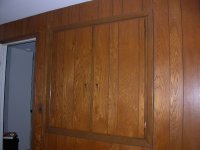
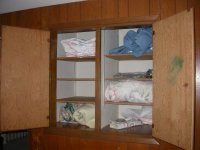
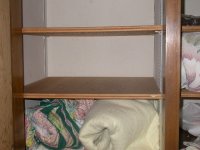
Thanx! I moved into a new house last summer and in one room there's a wall unit that I'd swear, was designed by a breeder and I'm shopping for ideas, as well, to start a couple projects next spring. Most units I've seen have a ventilated peg board on back like yours does. You can see in my pics, it's a closed in unit although it goes to the full height of the ceiling. I'd also be lowering and using only the bottom 2 shelves. Do you think, from a heat stand point that it would be an adequate set up or would it be too hard to regulate the heat with no ventilation from the back or sides? I would be removing the doors, by the way.
 

Attachments

  • DSCN1266.JPG
    DSCN1266.JPG
    99.5 KB · Views: 30
  • DSCN1269.JPG
    DSCN1269.JPG
    108.4 KB · Views: 30
  • DSCN1272.JPG
    DSCN1272.JPG
    106.4 KB · Views: 30
Back
Top