
-
Hello!
Either you have not registered on this site yet, or you are registered but have not logged in. In either case, you will not be able to use the full functionality of this site until you have registered, and then logged in after your registration has been approved.
Registration is FREE, so please register so you can participate instead of remaining a lurker....
Please be certain that the location field is correctly filled out when you register. All registrations that appear to be bogus will be rejected. Which means that if your location field does NOT match the actual location of your registration IP address, then your registration will be rejected.
Sorry about the strictness of this requirement, but it is necessary to block spammers and scammers at the door as much as possible.
You are using an out of date browser. It may not display this or other websites correctly.
You should upgrade or use an alternative browser.
You should upgrade or use an alternative browser.
How common in the wild?
- Thread starter Guruofchem
- Start date


Guruofchem
New member
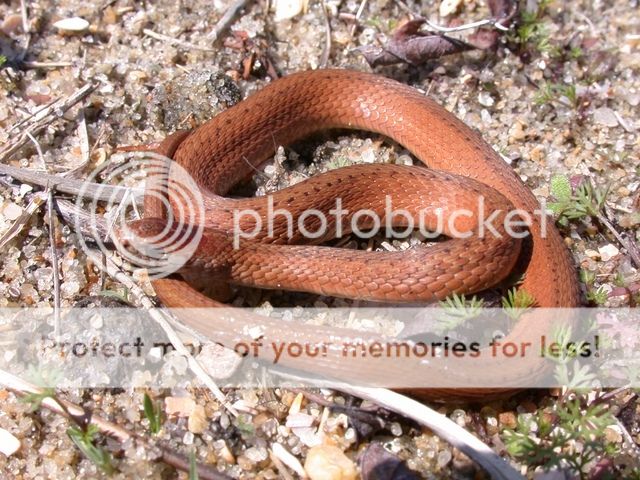
Found this pic of a Dekay's that's pretty red. Patterning is still weird, but I think it's more likely to be a Dekay's than a really aberrant garter. The head just wasn't that of a garter snake, and its disposition was really sweet...


dave partington
Crazy Dave
Storeria occipitomaculata ? (Dekay's Relation)
http://www.herpsoftexas.org/content/red-bellied-brownsnake
google images, and the natural range, and coloration of localities, are all over the place.
The range map looks like close to Houston (Cypress, OP's Location)
http://www.herpsoftexas.org/content/red-bellied-brownsnake
google images, and the natural range, and coloration of localities, are all over the place.
The range map looks like close to Houston (Cypress, OP's Location)
Guruofchem
New member
Storeria occipitomaculata ? (Dekay's Relation)
http://www.herpsoftexas.org/content/red-bellied-brownsnake
google images, and the natural range, and coloration of localities, are all over the place.
The range map looks like close to Houston (Cypress, OP's Location)
Their range is a couple of counties east of where we found it, but close enough to be at least possible. I have the 2013 release of Dixon's book at home - he may have expanded its range since the prior edition. Biggest problem I have is the lack of a red belly; some do not have it, and this little dude definitely did not. The reddish brown coloration is a better match than the Dekay's, though. Think we can say pretty certainly it's Storeria, but without finding him again we may never be able to settle the species.
dave partington
Crazy Dave
One of the things I've noticed (here, Volusia County, FL) is that a lot of the retail nurseries buy in plants from several different, mostly South Florida wholesale nurseries. And in those potted palms and b&b mature palm trees, come all sorts of reptiles, everything from iguanas and geckos to corn and everglades ratsnakes. There's even a Caribbean island (can't recall which one) where cornsnake eggs came onto their island in potted plants, and even though fumigated, hatched and established themselves.
It's a Brown Snake. Their color and pattern can vary.
This link shows some of their variability:
http://www.texassnakes.net/TexasBrown.htm
I don't think Corn Snakes live in Texas and I don't think there has ever been a striped Corn Snake found in the wild.
This link shows some of their variability:
http://www.texassnakes.net/TexasBrown.htm
I don't think Corn Snakes live in Texas and I don't think there has ever been a striped Corn Snake found in the wild.
Guruofchem
New member
Corns are pretty common in southeastern Texas (they seem to like our piney woods), which was why corn snake was my first guess. The one we found was so red it didn't seem to fit the brown snake description, but I feel pretty certain after all the good ideas voiced in the thread that it was a Storeria of some species, whether dekayi or occipitomaculata. Definitely a cute little snake, whatever the species...

michieldewit
New member
Still looks like some kind of garter snake to me. I have had both garter and brown snakes as pets before, and this is not a brown snake. closest you might get is a crossbreed between a brown snake and a garter if that is even possible.
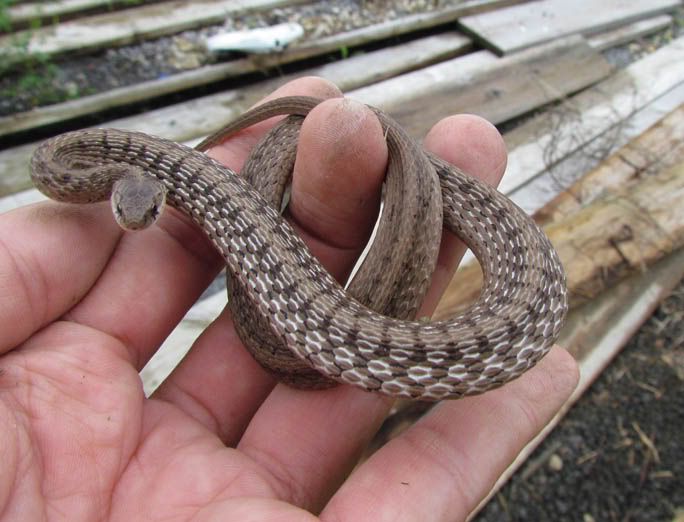
It's really clear in the first picture that your snake has checkers on the side. brown snakes don't have those as you can see in the picture tspuckler showed. here is a picture of my garter snake. it is just a common eastern garter snake, they don't really describe them to have checkers but all eastern garters have some checkers in them. some more visual then others.

Also here is a good link to a lot of garter snake morphs, not sure if any of them are like yours but just like corn snakes they have a lot of different paint jobs. And there is probably even less known about garter snakes then corn snakes.
http://snakesnmoresnakes.blogspot.ca/2008/10/garter-snake-morphs-and-species-photos.html
hope this helps
It's really clear in the first picture that your snake has checkers on the side. brown snakes don't have those as you can see in the picture tspuckler showed. here is a picture of my garter snake. it is just a common eastern garter snake, they don't really describe them to have checkers but all eastern garters have some checkers in them. some more visual then others.
Also here is a good link to a lot of garter snake morphs, not sure if any of them are like yours but just like corn snakes they have a lot of different paint jobs. And there is probably even less known about garter snakes then corn snakes.
http://snakesnmoresnakes.blogspot.ca/2008/10/garter-snake-morphs-and-species-photos.html
hope this helps
michieldewit
New member
Ok, I think I'm leaning more towards brown snake now....have been looking a lot at pictures and I did find a few with light checkers on their body. so....having said that, it looks like you have a pretty young brown snake their. which might explain the more reddish color. but i'm not sure if that would make a difference.
Guruofchem
New member
Ok, I think I'm leaning more towards brown snake now....have been looking a lot at pictures and I did find a few with light checkers on their body. so....having said that, it looks like you have a pretty young brown snake their. which might explain the more reddish color. but i'm not sure if that would make a difference.
Pretty close to full grown, I suspect - it was a good 10 inches long, and most browns don't go much more than a foot. Pretty little snake, and it was probably eating slugs from our landscape plants.
michieldewit
New member
they do eat slugs yes, but they get much bigger then 10"
http://www.ontarionature.org/protect/species/reptiles_and_amphibians/dekays_brownsnake.php
I find them all the time around here and decided to take one inside for a day this summer to show my kids, it decided to give birth right that day and leave me with 17 babies. all at about 3,5" (put her and the babies back where I found her).
The Dekay’s brownsnake is relatively small and grows to just over 50 centimetres in length.
http://www.ontarionature.org/protect/species/reptiles_and_amphibians/dekays_brownsnake.php
I find them all the time around here and decided to take one inside for a day this summer to show my kids, it decided to give birth right that day and leave me with 17 babies. all at about 3,5" (put her and the babies back where I found her).
I am just about certain it thamnophis. The clear, distinct dorsal stripe is, well, distinct, and the checkering pattern just below it along the sides is typical as well (see the wandering garter (t. elegans vagrans) the plains garter (t. radix), and of course the checkered garter!). Parietalis are found in texas -- the red sided garter (pics below). It doesn't have to be parietalis just because it is red, though; 'flames' is a common garter morph among easterns (sirtalis), and could hence show up among the texas subspecies as well.


I own a pair of parietalis myself... great little snakes! But not the only match, which is why I'd still consider it a possibility that it is a 'flames' or other such morph of a texas eastern... in which case it should have been a keeper!
I own a pair of parietalis myself... great little snakes! But not the only match, which is why I'd still consider it a possibility that it is a 'flames' or other such morph of a texas eastern... in which case it should have been a keeper!
Guruofchem
New member
they do eat slugs yes, but they get much bigger then 10"
http://www.ontarionature.org/protect/species/reptiles_and_amphibians/dekays_brownsnake.php
I find them all the time around here and decided to take one inside for a day this summer to show my kids, it decided to give birth right that day and leave me with 17 babies. all at about 3,5" (put her and the babies back where I found her).
All the references I've read (including Peterson's and Dixon's 2013 Texas tome) put normal adult size at 10-12 inches, with record sizes at 19 inches.
Guruofchem
New member
I've got it solved - it was Storeria dekayi limnetes, the marsh brown snake. Found some pics of this subspecies in one of my books, and they match very well - head is right, the color ranges to rusty shades more than brown, the lines match, and the light checkering does too. Even the range matches...
michieldewit
New member
awesome, I knew they had some subspecies, but didn't know much about them.
glad you figured it out
glad you figured it out
anerythristic/okeete
Future snake breeder
wow that is cool