• Hello!

    Either you have not registered on this site yet, or you are registered but have not logged in. In either case, you will not be able to use the full functionality of this site until you have registered, and then logged in after your registration has been approved.

    Registration is FREE, so please register so you can participate instead of remaining a lurker....

    Please be certain that the location field is correctly filled out when you register. All registrations that appear to be bogus will be rejected. Which means that if your location field does NOT match the actual location of your registration IP address, then your registration will be rejected.

    Sorry about the strictness of this requirement, but it is necessary to block spammers and scammers at the door as much as possible.

I think I have some keepers...

tyflier

[Insert Witty Commentary]
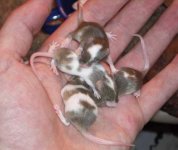
These four female fuzzies sure are cute. I'm considering holding them back to pair with a male from my other colony (unrelated colonies).

My question is in regards to the spotted mouse breeds. I heard something about a liver disorder and premature deaths, but I don't remember what it was. Does anybody have information on the correlation between the different types of spotted mice and various diseases?

I don't really have much to go on as far keywords to search. I'm pretty vague on details... :rolleyes:

Anyhjow, they are cute, and I will probably let my daughter have one as a pet, anyhow...

Here's the girls in all their fuzzy glory...
 

Attachments

  • keeper_females_5_07.jpg
    keeper_females_5_07.jpg
    63.5 KB · Views: 74
Spotted mouse disorders are detailed here... but basically:

Your animals are probably "piebald" - recessive spotting gene s. This can be associated with megacolon (disorders of the large intestine) but is not always. Basically, if you get a line where the offspring grow up to fuzzy size but then seem to fail to thrive and die, you've got the megacolon effects of reduced pigmentation. About 10% of spotted animals, from what I've read on the site linked above and other places, tend to wind up affected.

Granted, I started off saying "no spotted mice" in my group. Right up until we had a buck born with markings that are the spitting image of my tuxedo cat Jonesy - black with white paws, white blaze, white belly, even the little 'flour' spot on the back of the neck. I kept him - and now I have one cage of spotteds and one cage where the buck is a spotted descendant of Jonesymouse's. However, I'm planning to get rid of Patch, the other spotted buck - he's a nasty son of a sausage - and descendants of Jonesymouse are not seeded into my other two colonies.
 
:-offtopic Ssthisto, I'd never thought I'd say this, but I'd never be able to feed a blue mouse like that to any of my snakes, not even Lil!
 
diamondlil said:
:-offtopic Ssthisto, I'd never thought I'd say this, but I'd never be able to feed a blue mouse like that to any of my snakes, not even Lil!

What, one like this:

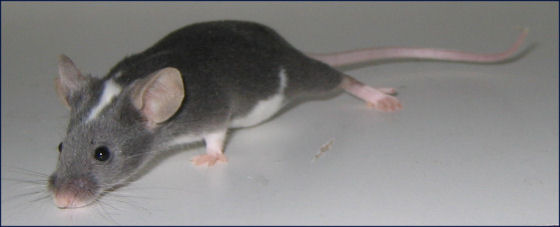
cloud.jpg


This is Cloud, one of my breeder females. She's probably got the recessive spotting gene (which is why she gets the "tuxedo" patterning). We've not had any obvious 'fail to thrive' babies yet - but then, a lot of my snakes are still eating fuzzies and fluffs, and I might be subconsciously selecting "you look a little slower, you're not staying" without intending to.
 
well................maybe I could! It was harder to cull after I switched from pew to coloured mice, because they just look so much nicer! I actually meant the blue on the site you linked to, it looked just like a great dane's blue merle pattern!
 
You'll have to excuse me being girly for a minute:

AWWWWW!!! They're so cute!

And now that's out of my system, I would say to keep them, but closely monitor their weights. If they look like they're not measuring up to other mice of their age (as far as weight and energy goes), then I probably wouldn't breed them.
 
Back
Top