
• Hello!

    Either you have not registered on this site yet, or you are registered but have not logged in. In either case, you will not be able to use the full functionality of this site until you have registered, and then logged in after your registration has been approved.

    Registration is FREE, so please register so you can participate instead of remaining a lurker....

    Please be certain that the location field is correctly filled out when you register. All registrations that appear to be bogus will be rejected. Which means that if your location field does NOT match the actual location of your registration IP address, then your registration will be rejected.

    Sorry about the strictness of this requirement, but it is necessary to block spammers and scammers at the door as much as possible.

Lavender/'A' Anerythristics.....

Rich Z

Administrator
Staff member
Administrator
Insiders Club
Here's another puzzler.

Last year I hatched out a couple of clutches of babies that I thought were the result of breeding 'A' Anerythristic to 'A' Anerythristic. Of course, these Anerythristics came out of my Lavender stock and I thought perhaps it would be interesting to see if they were both het for Lavender. I have a couple of animals that look like they are probably homozygous for both Lavender and 'A' Anerythrism, based on the coloration that showed up at maturity.

But when the eggs began hatching in those clutches, I got a couple of regular Lavenders in each clutch along with the rest being Anerythristics, so I assumed I screwed up somewhere with my record keeping.

So this year I bred several pairs of these again and paid STRICT attention to what was going on. And again, this is the results I have gotten:
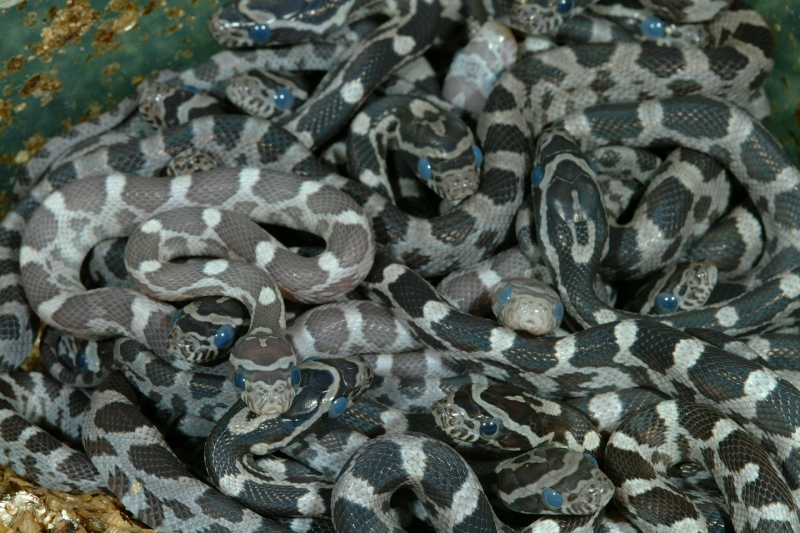
lavanery51.jpg


OK, so maybe I'm jumping to a conclusion, but it sure as heck looks like I have some pretty firm evidence that the Lavender gene takes precedence over 'A' Anerythrism when both are expressed in the same animal. Both parents of the Lavenders in the photo are definitely Anerythristics, no two ways about it.

This is certainly not what I would have predicted would happen. I felt a slight modification of the coloration of the Anerythristic might have resulted, but certainly not this.........
 
I dont understand what the problem is. I am not a genetics wiz, but they all look beautiful to me!! If ya dont like them stick them in my shipment :)
 
Neat... so, once you have proven it and are sure, will you still think that it is worth it to continue producing them? If they just look like a lavender anyways? Then again, that picture that widgets posted a while back....looked like a new caramel form.
 
So what your saying Rich is you beleive that at least some of the lavenders produced from these clutches are also homozygous for Anery A but the Lavender is washing it out?

Any photo's of some of the double homozygous hatchlings from this project last year?
 
You'll probably have it figured out by then, but.....

I had a bunch of anery 'A' babies hatch from my Lav male X Snow. I'll be keeping a few back to do the same cross you've done.

I wonder if Lav would react the same way with Charcoal. It's been my experience that when Charcoal and anery 'A' express themselves together in an amel you get a Blizzard. Showing me that Charcoal overpowers 'A' at least in amels. But then again, most of those Blizzards show more patterning then the ones from a Charcoal female that throws some patternless ones. (here I go thinking out loud again!)
 
Rich, when you say that you got anerys from your lavender line, did you get anerys from lav to lav crosses? Or did you only get anerys from, say, lav to het lav crosses?

If you answered no to the first question and yes to the second, here's a theory, also based on Clint's lav to snow cross: the lavender gene is another allele of the anery gene, but one who is recessive to the regular anery. So Clint's anery babies from the lav x snow cross would have one anery and one lav gene in that locus, manifesting only the regular anery. And thus a lavender animal would have both genes lavender and no regular anery gene.

But if you answered yes to the first question, then, Nevermind!!!
 
No, I have never gotten Anerythristics in a Lavender to Lavender breeding. Of course, with the evidence I have seen, it is entirely possible that some of the Lavenders could be homozygous for Anerythrism as well as Lavender, it's just the Anerythrism isn't visible.
 
so let me ask you this Rich. I bred a hypo lavender male to my snow stripe female and needless to say,all the babies are normal looking het for Lavender, stripe, anery type a, amel, and Hypo. Here is my question........
if anything ends up being lavender striped or anery striped, will the lavender always override the anery when they are homo for both? I mean if an anery stripe pops out, if your theory applies, it should look different than a Lavender stripe correct? I am worried that I will have trouble telling them apart. Thanks
 
Mike, you really don't expect me to go out on a limb and make any broad sweeping proclamations on this, now do you?? :)

For the last few years, I have been breeding 'A' Anerythristics together that are heterozygous for Lavender, and the hatchlings have always been the greater of the majority 'A' Anerythristics, with a few Lavenders sprinkled in. Statistically, the results favor the hypothesis that Lavender obscures the 'A' Anerythristic gene, with an approximate 1 in 4 ratio of Lavenders compared to Anerythristics. But I certainly wouldn't say that this is set in stone. To many weird things happen around here for me to feel comfortable that I can say I really know what the heck is going on.

BTW, I will be selling off the remainder of those Anerythristics if anyone else wants to try to duplicate these results for themselves.

But with what Clint is showing here, this seems to be the exact opposite of what I am seeing. Unless there is an additonal wild card in there and this is just an odd looking 'A' Anerythristic, which certainly would not surprise me in the least.

In the clutches I mentioned above, there was no doubt at all about which ones were Lavenders and which ones were 'A' Anerythristics. But some of those 'A' Anerythristics I have gotten from the Lavender stock over the years look nothing at all like 'A' Anerys from other stock I am working with. Hmm, let me dig up one of the photos I just took of one of those Anerys to show you an example..... Back in a minute.....

OK, let's load it on up here....

98568.jpg


See what I mean? Now I thought for the longest time, looking at this one animal and others, that Lavender and 'A' Anerythrism was going to produce a blending effect much like you see in this animal. To say I was surprised to get regular Lavenders in those clutches is really an understatement!

So Mike, in a nutshell, you might as well set it in your mind right here and now that no matter what happens, you are going to get confused. It's just the nature of the beast working with corn snakes.
 
Hey Clint!

That youngster up there looks a lot like the "New Blue Motleys" that I've seen at a few of the shows out here in Texas!
A definite blue cast to it.
Very pretty!

P.S. If you get a chance, please check out my Candy Cane post over in Cultivars. Thanks. :)
 
It certainly seems that lavender takes precidence over anery A! Maybe there's some pathway involved, and lavendar interrupts it earlier than anery does...? Don't mind the molecular biologist ^-^
I guess the final acid test would be to breed one of the lavenders that should be homozygous for anery A to an anery A animal (one that's not het for lavender) and see if you get all anery A babies. If you were interested in exploring the gene further, anyway! Same thing with the butters x lavenders too, if I've heard the right rumors.
 
I have a pair of anery 'A's het lav that should produce this year.

Breeding the Lav het anery 'A' to anery 'A' would prove the genetics of that snake, but wouldn't my above breeding prove the same theory? Well, only if I get Lavs, I suppose.
 
I have bred Anerys het Lavender together for the last few years and in all instances got a few Lavenders hatched out. The ratio has been roughly 1 in 4, which seems to indicate that the Lavender gene is neutralizing the type 'A' Anerythristic gene. Not what I would have suspected, but that's what the evidence is telling me.

This year I have bred several Lavenders together that came from the above mentioned breedings. So I am assuming they are homozygous for both Lavender and 'A' Anerythrism. I would also assume I would get ALL Lavenders, but if I get some Anerythristics, I don't have a clue what to think about that result. It sure isn't going to surprise me much, though. :crazy01:
 
all of these posts that you are putting on Rich Z's threads are 3-4 years old. most links or information will have certainly changed by then.

Galen
 
gwb8568 said:
all of these posts that you are putting on Rich Z's threads are 3-4 years old. most links or information will have certainly changed by then.

Galen
But now I am curious what happened with this. Were these the start to becoming the Famous Z morph? aka "C" Anerythristic.
I would love to see an update from Rich on these.
 
Back
Top