• Hello!

    Either you have not registered on this site yet, or you are registered but have not logged in. In either case, you will not be able to use the full functionality of this site until you have registered, and then logged in after your registration has been approved.

    Registration is FREE, so please register so you can participate instead of remaining a lurker....

    Please be certain that the location field is correctly filled out when you register. All registrations that appear to be bogus will be rejected. Which means that if your location field does NOT match the actual location of your registration IP address, then your registration will be rejected.

    Sorry about the strictness of this requirement, but it is necessary to block spammers and scammers at the door as much as possible.

More ants

desertanimal

2003 UB313
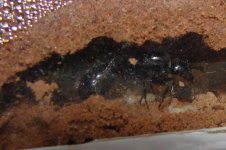
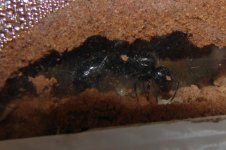
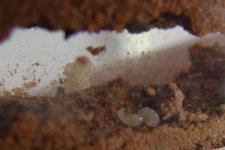
I've been working this year on developing an ant lesson plan for grade-schoolers. Though I wanted to have a colony in the classroom all year, that didn't work out because I had no success raising the species of harvester ant I was working with in the fall. This spring, however, a friend and I went out and collected over 100 queens of another species of harvester ant--Messor sp.--that doesn't sting. So I've set up a couple queens at the house on the flex-watt to keep them warm, and two of my queens have larvae! :D I've got some set up in little ant farms I made out of CD cases, and it's working pretty well I think.

Here are some pics of one of my queens, her egg bunch, and her larvae.
 

Attachments

  • March22-1s.jpg
    March22-1s.jpg
    109.1 KB · Views: 44
  • March22-2.jpg
    March22-2.jpg
    119.8 KB · Views: 44
  • March22-4.jpg
    March22-4.jpg
    122.1 KB · Views: 43
  • March22-6.jpg
    March22-6.jpg
    96.4 KB · Views: 43
  • March22-6s.jpg
    March22-6s.jpg
    87.7 KB · Views: 43
How do you get food in without messing up the burrows?
That's a nice idea, the CD case "ant farm".
I see by your Eris reference you like stuff off of the planet, too.
 
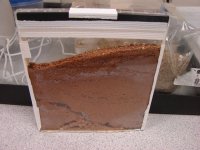
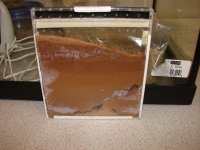
Once these queens have workers, I'll drop food in from the top. I'll post a picture of the whole ant farm. I've used part of the black thingy in the CD case to make a door that I can open when I want to. For now I don't have to worry about it, though, because in this species, the queens do not forage.

LOL! I was very confused by your comment about stuff "off of the planet," until I googled "Eris." No, actually, I'm not much into astronomy at all. It's way too abstract for me. But there was a thread here a while back about the "demotion" of Pluto, and some little obnoxious kid said something about how those number names are so gay . . . So I immediately changed my whatever-that-thingy-is-called to Pluto's new "gay" name.
 
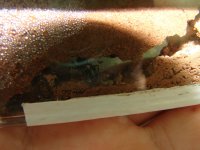
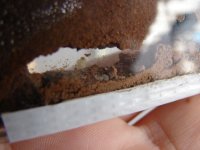
Here are pictures of the whole set-up. I just cut that black thing down and taped it in so that the tape acts as a hinge and I can open the little black door the length of the entire CD case. I dropped the queen in the top, and that's how I add water and food.

In my later models, I put cotton ball pieces in the case up against those little slots in the sides (to keep the dirt and ants in) so that I can wick water into the CD case from the sides as well as from the top. But this one doesn't have that. It doesn't really seem to matter. Dropping water in from the top is working just fine.
 

Attachments

  • March7-1.jpg
    March7-1.jpg
    132 KB · Views: 33
  • March7-2.jpg
    March7-2.jpg
    141.4 KB · Views: 33
I got attacked by ants twice yesterday...(For leaf-blowing their home, in my patio). Just the scale of your ant farms seems so small! When you get the queen, then she lays eggs- how have the eggs been fertilized? And the babies just grow up into various jobs? How is that determined?
 
This size ant farm is small, it's true. But it will work fine until the colonies get established, and then I can put them in something bigger. That will take a while, though, maybe up to a year. And, I can also just connect a foraging container to the CD case via tubing, and that would open up more room for them.

The queens have already been fertilized. When new queens leave a colony, they go on a mating flight, mate, land, tear off their wings, and start digging a new colony (in most species, this is how it works anyway--in some species the queens return to their old colony). They won't need to mate again for their whole lives, and whether they use the sperm to fertilize their eggs or not determines whether the egg develops into a male or female (can't recall which is which). Queens only produce males once the colony is mature and is ready to reproduce. All workers are females, and just like in social bees, males don't do anything and aren't good for anything but mating, and they don't live for very long, just a few days after taking off on mating flights.

Some queens have lived in captivity for as long as 20 years.

In some species of ants, the babies do grow up into different castes. Army ants have quite a few castes, as do the leafcutter ants--there are cutters, carriers, specialized tiny workers whose job it is to keep all types of invasive fungus out of the colony's fungus farm (weeders, I guess). I believe the way that works is that caste is determined by how the larvae are fed by the workers, but I'm a little foggy on that, to be honest.

For a wonderfully interesting and very accessible read that will introduce you to the amazing diversity of ants and their ecologies, check out Journey to the Ants. It's a fabulous book and you'll learn so many cool things about ants that even if you don't really like ants (like I didn't), you won't be able to help but find them really fascinating afterwards. It's perfect for reading a chapter a night before bed or something like that. I need to re-read it, myself!

 
Back
Top