• Hello!

    Either you have not registered on this site yet, or you are registered but have not logged in. In either case, you will not be able to use the full functionality of this site until you have registered, and then logged in after your registration has been approved.

    Registration is FREE, so please register so you can participate instead of remaining a lurker....

    Please be certain that the location field is correctly filled out when you register. All registrations that appear to be bogus will be rejected. Which means that if your location field does NOT match the actual location of your registration IP address, then your registration will be rejected.

    Sorry about the strictness of this requirement, but it is necessary to block spammers and scammers at the door as much as possible.

Red light-Blue light?

snakewispera snr

The Devils Advocate
I am in need of educated opinions to do with lighting...
I am buying new tubs for a few new snakes that are arriving. These snakes are identical (for all intents and purpose)so I was looking to get blue tubs for the boys and red/pink tubs for the girls.(cute hey).
Then I started to wonder about the light the animal will receive. Snakes can't see red or blue light. (we use these with our nocturnals, to watch them at night) So will the snakes think it is dark all the time or do you think they will just think it's an overcast day, as the light will be red/blue through the tubs....
I know this sounds like a stupid question, but I've never seen anyone use coloured tubs before.
I'm just hoping with the accrued knowledge on here, someone will have a definitive answer.
 
Its a good question! Can't remember my GCSE Physics at all, isn't it something like the only colour that would pass through would be the red light, in the red tubes, all the rest of the light spectrum would be filtered out.

So, if they have trouble seeing red light freqencies then maybe they wouldn't be able to see any light at all, thats what i would think anyway :shrugs:

Tom
 
Thats what I'm having trouble working out.. I know it will be red/blue in there but will the snake be able to see anything...My 'o' level physics didn't extent to snake sight...LOL
 
actually.. im kinda learning about this stuff.. haha

for us to see a red/blue tub, the red and blue wavelengths of light are being reflected every other one is being absorbed. so, im not sure if the other wavelengths will go through the tub or not, but as for the tub being red or blue that means that the red or blue colors are being reflected. so... thats as much as i know, not sure if the other wavelengths would go all the way through or not.
 
Hey Mike (here comes A level physics) :grin01:

Basically, white light (which is obviously the light that comes from incandescant bulbs and the sun) is composed of all other visible light colours in the visible light spectrum. As it passes from a medium that is less dense, to another that is more dense; refraction occurs. Since air has a refractive index of 1 (Snell's law), and plastic (I'm assuming that the plastic is polyethylene, please correct me if I'm wrong) has a refractive index of 1.51.

Red light is refracted/bent the least out of all of the other colours. The plastic will not be acting as a prism, it will be acting as a filter. So all of the other colours in the spectrum will be filtered out, leaving only red/blue light.

Snakes do not see colors, but their eyes are equipped with a combination of light receptors; rods that provide low-light but fuzzy vision, and cones that produce clear images. The complexity of the eyes varies among species because of their different lifestyles. So in snakes that live above ground (I assume that the ones that you're getting do), much clearer images are produced and they have a greater depth of vision.

Since snakes can not see colour, the inside of the box will be perpetually dark. However, I'm not sure if they'll be able to see through (and therefore outside of) the plastic. A good experiment to perform would be to place one in the box in a light room, and wave your hand near to the box (if one of them is nippy it would be perfect). If they respond then that could give 'some' indication (since they could just be responding to scent).

OR

You could get a blue LED torch and shine it against the red plastic in a dark room. If little or no light passes through, you know it's an effective filter and will filter out all other parts of the spectrum. If light passes through, you know it's a bogus filter and other colours of light will pass through. As the various colours of the spectrum combine again they begin to form white light, which would produce light inside the box.

OR

You could buy clear plastic boxes and labels and save yourself some hassle :grin01:

All the best

David
 
Snake Dave Hey Mike (here comes A level physics)

Basically, white light (which is obviously the light that comes from incandescant bulbs and the sun) is composed of all other visible light colours in the visible light spectrum. As it passes from a medium that is less dense, to another that is more dense; refraction occurs. Since air has a refractive index of 1 (Snell's law), and plastic (I'm assuming that the plastic is polyethylene, please correct me if I'm wrong) has a refractive index of 1.51.

Red light is refracted/bent the least out of all of the other colours. The plastic will not be acting as a prism, it will be acting as a filter. So all of the other colours in the spectrum will be filtered out, leaving only red/blue light.

Snakes do not see colors, but their eyes are equipped with a combination of light receptors; rods that provide low-light but fuzzy vision, and cones that produce clear images. The complexity of the eyes varies among species because of their different lifestyles. So in snakes that live above ground (I assume that the ones that you're getting do), much clearer images are produced and they have a greater depth of vision.

Since snakes can not see colour, the inside of the box will be perpetually dark. However, I'm not sure if they'll be able to see through (and therefore outside of) the plastic. A good experiment to perform would be to place one in the box in a light room, and wave your hand near to the box (if one of them is nippy it would be perfect). If they respond then that could give 'some' indication (since they could just be responding to scent).

OR

You could get a blue LED torch and shine it against the red plastic in a dark room. If little or no light passes through, you know it's an effective filter and will filter out all other parts of the spectrum. If light passes through, you know it's a bogus filter and other colours of light will pass through. As the various colours of the spectrum combine again they begin to form white light, which would produce light inside the box.

OR

You could buy clear plastic boxes and labels and save yourself some hassle

All the best

David

Snake Dave, what ever you say mate! :smash:

That post is brilliant, awesome answer to the question!.

Dave, whats the meaning of life? I'll take your word on it after that ;)

Tom
 
*Waits for the numerical answer..*

No need to calculate Snell's law if that's what you were referring to.

Or were you referring to the meaning of life thing, I answered it in my rep to Tom. 'You're 7 years my senior, surely you've experienced it by now' :grin01: If you're looking for the numerical answer, I'd say 0 or 1:6.65 billion.
 
I've been reading up today on snakes and light....The red/blue theory is not confirmed....All that is known is that it does not interrupt the sleep pattern...Whether they can see it or not is another thing.....Like the answer Dave, but you lost me after 'basically'
 
Lmao, okay Mike. As long as you've established what you've gotta do that's the main thing. I'll just leave my cool answer to collect dust then :( *skulks away sadly*
 
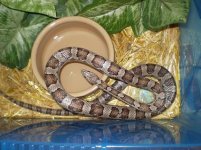
If it's any help, Norwood still reacts to a hand outside his blue tub
 

Attachments

  • 22.JPG
    22.JPG
    43.7 KB · Views: 32
The blue crystal tubs are quite easy to see through. Obviously it changes how the snakes look to me, from outside, but I can't really ask Norwood what he thinks about it!:rofl:
 
composed of all other visible light colours
Red light is refracted/bent the least out of all of the other colours.
So all of the other colours in
Since snakes can not see colour, the
All the best

David

Oh, he's not so smart, he can't even spell color.
 
No need to calculate Snell's law if that's what you were referring to.

Or were you referring to the meaning of life thing, I answered it in my rep to Tom. 'You're 7 years my senior, surely you've experienced it by now' :grin01: If you're looking for the numerical answer, I'd say 0 or 1:6.65 billion.


Close... but its actually 42.
 
Back
Top