• Hello!

    Either you have not registered on this site yet, or you are registered but have not logged in. In either case, you will not be able to use the full functionality of this site until you have registered, and then logged in after your registration has been approved.

    Registration is FREE, so please register so you can participate instead of remaining a lurker....

    Please be certain that the location field is correctly filled out when you register. All registrations that appear to be bogus will be rejected. Which means that if your location field does NOT match the actual location of your registration IP address, then your registration will be rejected.

    Sorry about the strictness of this requirement, but it is necessary to block spammers and scammers at the door as much as possible.

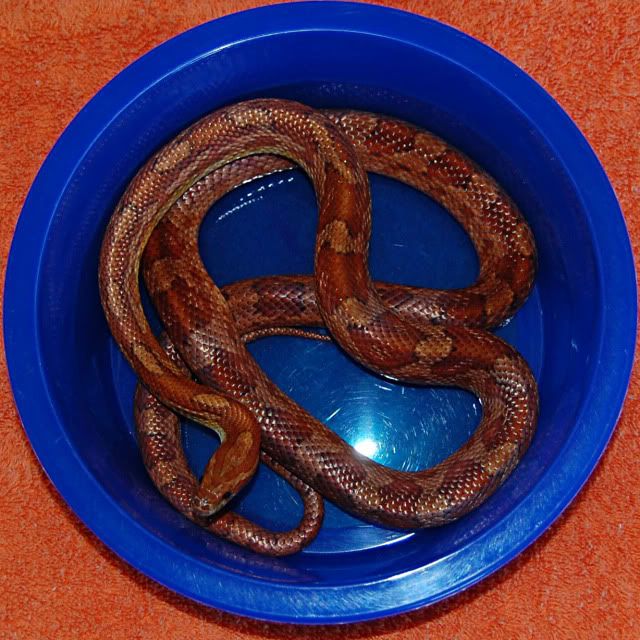
The diffuese pattern (bloodred)

cmariles

New member
From What I understand it is so very expressive that even animals that are only het for the gene will eventually express it. If that is so... is it fair to assume that if I mate 2 snakes with no homozygous matches including bloodred though, they will will appear as normal looking grey headed babies?

I appreciate your consideration and help.

thanks,

Carlos
 
I guess I am a little confused at what you are asking.

Do you mean that if you breed together 2 which are only het for diffused...or 1 diffused and 1 het diffused... can you create diffused offspring? If that is your question the answer is yes.

diffused x diffused = 100% of the offspring will be diffused
diffused x het diffused = 50% diffused, 50% normal het diffused
het diffused x het diffused = 25% diffused, 75% normal possibly het diffused (66% chance of being het diffused)

diffused x normal not het for diffused = 100% normal het diffused
normal het diffused x normal not het diffused = 100% normal possibly het diffused (50% chance of being het diffused)
 
I guess I am a little confused at what you are asking.

Do you mean that if you breed together 2 which are only het for diffused...or 1 diffused and 1 het diffused... can you create diffused offspring? If that is your question the answer is yes.

diffused x diffused = 100% of the offspring will be diffused
diffused x het diffused = 50% diffused, 50% normal het diffused
het diffused x het diffused = 25% diffused, 75% normal possibly het diffused (66% chance of being het diffused)

diffused x normal not het for diffused = 100% normal het diffused
normal het diffused x normal not het diffused = 100% normal possibly het diffused (50% chance of being het diffused)

If I am understanding your question right. You have 2 snakes that are not the same morph but are both het for bloodred? If that is correct the bolded area from ZoologyGirl quote is the percentages that you would be looking at if you bred them.
 
You may want to do a search on Masque. It's debatable how much the Masque gene is actually what we consider Diffused/Bloodred.

Some snakes that have no Diffused genes seem to have the skullcap head pattern. This may be a separate gene known as Masque.

As far as your original question goes.. it's too confusing to make sense of. Can you re word it?
 
From What I understand it is so very expressive that even animals that are only het for the gene will eventually express it. If that is so... is it fair to assume that if I mate 2 snakes with no homozygous matches including bloodred though, they will will appear as normal looking grey headed babies?

I appreciate your consideration and help.

thanks,

Carlos
im not sure i understand completely but here goes...
first part....
corns that are "het." will never truly express what there het for (i dont think) unless you breed it out. that to my knowledge is the only "true" way to know what the hets were.
second part...
it really doesnt matter what the homo. is if the hets are there, it does to an extent...meaning if you have a gazzillion hets. you might not get what your looking for because of the percentages & luck of the draw. now if there both homo. your pretty much guaranteed to get at the very least one.

sample....
from my breedings (same pair,3 times...)
(m) hypo.a "het." granite TO (f) normal "het." granite stripe (both are 100% het.granite!!!) took 3yrs to see one.then i had to choke murphy!! & finally he gave in:nyah:

year 1... 90% normal 10% anery.a
year 2...80% normal 10% anery.a, 10% bloodred
year 3...50% normal 10%bloodred 10%granite 30%anery.a

hope i got it all right ?

-jay
 
Thanks all!

I am going to have to break down and buy some books. Just reading the info on the net is leaving too many questions for me. Sorry for the confusion... let me see if I can clarify a little.

In my effort to reach the Sulfer color I purchased both a motley male butter and a motley female anrey. This led to me reading articles on the diffuse trait. I read where snakes het for diffuse would eventually express it even though they were only het for the gene. It would not be as obvious if there were homozygous for the gene.

As for the Masque gene... further proof that a little bit of knowledge only creates a need for more knowledge!
All of your comments and responses are greatly appreciated!

:duck:
thanks,

Carlos
 
To answer your question, no. A snake het for Bloodred (Diffused) will not end up looking like a Bloodred. Many het Bloodred animals show the bald head, but so do many animals with zero Bloodred in them.

I think this is what you're referring to...

Ice ph Bloodred...bald head.
DSC_0290.jpg


Normal het Hypo Lav Blood...full head pattern.
DSC_0442.jpg
 
In my effort to reach the Sulfer color I purchased both a motley male butter and a motley female anrey. This led to me reading articles on the diffuse trait. I read where snakes het for diffuse would eventually express it even though they were only het for the gene. It would not be as obvious if there were homozygous for the gene.

If you're wanting to produce Sulfurs you will need to buy snakes which have the genes for Caramel, Amel, and Bloodred. It sounds like you don't have the genes yet. You can breed an Anery Motley and a Butter Motley together all you want, but you will never end up with a Sulphur, or even another Butter Motley.

Ok, your options are to buy a Bloodred female het for Caramel and Amel for your Butter Motley male, or to buy two animals that are either BOTH het or homo for Caramel, Amel, and Diffused.

With the Bloodred het Caramel, Amel female, and the Butter Motley male, you should get Butters that are het for Bloodred and Motley. It would take you about 6 years to reach your target, but you could end up with Sulphur Motleys!

If you were to buy animals that were het for Sulfur (diffused, Caramel, Amel), you could pair them together in 3 years (the time snakes need to reach maturity), and end up with a Sulfur.

Probably your best bet is to save a little extra money and try to buy a Sulfur outright.

If you didn't understand anything I said about the pairings, then yes, you should definitely do a lot of reading and gain some experience before you consider breeding. Not EVERY Corn Snake keeper needs to breed their animals..

Good luck in your endeavors, whatever they end up being.
 
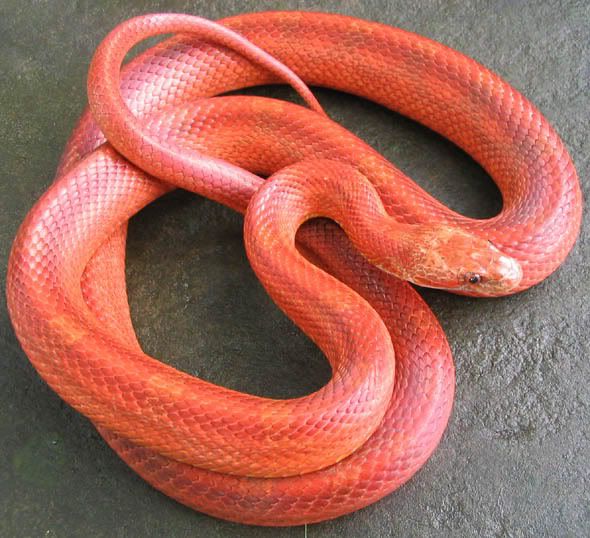
There's no such thing as a normal-appearing snake being "het for bloodred." And yeah, I realize that many people sell snakes under this name. "Diffused" is a simple recessive genetic trait. But this is only one element of bloodred which is diffused + hypererythrism (excessive red pigment). The hypererythrism aspect is not recessive, rather it is variable (not like a simple recessive genetic trait, which is an "all or nothing" expression). Each snake carrying the trait will vary in the amount of red coloration it has.

No normal-appearing snake can be het for a morph that expresses two or more traits (snow, striped hypo, ghost, amel motley, etc.). A normal-appearing snake can be DOUBLE HET for a a trait that expresses two morphs, but in the case of bloodreds, this would not apply, since only one of its traits (diffused) is recessive. The other trait (hypereyrthrism) is not recessive, therefore a snake cannot be "het" for it.
07corn30.jpg
 
There's no such thing as a normal-appearing snake being "het for bloodred." And yeah, I realize that many people sell snakes under this name. "Diffused" is a simple recessive genetic trait. But this is only one element of bloodred which is diffused + hypererythrism (excessive red pigment). The hypererythrism aspect is not recessive, rather it is variable (not like a simple recessive genetic trait, which is an "all or nothing" expression). Each snake carrying the trait will vary in the amount of red coloration it has.

No normal-appearing snake can be het for a morph that expresses two or more traits (snow, striped hypo, ghost, amel motley, etc.). A normal-appearing snake can be DOUBLE HET for a a trait that expresses two morphs, but in the case of bloodreds, this would not apply, since only one of its traits (diffused) is recessive. The other trait (hypereyrthrism) is not recessive, therefore a snake cannot be "het" for it.

07corn30.jpg

So what your saying is that i bloodred is not a gene but a selectively bred diffused?
 
So what your saying is that i bloodred is not a gene but a selectively bred diffused?

It's not a single gene. It's the expression of two: diffused + bloodred.

Diffused is a single recessive genetic trait.

The "bloodred" part of the equation would be regarded as selective breeding.

Tim
 
If I am following the diffused pattern on the sides of the snake is the genetic recessive trait. The "bloodred" part of the equation is the hypererythrism = the amt of excessive red pigment the snake winds up showing. Being variable in that to get the color grades you want you eventually have to breed the like colors together to increase the odds of maintaining that amt of color.
So, the anrey motley blood that I purchased should have been labled under diffused motley anrey since the hyper variable should have been taken out of the equation?
 
Third eye herp.....
Isn't the Tuatara a lizard with a vestigial 3rd eye that can still distinguish between light and dark?
:-offtopic
I know!
Thanks by the way for your input!

Carlos
 
Third eye herp.....
Isn't the Tuatara a lizard with a vestigial 3rd eye that can still distinguish between light and dark?
:-offtopic
I know!
Thanks by the way for your input!

Carlos
There was just something on cable the other night about primitive deep sea aquatic reptiles from the cretaceous period having a photoreceptive organ or 'parietal eye',...that evidently was so developed that it served to assist in hunting prey.
http://www.google.com/search?client=safari&rls=en&q=parietal+eye&ie=UTF-8&oe=UTF-8
Re: the tuatara (Sphenodon punctatus) . . .
http://animaldiversity.ummz.umich.edu/site/accounts/information/Sphenodon_punctatus.html
 
:shrugs:

(sigh)
So much cool stuff on the tube and sooo much on tivo already! Sounds interesting. I was on track with the Tuatara right? My memory and I are not always on speaking terms!
Thanks,

Carlos
 
Back
Top