
-
Hello!
Either you have not registered on this site yet, or you are registered but have not logged in. In either case, you will not be able to use the full functionality of this site until you have registered, and then logged in after your registration has been approved.
Registration is FREE, so please register so you can participate instead of remaining a lurker....
Please be certain that the location field is correctly filled out when you register. All registrations that appear to be bogus will be rejected. Which means that if your location field does NOT match the actual location of your registration IP address, then your registration will be rejected.
Sorry about the strictness of this requirement, but it is necessary to block spammers and scammers at the door as much as possible.
You are using an out of date browser. It may not display this or other websites correctly.
You should upgrade or use an alternative browser.
You should upgrade or use an alternative browser.
Just got a new corn snake
- Thread starter Jase82
- Start date

K. Rene
Cozmic Cornz
Normally we wait like 3-5 days for the snakes to settle in to a new enviornment before we feed them. it reduces the chance of them regurgitating. The more often you feed them the faster they grow. I believe one week in between feedings is an avareage we use. I can only speak for myself tho. Let us know if you have more questions. Post a pic on this thread when u get a chance, would love to see the new guy 
Mine are 7 months old and about that long. Hard to measure them hu? lol
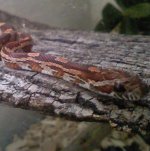
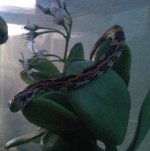
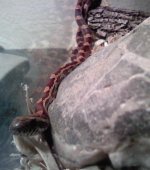
Haha shes been pretty active, so ive seen her length pretty well in the tank. The pictures ive taken so far are poor quality, sorry for that.
About how old does a corn snake need to be to visually determine it's sex via it's tail width?
Do you think shes an okeetee or a normal?
Thanks for all the info =D
Attachments

Nanci
Alien Lover
This is a general guide to acclimating snakes and geckos from Sean Niland at VMS Herp:
General Acclimation
You've just received your shipment, opened the box and there's your new friend staring up at you from the inside of a deli cup. Now what?
Glad you asked, because what happened to your pet during transit was pretty frightening. What happens next can be even more traumatic, depending on how you acclimate your new pet. Please take a few moments to read the following paragraphs, hopefully before you receive your shipment, so that you know what to do to minimize further stress on your new reptile.
There's a few simple rules to follow which can really ease the transition from their old home here at VMS (the only home they ever knew) to the new home somewhere else in the United States.
First, resist the temptation to tear into the box and dig out your new pet. I know this is hard, but please take just a moment to collect one critical piece of information - the temperature inside the box upon arrival. Just quietly crack the lid and slip a thermometer inside. This information can be very helpful if you should need to contact us later regarding difficulties in getting your pet to settle in.
Second, resist the urge to handle your new pet for a few days. VMS is a commercial breeding facility, housing many hundreds of baby reptiles at any given time. As a result, they rarely get handled other than for routine maintenance and cage cleaning. Your new pet may view being handled as yet another stressful event following the trauma of being packaged up and shipped across the US, ending up in some strange new place. Give them time to settle in and start feeding before attempting to handle them. When you do decide handle them, do it inside the cage if possible or at least on the floor. Odds are high they will be nervous and easily startled - jumping out of your hand for a five foot plunge to the floor can be fatal! Handle only for a few minutes at first, increasing the time spent handling each day until your new pet no longer minds at all.
Third, resist the urge to unceremoniously dump your new pet into his new spacious cage. This can be another real shocker to them. Instead, set the deli cup inside the cage and gently pry off the lid. Turn out the lights on the cage (or even the room if very bright) and quietly withdraw, allowing the reptile to venture out and explore the new surroundings at will. This increases the chances of successfully locating the hide area and water dish, etc. without panicking.
Special Notes About Feeding
Please, don't even think about feeding your new pet immediately. Sadly, this is the first thing most newcomers to reptile keeping try to do. Odds are very high that your new lizard or snakes will be too frightened to feed. Attempting to feed under these conditions can have several negative consequences. Here's a list of points to consider:
Uneaten live rodents and crickets may actually turn to your new pet as a food source, gnawing on exposed areas of your new pet! Too frightened to come out of hiding, your new reptile may receive some serious damage.
Most of the reptiles we sell are nocturnal and feed best in low light conditions. It's best to offer food in the evening or early morning hours, before bright lights and a lot of household activity disturb your pet.
Feed very sparingly the first few weeks after arrival. Feed snakes smaller meals than normal and give lizards fewer crickets than normal. The stresses of shipping can often upset their digestive systems, and large meals may be regurgitated, causing additional problems.
Also, avoid handling your new reptile before attempting to feed. It's more important that it resume a regular feeding schedule than anything else. Many keepers have the idea that snakes should always be moved to a separate container for feeding. While that may be fine for a very well-established feeder, a recently transported and scared individual is best left alone before attempting to feed.
Snakes frequently seem to associate the presence of the food item with the recent trauma of shipping, and will remember it! This is likely the reason for a juvenile snake refusing to feed after shipping. It simply associates the food item with the traumatic event. We recommend waiting about a week before attempting to feed snakes.
Lizards seem to get over it all a little quicker than snakes, especially very young geckos. Waiting two days is usually sufficient. Even then, feed sparingly! A couple crickets is plenty to tempt your new pet, and you can always add a few more if you see them get eaten. But two dozen crickets running about can be a bit frightening to an already nervous little lizard! Remember, less is better.
Larger geckos may require longer periods to adjust, with some adults refusing to feed well for several weeks! Some keepers report success tempting such stubborn with wax worms, which seem to have an irresistible wiggle when they crawl. But most will simply resume feeding one day as if nothing had ever happened.
A Final Thought:
It is of prime importance that your new pet be allowed to settle in and acclimate fully. Constant stress during the acclimation period should be avoided. With proper care and conditions, you should have your new pet for years to come. There will be lots of time to mess with them later - for now, give them a rest!
General Acclimation
You've just received your shipment, opened the box and there's your new friend staring up at you from the inside of a deli cup. Now what?
Glad you asked, because what happened to your pet during transit was pretty frightening. What happens next can be even more traumatic, depending on how you acclimate your new pet. Please take a few moments to read the following paragraphs, hopefully before you receive your shipment, so that you know what to do to minimize further stress on your new reptile.
There's a few simple rules to follow which can really ease the transition from their old home here at VMS (the only home they ever knew) to the new home somewhere else in the United States.
First, resist the temptation to tear into the box and dig out your new pet. I know this is hard, but please take just a moment to collect one critical piece of information - the temperature inside the box upon arrival. Just quietly crack the lid and slip a thermometer inside. This information can be very helpful if you should need to contact us later regarding difficulties in getting your pet to settle in.
Second, resist the urge to handle your new pet for a few days. VMS is a commercial breeding facility, housing many hundreds of baby reptiles at any given time. As a result, they rarely get handled other than for routine maintenance and cage cleaning. Your new pet may view being handled as yet another stressful event following the trauma of being packaged up and shipped across the US, ending up in some strange new place. Give them time to settle in and start feeding before attempting to handle them. When you do decide handle them, do it inside the cage if possible or at least on the floor. Odds are high they will be nervous and easily startled - jumping out of your hand for a five foot plunge to the floor can be fatal! Handle only for a few minutes at first, increasing the time spent handling each day until your new pet no longer minds at all.
Third, resist the urge to unceremoniously dump your new pet into his new spacious cage. This can be another real shocker to them. Instead, set the deli cup inside the cage and gently pry off the lid. Turn out the lights on the cage (or even the room if very bright) and quietly withdraw, allowing the reptile to venture out and explore the new surroundings at will. This increases the chances of successfully locating the hide area and water dish, etc. without panicking.
Special Notes About Feeding
Please, don't even think about feeding your new pet immediately. Sadly, this is the first thing most newcomers to reptile keeping try to do. Odds are very high that your new lizard or snakes will be too frightened to feed. Attempting to feed under these conditions can have several negative consequences. Here's a list of points to consider:
Uneaten live rodents and crickets may actually turn to your new pet as a food source, gnawing on exposed areas of your new pet! Too frightened to come out of hiding, your new reptile may receive some serious damage.
Most of the reptiles we sell are nocturnal and feed best in low light conditions. It's best to offer food in the evening or early morning hours, before bright lights and a lot of household activity disturb your pet.
Feed very sparingly the first few weeks after arrival. Feed snakes smaller meals than normal and give lizards fewer crickets than normal. The stresses of shipping can often upset their digestive systems, and large meals may be regurgitated, causing additional problems.
Also, avoid handling your new reptile before attempting to feed. It's more important that it resume a regular feeding schedule than anything else. Many keepers have the idea that snakes should always be moved to a separate container for feeding. While that may be fine for a very well-established feeder, a recently transported and scared individual is best left alone before attempting to feed.
Snakes frequently seem to associate the presence of the food item with the recent trauma of shipping, and will remember it! This is likely the reason for a juvenile snake refusing to feed after shipping. It simply associates the food item with the traumatic event. We recommend waiting about a week before attempting to feed snakes.
Lizards seem to get over it all a little quicker than snakes, especially very young geckos. Waiting two days is usually sufficient. Even then, feed sparingly! A couple crickets is plenty to tempt your new pet, and you can always add a few more if you see them get eaten. But two dozen crickets running about can be a bit frightening to an already nervous little lizard! Remember, less is better.
Larger geckos may require longer periods to adjust, with some adults refusing to feed well for several weeks! Some keepers report success tempting such stubborn with wax worms, which seem to have an irresistible wiggle when they crawl. But most will simply resume feeding one day as if nothing had ever happened.
A Final Thought:
It is of prime importance that your new pet be allowed to settle in and acclimate fully. Constant stress during the acclimation period should be avoided. With proper care and conditions, you should have your new pet for years to come. There will be lots of time to mess with them later - for now, give them a rest!

snakemom1961
Spring is here!
Also, There is no positive exterior way to sex a corn snake. The only positive way to sex them is to have them "popped" as a baby by a professional, or someone that knows what they are doing, or to have them "probed" by a professional or someone that knows what they are doing. I wouldn't recommend either one be tried by someone knew to the hobby or has never been properly instructed as to how to perform each technique.

Oh, I thought that females had a tail that got skinnier faster, while the male's tail slopes at a constant rate, I guess this varies from snake to snake?Also, There is no positive exterior way to sex a corn snake. The only positive way to sex them is to have them "popped" as a baby by a professional, or someone that knows what they are doing, or to have them "probed" by a professional or someone that knows what they are doing. I wouldn't recommend either one be tried by someone knew to the hobby or has never been properly instructed as to how to perform each technique.
Nanci
Alien Lover
That's a general rule, but you don't know for sure. If breeding plans depend on knowing the sex of your snake, you have to pop or probe. If you just want a reasonable guess so you can name it- then tail shape is fine. However, I think I'm pretty good at guessing by tail shape, and in Kathy Love's book I got all of the examples incorrect.
K. Rene
Cozmic Cornz
Mine were sexed as babies and popped in front of me to see their gender. They are both females and I can see how their tails taper.
As for what kind it is. Usually Oketees have lighter Orange background color with dark orange spots that are outlined by a black line. Your snake seems to be really red in color and I can't see much black. I'm still new but I have seen lots of pictures. I'd say a normal, maybe hypo cause the red is pretty intense. What color are the belly scales? It's very pretty in any case. Better pics would help and someone who does breeding could probably make a better guess than me.
As for what kind it is. Usually Oketees have lighter Orange background color with dark orange spots that are outlined by a black line. Your snake seems to be really red in color and I can't see much black. I'm still new but I have seen lots of pictures. I'd say a normal, maybe hypo cause the red is pretty intense. What color are the belly scales? It's very pretty in any case. Better pics would help and someone who does breeding could probably make a better guess than me.

v_various
secretly normal
Not an okeetee, but it might be a motley. Kind of looks like it, but I can't say for sure from the photos. If your snake has a plain white belly, it's a normal mot. If he has checkers, it's a normal.
The munson plan is a good rough guide to feeding
http://www.cornsnakes.com/forums/showthread.php?t=50106
but it does depend on the snake. FinFang can't handle it, I have him on juvies even though he should be able to take adults.
The munson plan is a good rough guide to feeding
http://www.cornsnakes.com/forums/showthread.php?t=50106
but it does depend on the snake. FinFang can't handle it, I have him on juvies even though he should be able to take adults.

carnivorouszoo
Crazy Critter Lady
Oh, I thought that females had a tail that got skinnier faster, while the male's tail slopes at a constant rate, I guess this varies from snake to snake?
My Amel popped female everytime, 2 vets and a snake friend all checked. I've seen pics of what was supposed to be "male" tails and if that was how to tell then she is a he. However my 2 males, both popped male which is more obvious than females, have tails that look the way the tails marked female in pics i have seen. So, I don't think it is reliable at all.
Ok, awesome guys thanks. Maybe ill have him/her probed later.
I am concerned about my UTH. I have a 10-20 gallon Zoo Med. I have heard that they run far too hot. I have a lamp dimmer now, but i have no accurate means of measuring the temperature of the UTH. Should I dim the UTH or leave it on full power? Also its fairly cold in my apartment 50-60 F. What should I do? (I am getting a digital thermometer very soon in the mail)
Thanks again ^^
I am concerned about my UTH. I have a 10-20 gallon Zoo Med. I have heard that they run far too hot. I have a lamp dimmer now, but i have no accurate means of measuring the temperature of the UTH. Should I dim the UTH or leave it on full power? Also its fairly cold in my apartment 50-60 F. What should I do? (I am getting a digital thermometer very soon in the mail)
Thanks again ^^

Lennycorn
Just see the truth
Don't leave it on full. Cut it back 3/4 of the way for now.
You need to get a thermometer with a probe and place the probe right above the uth...under the bedding. Get this tomorrow. It's important!!
As for feeding let you snake settle in for a few days or longer. A hungry stress free snake is easier to feed. Feed the snake an f/t pinky that is warm in a small container. Leave snake undisturbed for five to ten minutes. The snake should be done by then and you can place him back in the viv.
Good luck.
You need to get a thermometer with a probe and place the probe right above the uth...under the bedding. Get this tomorrow. It's important!!
As for feeding let you snake settle in for a few days or longer. A hungry stress free snake is easier to feed. Feed the snake an f/t pinky that is warm in a small container. Leave snake undisturbed for five to ten minutes. The snake should be done by then and you can place him back in the viv.
Good luck.

elipsis1
Scott
I was using a dimmer too, with a thermometer probe on the glass above the UTH.
I now have a thermostat, and let me tell you, the money I spent on it ($35 from bigappleherp.com) was so worth it. I no longer worry about my snake getting to cold, OR too hot while I am at work.
They really are the best thing you can do for your snake as far as heating goes. I don't know why I waited so long
I now have a thermostat, and let me tell you, the money I spent on it ($35 from bigappleherp.com) was so worth it. I no longer worry about my snake getting to cold, OR too hot while I am at work.
They really are the best thing you can do for your snake as far as heating goes. I don't know why I waited so long
Don't leave it on full. Cut it back 3/4 of the way for now.
You need to get a thermometer with a probe and place the probe right above the uth...under the bedding. Get this tomorrow. It's important!!
As for feeding let you snake settle in for a few days or longer. A hungry stress free snake is easier to feed. Feed the snake an f/t pinky that is warm in a small container. Leave snake undisturbed for five to ten minutes. The snake should be done by then and you can place him back in the viv.
Good luck.
Thanks, how long and how should i thaw the pinky? Im going to wait untillSunday to feed her