
-
Hello!
Either you have not registered on this site yet, or you are registered but have not logged in. In either case, you will not be able to use the full functionality of this site until you have registered, and then logged in after your registration has been approved.
Registration is FREE, so please register so you can participate instead of remaining a lurker....
Please be certain that the location field is correctly filled out when you register. All registrations that appear to be bogus will be rejected. Which means that if your location field does NOT match the actual location of your registration IP address, then your registration will be rejected.
Sorry about the strictness of this requirement, but it is necessary to block spammers and scammers at the door as much as possible.
You are using an out of date browser. It may not display this or other websites correctly.
You should upgrade or use an alternative browser.
You should upgrade or use an alternative browser.
Kistanie and Buff
- Thread starter nmoore601
- Start date


Susan
Go Ahead, Make My Day!
Dave Partington bred a Kastanie to a copper and from what I've seen of the hatchlings, they look like the same morph, but perhaps the coppers have a little something extra. Hypo has been kicked around but I'm thinking red coat/red factor. I would have to see the comparison photos again.
Several breeders here in the states have picked up some buff and are working with it. I think Chuck Pritsel/Connie Hurley have some and at least one other breeder here on this forum, but I can't think of who it is at the moment.
Several breeders here in the states have picked up some buff and are working with it. I think Chuck Pritsel/Connie Hurley have some and at least one other breeder here on this forum, but I can't think of who it is at the moment.
Troy and Jarrett have Bufs. Here is a link to pics of them:
http://www.cornsnakes.com/forums/showthread.php?t=124858&highlight=yellow+factor&page=3
http://www.cornsnakes.com/forums/showthread.php?t=124858&highlight=yellow+factor&page=3

iculatr
NO...WIRE...HANGERS!!!
Is kistanie the same as copper? What's the latest on buff? I haven't seen them offered for sale.
We will be working with both genes next year.

chris68
Arundel Reptiles
Is kastanie the same as copper?
Kastanie X Copper kids from Dave P
male

female

slangenbroed
New member
Buf has mixed in amel-ultramel-anery-lavendel-hypo-charcoal, but the story is how wil it look like there is no example to compare with. so i let them grow and testbreed.Ive i post a pic from i beleef a bufanery they will say ii have that tThanks Susan. I would love to see what buff has been mixed with. I wonder what a buff Tess will look like?
 nly in lavender i have never seen an anymal like that.
dave partington
Crazy Dave
Is kistanie the same as copper? I haven't seen them offered for sale.
Just found this thread today. If anyone sees a thread they think I might want to play on, please PM it to me. Thanks.
Are Kastanie & Copper the same?
Please take anything I post here with a big side helping of speculation.
I sent a pic of my Copper to Don and he replied that he is visually the same as his Kastanie's.
My Kastanie is 100% het amel, from Frank in Germany. He is lighter than the Copper male. Being het for amel shouldn't cause a classic to change color, but in the instance of Kastanie, it appears to. Please keep in mind I have only 1.1 adult Copper & 1.0 adult Kastanie. Is 3 individuals enough to make a broad statement about both lineages over? No.
This year I bred Copper X Xanthic Snow. The offspring are all wild-type classics, they are not lighter in color as I would have expected them to be, they are visually darker than the Kastanie het amel.
There are differences in the belly checkers. But I recall a thread on Tess where Don posted pics of belly checkers on a broad assortment of Tess babies. And there was a lot of variation. Then I looked at the belly checkers on the original female Tess here from Graham, and gee whiz, she has NO belly checkers. So I'm tossing out the belly checker is a sign of anything consideration. Sure, belly checkers can be helpful for Masque, Diffused, Motley, maybe a couple other critters, but is not applicable to Ka/Cop.
Kastanie turned up in a c/b European collection;
Copper originates from wild-caught locality stock.
They look very similar.
A lot of amels look very similar.
Okees look like Okees, but from what I can gather, there seem to be different versions of those, too, which each play a different result when out-crossed to other morphs/genes/traits/localities &c.
Breeding Ka X Cop is kind of like breeding Buf X Toffee. You'll likely get offspring which could pass for either parent. But does this mean they are the same thing?
If one thinks of locality types as a line-bred-morph,
even though they were not line-bred in captivity...
and the F1's from out-crossing are around 50% visually very similar to the locality-type, then one is seeing the F-1 affect of the line bred genetic lineage.
50% of the parents were a line-bred locality-type, so the 50% visuals of the clutch makes sense. Visual F1's is the effect of the line-bred/locality gene/trait. This should not be confused with co-dominance.
With Copper X Kastanie, perhaps there are similarly behaving genes or traits in play, but personally I am not convinced they are the same thing.
iculatr
NO...WIRE...HANGERS!!!
With Copper X Kastanie, perhaps there are similarly behaving genes or traits in play, but personally I am not convinced they are the same thing.
I agree. We've got a few Coppers and they are much brighter than our Kastanies.

JimGERcream
German efficiency
With Copper X Kastanie, perhaps there are similarly behaving genes or traits in play, but personally I am not convinced they are the same thing.
If I didn't got you wrong you doubt coppers beeing hom kastanie? If so, don't forget to calculate the different lineages, folks!!
Variability in Kastanies is HUGE. Much more than in other morphs if you ask me. E.g. the german Kastanie of Mr. Galewood is a very dark example of our german Kastanies (and btw the only one with those funny frosting markings in the saddles). I totally agree Coppers look brighter etc., but I'm VERY SURE Coppers, Rosybloods and german Kastanies are ALL hom. Kastanie! Of course, those Coppers could also be Red Coat or Red Factored or whatever you call it, or there is something else working, but personally I really really really doubt these are not Kastanies but something which looks similar. Has anyone ever produced a normal f1 from those and compared those normals to each other? I'd bet the Copper lineage produces nice bright normals, at least brighter and nicer than the normals of the german Kastanie lineage.
Let me show you an example for the incredible variability of kastanies
these both are hypo kastanies from exactly the same lineage

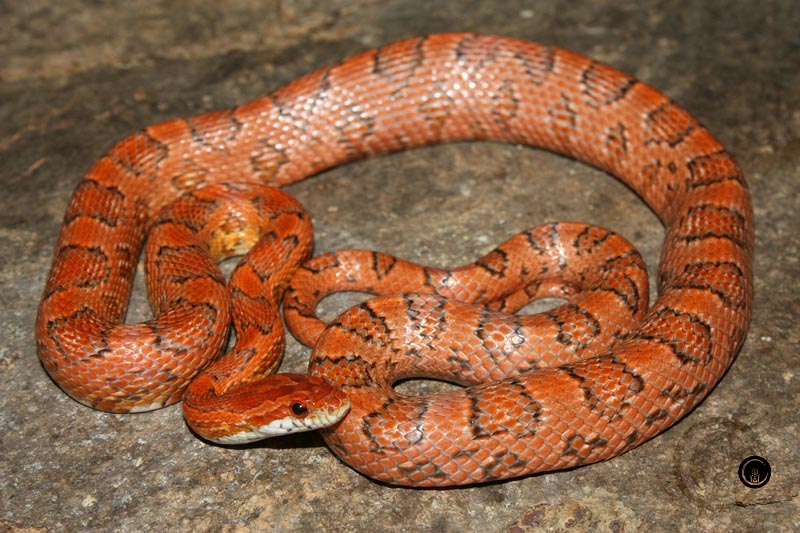
If you say Coppers are Kastanie (maybe + x) I'd agree. I'd disagree with those Coppers not beeing Kastanies. The hatchlings of Kastanie x Copper look EXACTLY the same compared with german Kastanie hatchlings and Kastanie x Rosyblood hatchlings.