• Hello!

    Either you have not registered on this site yet, or you are registered but have not logged in. In either case, you will not be able to use the full functionality of this site until you have registered, and then logged in after your registration has been approved.

    Registration is FREE, so please register so you can participate instead of remaining a lurker....

    Please be certain that the location field is correctly filled out when you register. All registrations that appear to be bogus will be rejected. Which means that if your location field does NOT match the actual location of your registration IP address, then your registration will be rejected.

    Sorry about the strictness of this requirement, but it is necessary to block spammers and scammers at the door as much as possible.

Looking for expert opinions

Kosmic Kid

New member
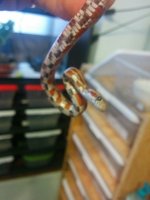
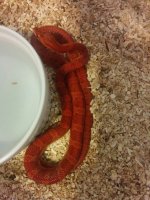
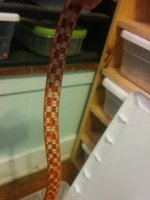
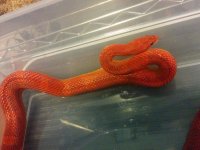
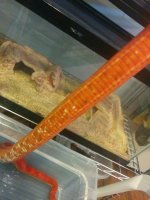
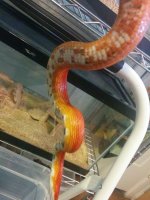
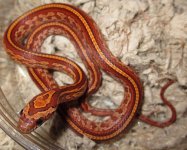
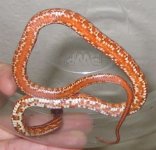
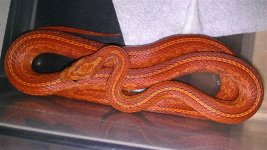
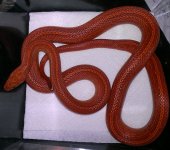
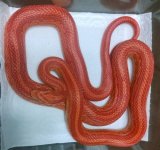
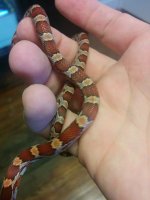
Hey, so I'm still not very savvy when it comes to identifying various corn snake morphs so I wanted to get some thoughts on one of my adult females. She was a PetCo find and I got her as a baby and I have always thought of her as a normal/wild type. As she grew she seemed to have less and less pattern and got deeper and deeper red in color, like what I think of as diffused/bloodred. The odd thing to me is her belly pattern, which still has the black and white checkers towards her head but about halfway down her belly is like this tomato orange color. When I breed her, her "normal" babies do the same thing. I'm not a photographer, but I am adding some pictures below to illustrate what I mean. The first 2 are of one of her babies (she was bread to an anery with no hets that I am aware of). This is how she looked when I got her. The second 2 are of one of her yearlings (same paring) and the last 3 are of her. So again, newbie to genetics here just looking for an expert opinion. Thanks!
01.jpg

02.jpg

03.jpg

04.jpg
 
The masking of the black reminds me more of red coat, but my experience there is limited. Curious to see opinions from someone who does work with RC.
 
I have no idea how to differentiate between red coat and red factor visually, but the fact that she had babies with a similar appearance makes me think red factor (because it's dominant, right?).
 
The way it's always been described to me is that red coat is a top coating of red pigment which can mask some of the markings whereas red factor pumps up the reds in the background.
 
Interesting that you say she looked pretty normal when she was small, I would expect redcoat and red factor to be more obvious at that age? Do you have any baby pics of her from around the time you got her?
 
Interesting that you say she looked pretty normal when she was small, I would expect redcoat and red factor to be more obvious at that age? Do you have any baby pics of her from around the time you got her?

It's possible... I need to do some digging though.
 
I do agree with the assessment she's probably red factor though, since she produced such red animals when mated to an unrelated animal, consistent with a dominant trait.
 
So is red coat recessive then? I was under the impression it was at least incomplete dominant or something. I guess that's just red factor then?

What are your future plans for these guys? I wouldn't mind picking up a hatchling sometime down the road for a bit of testing. I've been debating about bringing one of the red genes into a future project.
 
I think redcoat is recessive, and that the animal in question here seems red factor.

Steve says the results in his collection are consistent with redcoat being recessive. People that work with red factor see results consistent with incomplete dominance.

I have redcoat and red factor in my collection so am interested in working them both into other morphs. But red factor seems like much less of a hassle due to it being dominant.
 
If that's the case, I definitely agree about being less of a hassle. I know I want to bring my cayenne fire's red factor into a project or two, though if this is the same gene it might make sense to have a more...er, "pure" project animal? Otherwise the original female is a normal with possible unknown hets, right? I mean that yearling holdback is just stunning on its own.
 
I'm going to say Red Factor, because of the fact some of her babies ended up with the red.
Red Factor does diffuse some of the patterning.

Here is Cinaed, my first experience with RF.
I saw something different about him, and contacted John F about him.
As he grew, the red wash became more intense, and his Tessera pattern became more diffused.

He is a Red Factor Tessera het for Amel Bloodred. His Dam was a Cayenne Fire.
He sire a clutch of babies two eyars ago, and the RF doesn't always show up immediately, I found. Some that I didn't think were RF, started developing the RF wash.

The last pic is his son, Sol, a Sunglow Tessera (RF Amel) het Anery poss het BR
 

Attachments

  • 72660_158563_Large_T0bg6uberocC.jpg
    72660_158563_Large_T0bg6uberocC.jpg
    59.9 KB · Views: 67
  • 72660_158564_Large_nsipN5gFVyuawTm.jpg
    72660_158564_Large_nsipN5gFVyuawTm.jpg
    56.3 KB · Views: 67
  • 72660_225677_VeryLarge_6R3pdRVTwVhtU.jpg
    72660_225677_VeryLarge_6R3pdRVTwVhtU.jpg
    113.3 KB · Views: 68
  • 72660_268712_VeryLarge_8dAV5NSuo6QJ.jpg
    72660_268712_VeryLarge_8dAV5NSuo6QJ.jpg
    153.6 KB · Views: 67
  • 139962_404191_Large_qRtBlL0GQqsC.jpg
    139962_404191_Large_qRtBlL0GQqsC.jpg
    64.6 KB · Views: 68
I expect that if we saw baby pics of this snake, we'd be able to tell that it was red factor, but it may not have stuck out at the time without this knowledge since the difference is more subtle in babies. I wouldn't expect her to have had the gray ground color of her offspring in the first pic.
 
Could she be the non-amel version of a sunglow? that morph is Amel, selectively bred to show no white (IE no black borders if the amel was removed) Couldn't this snake be a non-amel version of that morph? She looks to have dark eyes, but her belly checks are dark but not 'black' looking. or maybe with Hypo?
 
Back
Top