• Hello!

    Either you have not registered on this site yet, or you are registered but have not logged in. In either case, you will not be able to use the full functionality of this site until you have registered, and then logged in after your registration has been approved.

    Registration is FREE, so please register so you can participate instead of remaining a lurker....

    Please be certain that the location field is correctly filled out when you register. All registrations that appear to be bogus will be rejected. Which means that if your location field does NOT match the actual location of your registration IP address, then your registration will be rejected.

    Sorry about the strictness of this requirement, but it is necessary to block spammers and scammers at the door as much as possible.

Average incubation time?

crystalsangel08

New member
I have my first clutch of cornsnake eggs in the incubator and seeing what others times for incubation are
My questions are
1-how long did they take to pip?
2-at what temperature did you incubate?
3-did you incubate in a room or incubator
Mine are on day 42 at 82.6-83.8 in an incubator
Thanks for any replys
 
Pip time directly correlates to incubation temper. The lower the temp, the longer they take. I typically incubate between 80 and 82 degrees, and depending on where the container is in the incubator, hatch times can be between 75 and 80 days.
 
The above is a good temperature range. Try giving the eggs a modest day/night fluctuation. And the longer you give the eggs to hatch (within reason, of course) the better off the babies will be. I believe the trigger to hatch is when the yolk in the egg runs our of oxygen, not when it runs out of sustenance. Hotter the temps, the more rapid the respiration, and the quicker the the baby needs to pip, often before all the nourishment than can be attained has taken place. My opinion, of course. But after watching a few baby corns hatch out, this is an observation I have made.
 
Thank you for replying
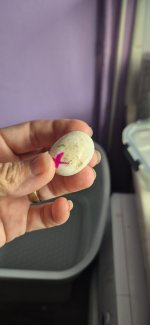
Eggs are now on day 55 and 2 started sweating on day 51 im trying not to look through the door ( its glass so no need to open it) every 5 seconds but its really hard
Im hoping they hatch by end of next week as were away for a week on the 31st which is day 71 😔
Il be super sad to miss them pipping but will have a camera on them and im only hr away if I need to run home to sort anything out
 

Attachments

  • 20260712_071502.jpg
    20260712_071502.jpg
    923.1 KB · Views: 1
One test I used to use that was pretty reliable was to lightly spray the eggs with water. Those that absorbed the water were good. Those that remained wet looking, well, not so good.
 
One test I used to use that was pretty reliable was to lightly spray the eggs with water. Those that absorbed the water were good. Those that remained wet looking, well, not so good.
All eggs look good still they all have viens and iv seen movment in most when iv candled them
Just getting impatient with them as there now potentially due to hatch anytime in the next few weeks
Do you ever cut before one pips?
 
All eggs look good still they all have viens and iv seen movment in most when iv candled them
Just getting impatient with them as there now potentially due to hatch anytime in the next few weeks
Do you ever cut before one pips?
No, not really. But I was dealing with such numbers that I was thankful of any babies that delayed me having to take care of them.

Honestly, I would not recommend it. If you spook the baby and it tries to exit the egg way too prematurely, good chance it will snag the yolk sac on something and pull out it's intestines. That would be a pretty discouraging day for you. Or if you have any sort of bug problem, the bugs could attack the opened egg. Especially ants. They can be especially aggressive when they discover a new food source.

In cases like this there is a term that applies in the horticultural realm that is somewhat beneficial to emulate. "Benign neglect". Sometimes just leaving things alone is the best course of action. Or in this case, inaction. Nature has been doing this for a very long time without our help.
 
Back
Top