spyrotheleo
New member
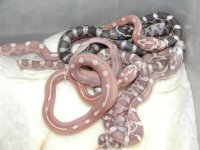
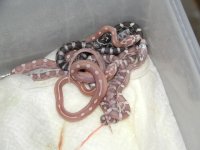
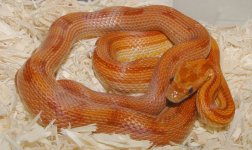
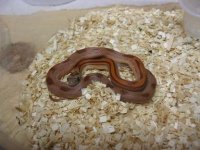
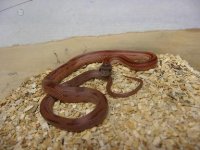
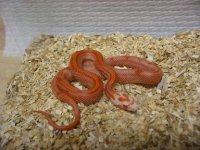
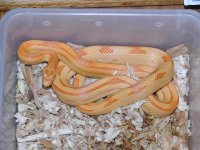
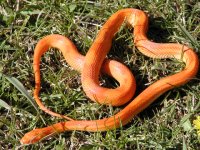
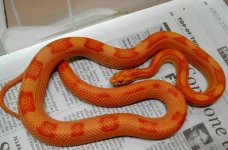
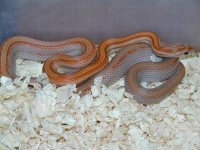
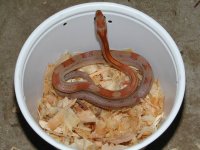
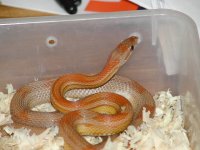
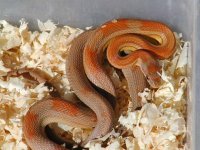
What would be cool is a motley opal corn and select breed the ones with the most striped pattern.


I couldn’t agree more! The future of the Opal Corns, in whatever pattern they come in, looks to be very promising! The underlying secondary colors of pink and orange, or we can lump them together as “Peach”, have only begun to be discovered. We haven’t even scratched the surface yet!spyrotheleo said:What would be cool is a motley opal corn and select breed the ones with the most striped pattern.

 IMO this would easily account for the reports that striped corns are rare when crossing motley/stripe X motley/stripe. Whether or not they actually, really, truly are alleles, in more than 99% of crosses they act exactly like alleles do. So for all intents and practical purposes, they should be considered and treated as alleles. It may technically be "wrong" but then so is the science behind all of the technology developed in the last 100 years. :santa:
Serpwidgets said:The normals that you guys say came from motley X stripe crosses, they have checkered bellies, right? I've heard people say that they got normals but what happened is the dorsal pattern didn't look motley to them, so they thought they weren't motleys.
Not trying to be a wiseguy, but if motley and stripe are alleles then motley x stripe are single heterozygous, not double. The number of hets comes from the number of loci, not the number of mutant genes.
I was thinking two different genetic traits but only one copy, so they were double hets. Now I know what they really are, Homo for Striped and Motley, OH that is not right either!LOL I guess we have moved beyond basic genetics, at least in my book, now. Single hets that are carrying single copies of two different genes. What is next?!
How about Motleys are Homo Motley and Stripes are Homo Motley and Gene Q? When Motleys are bred to Stripes, the offspring are Homo Motley and het Gene Q.Serpwidgets said:I haven't been able to come up with anything that even comes close to reasonable as an alternative to the alleles idea. Nobody else has ever mentioned a specific alternative either.
)
LMAO, with all the "quotes" everywhere, I sound like frickin' Dr Evil, eh?Serpwidgets said:"stripe."
"retained-sperm father"
"alleles"
"never"
"double hets."
"het for striped"
"pure striped"
"sufficiently identical to alleles."
Serpwidgets said:Along those lines, I wonder if the "cubed" type pattern in your stripes is in fact the result of a gene Q acting as a recessive (secondary effect) upon the striped pattern. It would actually be pretty handy if that were the case.
Yep, every rule in genetics has exceptions.Katt said:I just wanted to say, there is something called reversion that during meiosis a mutant gene mutants back to the wild type so one of the gametes is normal. It's like two amels producing a normal.
I'm fond of saying that if it weren't for the exceptions we wouldn't exist, nor would our cornsnakes.