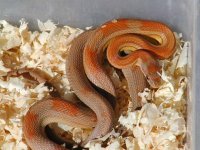
• Hello!

    Either you have not registered on this site yet, or you are registered but have not logged in. In either case, you will not be able to use the full functionality of this site until you have registered, and then logged in after your registration has been approved.

    Registration is FREE, so please register so you can participate instead of remaining a lurker....

    Please be certain that the location field is correctly filled out when you register. All registrations that appear to be bogus will be rejected. Which means that if your location field does NOT match the actual location of your registration IP address, then your registration will be rejected.

    Sorry about the strictness of this requirement, but it is necessary to block spammers and scammers at the door as much as possible.

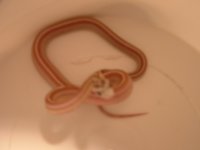
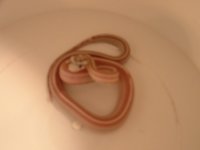
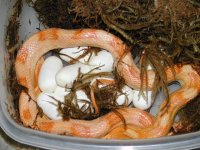
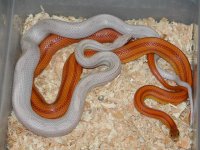
A few more striped bloods

spyrotheleo said:
What would be cool is a motley opal corn and select breed the ones with the most striped pattern.

I couldn’t agree more! The future of the Opal Corns, in whatever pattern they come in, looks to be very promising! The underlying secondary colors of pink and orange, or we can lump them together as “Peach”, have only begun to be discovered. We haven’t even scratched the surface yet!

Yes, I have discontinued using “Coral” Opals for the colorful Opals and started using “Peach” Opals. It works for me. The Opals I produce are not homo for Hypo anyway so Coral is out the door.

Look what started hatching yesterday. I was really hoping to get exactly what you described, an Opal Motley with dorsal striping, but I had to settle for this guy or gal. I used one of my Snow Motleys with almost complete dorsal Striping X Lavender. I have seen some dorsal striping in the Motleys from the 2004 hatch. Look at these two Lavender Motleys. One has classic Motley pattern and the other has a lot of dorsal striping and they are both from pure motley lines. See what I mean, about how the dorsal striping on Motleys is acting similar to the Aztec gene. Man, I use to call them Striped Motleys now I have to say Motleys with dorsal striping. I thought we were trying to keep things short. I think the new meaning of Striped Motleys SUCKS!!!!!!!!!!!

Talk about Murphy’s Law Hurley! It is not always bad. I have hatched out 5 Lavender Motleys out of a first clutch of 8 eggs and a second clutch of 8 eggs. They were Hets for Snow Lavender Motley so I could have produced an Opal Motley like what was described, but I won’t complain about 5 Lavender Motleys out of 16 eggs! I just took photos of the clump of hatchlings that had the two Lavender Motleys in them. Another one died before it got out of the egg, so my luck is not that good. There is another Lavender, Anery A and amel hiding under the towel. Not one normal, can you believe that!?
 

Attachments

  • P9170003.JPG
    P9170003.JPG
    61.1 KB · Views: 48
  • P9170002.JPG
    P9170002.JPG
    58.5 KB · Views: 38
I think there's a noticeable difference between pure motley and pure stripe. I don't think any amount of selective breeding can make motleys that would pass for stripes, nor do I think stripes can be selectively bred to look like motleys. From what little I've seen, the "cubed" pattern is not motley, but pure stripe.

It seems :shrugs: as if the heterozygous "motley stripe" takes on the motley phenotype. I dunno though, it also seems as if very few people can ID striped corns unless they actually have a 4-lined pattern. ;) IMO this would easily account for the reports that striped corns are rare when crossing motley/stripe X motley/stripe.

The normals that you guys say came from motley X stripe crosses, they have checkered bellies, right? I've heard people say that they got normals but what happened is the dorsal pattern didn't look motley to them, so they thought they weren't motleys.

I haven't been able to come up with anything that even comes close to reasonable as an alternative to the alleles idea. Nobody else has ever mentioned a specific alternative either. The only thing that will settle the argument, IMO, is actual genome mapping. ;) Whether or not they actually, really, truly are alleles, in more than 99% of crosses they act exactly like alleles do. So for all intents and practical purposes, they should be considered and treated as alleles. It may technically be "wrong" but then so is the science behind all of the technology developed in the last 100 years. :santa:

Not trying to be a wiseguy, but if motley and stripe are alleles then motley x stripe are single heterozygous, not double. The number of hets comes from the number of loci, not the number of mutant genes. :D
 
Serpwidgets said:
The normals that you guys say came from motley X stripe crosses, they have checkered bellies, right? I've heard people say that they got normals but what happened is the dorsal pattern didn't look motley to them, so they thought they weren't motleys.

Not trying to be a wiseguy, but if motley and stripe are alleles then motley x stripe are single heterozygous, not double. The number of hets comes from the number of loci, not the number of mutant genes. :D

Mine had checkered bellies and there was no doubt that they were normals and amels.

I learn something every day. Not a wise guy, a teacher! :) I was thinking two different genetic traits but only one copy, so they were double hets. Now I know what they really are, Homo for Striped and Motley, OH that is not right either!LOL I guess we have moved beyond basic genetics, at least in my book, now. Single hets that are carrying single copies of two different genes. What is next?!

Certainly, another allele to Stripes/Molteys or Ultra/Amels for sure!
 
Serpwidgets said:
I haven't been able to come up with anything that even comes close to reasonable as an alternative to the alleles idea. Nobody else has ever mentioned a specific alternative either.
How about Motleys are Homo Motley and Stripes are Homo Motley and Gene Q? When Motleys are bred to Stripes, the offspring are Homo Motley and het Gene Q.

Why would this scenario not be possible? What do you think?
 
My normal from motley x srtipe was %100 normal pattern checkers and all. Here is a pic of what I have been calling an "almost fully stripe motley/stripe". Sorry for my bad photography this is the only one from my ghost motley x ghost stripe breeding. Nothing else looked close.There was no selective breeding here, This was random. I hope you can tell from the photo it is not a normal stripe. It has much wider stripes. What should I call it?
 

Attachments

  • grp17 015.jpg
    grp17 015.jpg
    119.6 KB · Views: 45
  • grp17 002.jpg
    grp17 002.jpg
    116.4 KB · Views: 46
Last edited:
Jason, I would definitely say that is not a "stripe." (when I say stripe, I mean the genetic 4-lined stripers as opposed to the genetic motleys.) The light-colored center stripe is tiny, that's the indicator.

As far as the normal(s) go, I think sperm retention is one possibility. Another thing a lot of people don't consider is that multiple males can father the same clutch. We had a couple of clutches this year that were definitely from more than one father.

I would also be very curious to learn the genotype of that normal. If it hatched out of one of my clutches and I didn't believe it was from sperm retention, I'd definitely want to test it out. Is there a potential "retained-sperm father" (any non-motley or non-striped male bred to her this year or last year) that has a gene you know is not in the suspected father?

-----

Joe, I agree that the gene Q theory is a possibility, but in practice it will not vary sufficiently from the "alleles" thing and IMO it's an unnecessary complication.

1- If striped is homo motley and gene Q then it's still homozygous for the recessive motley. Breeding motleys to stripes (mm QQ X mm qq) should also "never" produce anything with checkered bellies. (Gene Q doesn't explain the appearance of normals any more than the alleles theory. :))

2- If gene Q is not linked to motley, then they will separate. Striped X Normal (mmqq X MMQQ ---> MmQq) would create "double hets." Breeding them would create an F2 consisting of 12/16 normals, 3/16th motleys, and 1/16th striped.

3- Since 2 is definitely not the case, then a theoretical gene Q must be linked to motley. In this case, they will act exactly like alleles... except when there is a crossover. (This depends on how strong the link is: 50%? 80%? 99%?)

In the case of a crossover, normals "het for striped" (from a "pure striped" X normal cross) should produce an occasional motley offspring. This would include (MmQq x MmQq) het x het, and (MmQq x mmqq) het X striped crosses.

I've never heard of this happening either, so IMO it would be rare enough to make it "sufficiently identical to alleles." :D
 
Serpwidgets said:
"stripe."

"retained-sperm father"

"alleles"

"never"

"double hets."

"het for striped"

"pure striped"

"sufficiently identical to alleles."
LMAO, with all the "quotes" everywhere, I sound like frickin' Dr Evil, eh? ;)

"tractor beam" :grin01:
 
Speaking of gene Q

Along those lines, I wonder if the "cubed" type pattern in your stripes is in fact the result of a gene Q acting as a recessive (secondary effect) upon the striped pattern. It would actually be pretty handy if that were the case. :D
 
Jason, I would also say that it is a Motley with a clean dorsal stripe. It looks exactly like the Snow Motleys that I was talking about that look like an Amel Striped Cal King.

I agree with Serp, that it is the width of the stripe that makes me think that it is a Motley. A Striped Corns dorsal stripe is nearly twice that wide.
 
Serpwidgets said:
Along those lines, I wonder if the "cubed" type pattern in your stripes is in fact the result of a gene Q acting as a recessive (secondary effect) upon the striped pattern. It would actually be pretty handy if that were the case. :D

Amen to that! I knew what your answer would be to the "Gene Q" theory to Stripes.

This is the only "Cubed" Striped which happens to be an Amel het Lavender that I have ever bred. I bred her to this Striped Lavender which is more of the broken striped type than the "Cubed" type. The clutch mainly consited of Stripes like both parents with a couple of nicely striped ones in the clutch as well.
 

Attachments

  • P5200019.JPG
    P5200019.JPG
    72.2 KB · Views: 62
  • P5030035.JPG
    P5030035.JPG
    73.1 KB · Views: 69
I only bred my motley female to one male this year, the striped.It was her one and only clutch this year. I was currious and contacted the guy who sold her to me as an adult early this year and he couldn't remember what he bred her to last year. So sperm retention from last year is possible. Anyway is it just me or does that type of stripe warrant a name of it's own? I am seeing more and more of them and since they are very different from a lot of the other motley/stripes I think they should have a name of thier own. I know I have heard reverse stripe at some point but can't remember where. I think it would be a fitting name.
 
I just wanted to say, there is something called reversion that during meiosis a mutant gene mutants back to the wild type so one of the gametes is normal. It's like two amels producing a normal.
 
Katt said:
I just wanted to say, there is something called reversion that during meiosis a mutant gene mutants back to the wild type so one of the gametes is normal. It's like two amels producing a normal.
Yep, every rule in genetics has exceptions. :) I'm fond of saying that if it weren't for the exceptions we wouldn't exist, nor would our cornsnakes.
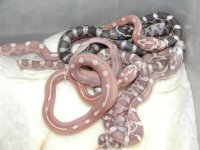
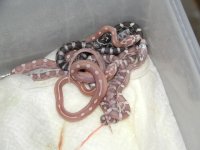
Anyway, as long as Joe and I have totally hijacked Richard's thread (hehe, we're good at that, aren't we?) I thought I'd throw in some more pics of the "cubed" pattern on striped corns.
 

Attachments

  • Zirc_0904_01.jpg
    Zirc_0904_01.jpg
    107.6 KB · Views: 52
  • Zirc_0904_02.jpg
    Zirc_0904_02.jpg
    107.5 KB · Views: 48
  • Zirc_0904_03.jpg
    Zirc_0904_03.jpg
    83.9 KB · Views: 48
Nope, I'm happy the thread was hijacked - actually, I've learned quite a bit following along. I understand now why these bloods I got this year and last, from breeding my 2001 striped blood female back to her father, are coming out mostly with the cubed pattern - partial stripes in the beginning, then fading into cubed. I also got it this year in a different breeding, which produced amel striped bloods. It's actually quite interesting looking, and I'm intrigued to see how they look as they mature, because they are both cubed and bloodred, so the cubing does fade as they age (I have a pair from 2003 that are doing just that). And I can say with certainty that there is no motley genes in these - I have been breeding these groups of animals since 1997 and have never produced a single snake that could be characterized as motley.

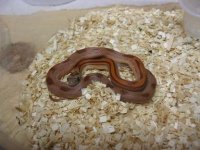
Anyway, here's a few more pics from some 2004 hatchlings, showing varying degrees of cubing - all are bloodreds. The snake in the first pic is in a shed, but it does show the pattern variation quite well anyway.

Rich Hume
 

Attachments

  • 112-1258_IMG.JPG
    112-1258_IMG.JPG
    24 KB · Views: 57
  • 112-1263_IMG.JPG
    112-1263_IMG.JPG
    21.8 KB · Views: 55
  • 112-1257_IMG.JPG
    112-1257_IMG.JPG
    26.7 KB · Views: 57
  • 112-1253_IMG.JPG
    112-1253_IMG.JPG
    24.7 KB · Views: 61
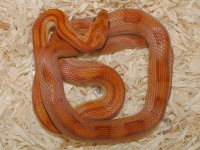
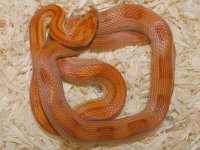
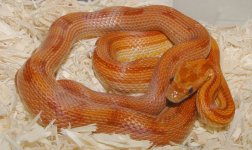
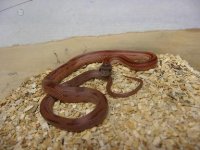
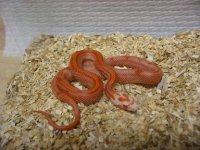
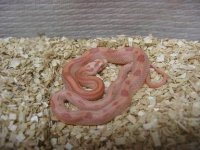
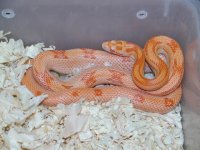
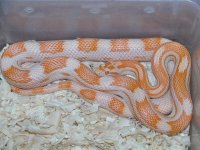
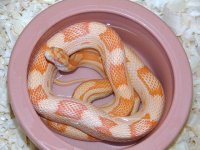
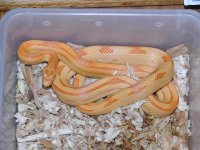
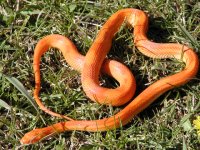
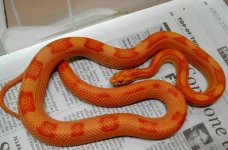
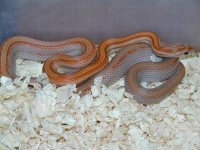
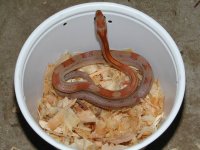
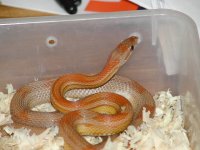
I thought I would take some photos of my “Cubed” Corns since I had the camera out today. The photos are not the greatest, but good enough. I have been surprised at the variety in color that I have seen from this group of corns. I really hate the “Cubed” Name and call them Sunspot around here, but some are very Cubed and very few have circles on them.

I have pretty much named most of these. Orange Sherbet & Vanilla, Indian Pattern, Creamcicle Look alike, Sunglow. Not real names, but kind of what they look like to me. Say what ever you want about their genetic make up, but they are very unique and beautiful Corns, especially when they get older.

I get perfect stripers from this group and some of these, but never a typical Motley. This group does not have Motley in them as far as I know. I have been working with them a great deal longer than Richard has been working with his, and not one Motley in the bunch.

I saw the photo that Rich posted of a known Motley X Striped, which was very cool looking. The striping was very random and looked like streaks from a meteor shower. When I have crossed the two lines, I have gotten Motleys on the side of normal looking. I bred them back to Motleys and got all Plain Jane Motleys. The mystery continues.
 

Attachments

  • P9230007.JPG
    P9230007.JPG
    68.5 KB · Views: 46
  • P9230011.JPG
    P9230011.JPG
    70.7 KB · Views: 46
  • P9230012.JPG
    P9230012.JPG
    69.2 KB · Views: 45
  • P9230017.JPG
    P9230017.JPG
    71.5 KB · Views: 43
  • P4240026.JPG
    P4240026.JPG
    79.9 KB · Views: 45
Here is another Sunglow, that Mike Panichi has.

The other one is not a Cubed Corn, but one of my favorite from this project. She looks like a Striped Miami Phase if you ask me and very unique in my collection.

I found an old photo of my “Ugliest” Corn candidate, that is a “Miami Phase Cubed” Corn, I suppose. I have to get some new photos of him. He has turned out to be a very interesting looking young adult. Not so Ugly anymore.
 

Attachments

  • Mike Panachi 180.jpg
    Mike Panachi 180.jpg
    71.4 KB · Views: 46
  • P9230006.JPG
    P9230006.JPG
    70.1 KB · Views: 49
  • P2260002.JPG
    P2260002.JPG
    66.6 KB · Views: 47
Here is “Mr. Ugly” as he looks today. I changed the poor guys file name to Miami Cubed, before he gets a complex.
 

Attachments

  • P9230003.JPG
    P9230003.JPG
    62.2 KB · Views: 50
  • P9230007.JPG
    P9230007.JPG
    73.4 KB · Views: 47
Back
Top