• Hello!

    Either you have not registered on this site yet, or you are registered but have not logged in. In either case, you will not be able to use the full functionality of this site until you have registered, and then logged in after your registration has been approved.

    Registration is FREE, so please register so you can participate instead of remaining a lurker....

    Please be certain that the location field is correctly filled out when you register. All registrations that appear to be bogus will be rejected. Which means that if your location field does NOT match the actual location of your registration IP address, then your registration will be rejected.

    Sorry about the strictness of this requirement, but it is necessary to block spammers and scammers at the door as much as possible.

Any feedback on this one?

sissabagama

New member
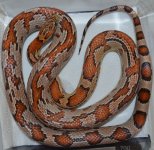
Out of the 22 babies, this is the only one that had a pattern like this. What do you think of it?


2G8oU
 
Nice looking snake !

It would help if you post what the pairing (mom and dad) are and what the other babies are?
Are the other 21 babies visually the same?
 
You tried to link an album. You need to put each direct image link inside tags. The simplest way to get a direct link without explaining how to navigate Imgur is to just right click each image and select "Copy image address". Add a lowercase h before the .jpg extension to make it automatically resize to forum-friendly dimensions.

[IMG]http://i.imgur.com/VS1ALIAh.jpg
od5qXJwh.jpg
 
Dad is a Tessera, mom is a Miami.
12 Tessera babies including this one and 10 Normals.

I just thought this one was a bit unusual because the back stripe did not develop.
 
I love the little odd ones that come out of predictive pairings.

You do see that broken stripe pattern with Tessera's. Your's is more unique than most. From what I read over time is most Tesseras produced are from Tessera X non-Tessera pairings due to high egg mortality rate with Tessera X Tessera.
So I would guess that the broken stripe pattern occasionally seen in clutches is influenced by the non-tessera.

I have a couple of corn snakes that I keep debating about seeing if their odd pattern will pass on to their progeny.
 
Do you have a full body dorsal pic? That is likely a non Tessera.
The Tessera gene can have an odd effect on some of the siblings.
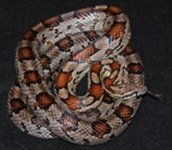
THIS CLUTCH that Tara Smith and I produced in 2011, three of the babies had odd Aztec type patterning.

The pic of the baby here is not a Tessera (just a sibling), produced by Steve Roylance.

The patterning has some Tessera resemblance, but they're not Tessera's.

It makes for very pretty babies though. :)
 

Attachments

  • 176205_409149_VeryLarge_EbKnDmNgIOLTJqF.jpg
    176205_409149_VeryLarge_EbKnDmNgIOLTJqF.jpg
    126.4 KB · Views: 124
I love the little odd ones that come out of predictive pairings.

You do see that broken stripe pattern with Tessera's. Your's is more unique than most. From what I read over time is most Tesseras produced are from Tessera X non-Tessera pairings due to high egg mortality rate with Tessera X Tessera.
So I would guess that the broken stripe pattern occasionally seen in clutches is influenced by the non-tessera.

I have a couple of corn snakes that I keep debating about seeing if their odd pattern will pass on to their progeny.

I have not heard of any high mortality rate with Tessera X Tessera pairings.
The clutch I produced, I had 100% hatch.

I spoke with Don about the odd patterning back in 2011, and he said he had seen some odd patterning in the non Tessera siblings, when one parent was a Tessera. I think it's the Tessera gene that has something to do with it.

That said, I suppose there is a chance your baby is a Tessera, but if I were selling it, I would not label it as a Tessera. JMO :)
 
I have not heard of any high mortality rate with Tessera X Tessera pairings.
The clutch I produced, I had 100% hatch.

I spoke with Don about the odd patterning back in 2011, and he said he had seen some odd patterning in the non Tessera siblings, when one parent was a Tessera. I think it's the Tessera gene that has something to do with it.

That said, I suppose there is a chance your baby is a Tessera, but if I were selling it, I would not label it as a Tessera. JMO :)

I just googled it to find where I possibly read about the egg mortality rate and found this from VMS.com
"The first known dominant mutation in Cornsnakes, with all adult specimens proven heterozygous for this allele!When bred to a completely normal Cornsnake, a Tessera will produce a clutch of half Tesseras and half completely normal babies. Tessera to Tessera breedings have thus far produced only what appear to be Tesseras and completely normal Cornsnakes. Such clutches have also resulted in a moderate egg failure rate, which leads one to the conclusion that the Tessera allele may be lethal in the homozygous state, a situation well known in other species such as Merle dogs. A large number of Tesseras from such clutches will need to be grown up and test bred to confirm or deny whether homozygous specimens may simply be identical to heterozygous."
I have no idea how accurate it is since I don't have or bred Tessera's. Your clutch seems to deny the theory. I do see a quite a few snakes listed as Tesseras that have a broken stripe pattern but not to that degree. My thought was one was influencing the other so it can be a Tessera influence on a normal.
Possibly we see most breedings of Tessera's are to non-Tessera's is because of the high return of Tesseras in the clutch and not because of egg mortality.

I'm always happy to hear from a member that has first hand experience on a subject. Great insight for the OP and the rest of us. Thank you :)
 
That's the first time I have heard about that.

Most of the clutches I have produced were Tessera pairings, and I found them to have the highest hatch rate, and best feeders, overall.
If someone is having mortality issues, my guess would be incubation problems, or something.

I've talked to others who have said their Tessera clutches were heartier than most others as well.

I think most people have not been doing Tessera X Tessera because they're focusing on producing Tessera morphs.

I think VMS is expecting visual differences in Super/homo Tessera's. I think that if there are markers, they are very subtle.
It doesn't sound like they had much interest in pursuing testing out which Tessera's from a Tessera X Tessera clutch were Super/homo.
 
I also did a tessera to tessera pairing this year. I got 16 fertile eggs, and only one baby didn't develop properly and died in egg.
 
I also did a tessera to tessera pairing this year. I got 16 fertile eggs, and only one baby didn't develop properly and died in egg.

If it were a lethal gene, there'd be a lot more deceased babies. I'll be doing more Tessera X Tessera pairings, and I hope that we're able to figure out markers for the Super/homo babies.
 
That's the first time I have heard about that.

Most of the clutches I have produced were Tessera pairings, and I found them to have the highest hatch rate, and best feeders, overall.
If someone is having mortality issues, my guess would be incubation problems, or something.

I've talked to others who have said their Tessera clutches were heartier than most others as well.

I think most people have not been doing Tessera X Tessera because they're focusing on producing Tessera morphs.

I think VMS is expecting visual differences in Super/homo Tessera's. I think that if there are markers, they are very subtle.
It doesn't sound like they had much interest in pursuing testing out which Tessera's from a Tessera X Tessera clutch were Super/homo.

That is my experience too from this year. Ihad 2 TesseraxTessera clutches and got 100% hatch rate and the percentage of non-feeders is quite lower than my other clutches.

Alex
 
Do you have a full body dorsal pic? That is likely a non Tessera.
The Tessera gene can have an odd effect on some of the siblings.

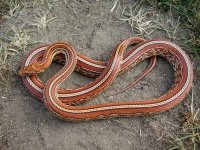
What would a tessera hatchling look like if it´s parents also had some polygenetic aztec and banded traits?

I think that is how a banded tessera should look like.
 
What would a tessera hatchling look like if it´s parents also had some polygenetic aztec and banded traits?

I think that is how a banded tessera should look like.
Have you produced Tessera's from a banded parent?
I have not, I have only used normal patterned to pair with Tessera's.
The three with aztec type babies we got from a Tessera pairing were out of a normal patterned WC Alabama locale female.
I've had a couple others with some odd pattern babies from Tessera to normal patterned pairings.
 
Count me in as another that has had great success with tessera x tessera, this being my first year doing such a pairing and with virgin snakes. IIRC the clutch was 17 with 15 fertile eggs. 15 out of 15 hatched and I only have 1 or 2 that are still refusing food, with most getting ready to hit meal #5.
 
This baby could be a Tessera, but I don't think it is.
You can always do a test breeding when this one is old enough, to find out for sure.

I think the Aztec/aberrant patterning is random, I don't think it is necessarily linked to the pattern of the non Tessera.
 
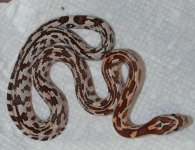
The first pic is the offspring of the second and third pics.
 

Attachments

  • 67537_363739_VeryLarge_RtPUVZyVM54i.jpg
    67537_363739_VeryLarge_RtPUVZyVM54i.jpg
    169 KB · Views: 43
  • 67537_388172_VeryLarge_6qxAOHN30hL.jpg
    67537_388172_VeryLarge_6qxAOHN30hL.jpg
    80.4 KB · Views: 44
  • 71683_266151_VeryLarge_khcfempBPMSx.jpg
    71683_266151_VeryLarge_khcfempBPMSx.jpg
    237.2 KB · Views: 44
Back
Top