• Hello!

    Either you have not registered on this site yet, or you are registered but have not logged in. In either case, you will not be able to use the full functionality of this site until you have registered, and then logged in after your registration has been approved.

    Registration is FREE, so please register so you can participate instead of remaining a lurker....

    Please be certain that the location field is correctly filled out when you register. All registrations that appear to be bogus will be rejected. Which means that if your location field does NOT match the actual location of your registration IP address, then your registration will be rejected.

    Sorry about the strictness of this requirement, but it is necessary to block spammers and scammers at the door as much as possible.

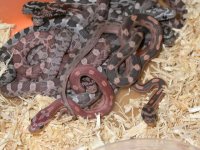
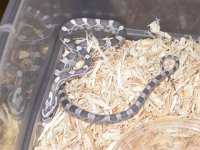
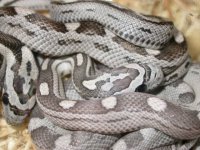
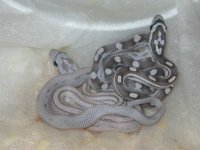
"Blued Steel" Pippies!

diamondlil said:
Have you still got the blue stripe? Love to see what she's like now

Unfortunately, she only ate once, then refused everything else. I eventually had to euthanize her.
 
I just talked to Rob on the phone to confirm some of his results. From both clutches of Anery Motleys het Dilute Striped he only produced Anery phenotypes and Dilute Anery phenotypes. There were no Ghost.

The Ghost that he has produced from the Blue Motley line, came from a Blue Motley X Blue Motley breeding, so I believe they were Hypo Blue Motley, (Hypo Dilute Anery Motleys). The reason I believe this, instead of the Blues being caused by a gene that is an allele to Hypo, is that Rob told me that the “Ghost” Motleys from this breeding, still had the diluted black (Blue) color on them, that is unlike any Ghost he has seen. They looked to him, to be a Hypo Blue Motley rather than a Pastel Motley.

Blue Motley X Anery has always produced Anerys. Blue Motley X Pewter, produced Normals. Rob lost his male Normal het Dilute, Motley, Blood, Anery A & B, so he bred some of the females to a Blue Motley male and the other one, to an Anery Motley het Dilute Striped. The loss of the male from this group is unfortunate, but still would not have really proved anything about the possiblity of an allele at the Hypo lucus due to the OR factor. The biggest loss is a Dilute Charcoal can not be produced now.

His Hypo het Dilute, Lavender, Anery A X Sibling are due to hatch any day. It will be interesting to see if we can see something that appears to be a Hypo Dilute, and not just a Hypo morph. If the Dilute gene is an allele to Hypo, then it should not be present in this group. It would have been passed on into the Normals due to the OR factor.

Are the Blue Motleys caused by an independent Dilute gene or one that is located at the Hypo Locus? I don’t see anything that can prove it one way or the other at this point. Until somebody breeds a Blue X Hypo and produces all Normals, I guess we wont know for sure. I guess I will have to test out my Blue Motley male X Hypo next year and see if he is a carrier.
 
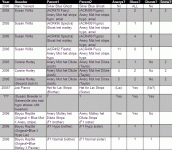
Ok, I think this is up to date. ;) (I added Susan's info from 4 posts ago.)
 

Attachments

  • BlueResults1.GIF
    BlueResults1.GIF
    42.5 KB · Views: 85
Ok, I've been trying to follow along with this thread for a couple of days and I'm not sure if I grasp all of the genetics, but I am working on that.

I'm chirping in here because I happen to have 3 of the siblings from Connie's 2006/11 clutch (the first clutch this year from Josh & Taylor.) I picked up 11/1, 11/7, and 11/8. Here are some updated photos of the three:

Gypsum (11/1 Snow)
gypsum7-17-06.jpg


Galena (11/7 Anery)
galena7-17-06.jpg


Graphite (11/8 Anery)
graphite7-17-06.jpg


The colors of the girls in the photos are pretty close to R/L. All three are eating regularly (Thought Graphite will refuse when in the blue.) and have had at least one or two sheds - I'd have to look at my records.

Now, what I was curious to know, is what the possibility of a 'Diluted' gene (I think that's the term!) would mean in regards to the hets that these critters could have? I must say I never expected anything more from these three beauties other then what I saw. Is there a possibilty that they could be het for the dilute/blue motley? What would be a reccomended mate for these 3 when they are mature enough to breed if I wanted to check for it?

I would of course be honored to work with all the Cornsnake Greats out there on this. The possibilty is exciting! I know Tim was making plans for them, but I'll bump his project if another planned breeding would be beneficial for researching the dilute gene.

I hope I don't sound presumtous (sp??), it was not my intention. I was more wanting to know if these critters of mine (thanks you Connie! They are gorgeous!) could be of help down the line for breeding trials.

Jenn :shrugs:
 
I just receive a note from Rob about the results of his third clutch from his Anery Motley het Striped Dilute X Same breedings. There were only two eggs that survived and he hatched out a Blue Motley and a Striped Blue. The guy must have taken Murphy out for some drinks or something. His over all results, were about 50% Blues and 50% Anerys.

I have been thinking about how any of the results would show that the Dilute and Blue genes are alleles, and the only one that shows anything is Rob”s Blue X Hypo Lav breeding. He reported that the result was around 50% Normals and 50% Hypos. If they were allele, he should have gotten, the Ghost Blues that he has been producing, but he didn’t.

I have hatched out two small clutches from my Blue Motley this year, with a couple to go. The first clutch contained a Snow and the last clutch contained two Striped Anerys, so my Blue Motley is het for Striped Amel. It would seem as if, there are quite a few genes that had already been mixed in with the Blues, before they were discovered. We know that at least Amel, Hypo and Striped are in there, so some interesting Dilute results may show up now that we know.
 
Last edited:
Jenn, the current hypothesis would make the dilute gene yet another recessive (for lack of a better term) "hypo-like thing," and it is independent of hypo at least. So, this would place all of yours as 66% poss hets. :)

SOS (grampa) was also het hypo, so there's a decent chance that Josh or Taylor carry hypo, too... translation: your hatchlings are also potentially carrying the hypo gene. ;)
 
Serpwidgets said:
Jenn, the current hypothesis would make the dilute gene yet another recessive (for lack of a better term) "hypo-like thing," and it is independent of hypo at least.
I was wondering how we would classify the Dilute gene. Will it be added to our long list of Hypomelanistic genes or will be stand alone? It is not simply reducing black pigment, but operating in a different way. It is more like adding white paint to other colors, than a reduction of black pigment.
 
ecreipeoj said:
I was wondering how we would classify the Dilute gene. Will it be added to our long list of Hypomelanistic genes or will be stand alone? It is not simply reducing black pigment, but operating in a different way. It is more like adding white paint to other colors, than a reduction of black pigment.
Good question. What does it do to normals? Maybe its effect only is visible when the snake lacks reds. :shrugs:

There should be some recovered in the normal phase this year from the hypo lav X blue motley F1s, so maybe we will see. :) (Or maybe we won't be able to tell. :grin01: )
 
Serpwidgets said:
Jenn, the current hypothesis would make the dilute gene yet another recessive (for lack of a better term) "hypo-like thing," and it is independent of hypo at least. So, this would place all of yours as 66% poss hets. :)

SOS (grampa) was also het hypo, so there's a decent chance that Josh or Taylor carry hypo, too... translation: your hatchlings are also potentially carrying the hypo gene. ;)

From the paperwork Connie sent us w/ the hatchlings I'd known about the 66% chance for the het hypo. I just forgot about it when I wrote the post last night. But that is about what I expected really. The only real way to be sure would be multiple breeding trials I suspect. Of course, that means I'd have to find a male that is carrying the gene (if that is what is causing the blue paint job! lol :sidestep: ).

Gives me a lot to think about.

Thanks!
Jenn
 
I was wondering how we would classify the Dilute gene. Will it be added to our long list of Hypomelanistic genes or will be stand alone? It is not simply reducing black pigment, but operating in a different way. It is more like adding white paint to other colors, than a reduction of black pigment.

Well, that depends on if you believe that long list of hypos just "simply reduce black pigment". IMO, only one does...ultra. We know it is an allele to amelanism, which seems to only affect the amount of black pigment. To me, ultra is "the" hypomelanism, so to speak, of the group we call types of hypo. Hypomelanism (standard, hypo A) does have the effect to our eye of having less pigment, but I don't know if that's truly the case or the result of the gene causing less spread of the black resulting in thinner borders and less coverage of the snake with a melanin wash. :shrugs: And what about those coral snows when hypo is in the mix? Not the result of simple "hypomelanism", for sure. Then take Sunkissed...absolutely there are pattern abnormalities at work there. Their hypo look is not the result of "simply reducing black pigment". Lava, same thing...it's more than just reducing pigment.

We call all of these genes "hypomelanistic genes" because of their net effect to our eyes of "lessening the blacks". I'd consider the dilution gene (assuming it's its own recessive gene) a type of hypomelanism as much as the above others are. To me, those animals look "less black" than a normal animal. Yes, other things, too, but that qualifies most of the hypo complex for being in the hypo complex. :crazy02:
 
From the paperwork Connie sent us w/ the hatchlings I'd known about the 66% chance for the het hypo.

With the realizations we're coming to with the possibility of a "dilute" gene, which may or may not be related/linked to hypo, the genotypes of Josh and Taylor (and their children) are in limbo.

S.O.S. (the grandfather) was an anery motley het hypo, that is known. He was bred to a standard hypo A type ghost with no weirdness in the line (that I know of). Half the clutch were typical ghosts, some anerys, some snows. We know he was an anery motley (q-tipped) het hypo and amel. Gwen (grandmother) was a normal motley known NOT het hypo, but het amel and anery. Josh and Taylor are anerys from that crossing. None of them or their siblings were hypo and none appeared "dilute". They were typical anery mots, some a little lighter (Josh and Taylor), some a little darker, but what I considered within normal variation for the morph.

The first year I bred them, I got a couple snows, some typical anerys, and what I thought was a ghost, so I believed them to be het for hypo A, just like Grandaddy S.O.S. (as well as het amel). Given the results this year and seeing other real ghost motleys, I no longer think that animal was a ghost. I was always taken with his silvery grey "non-brown" coloration, something I haven't seen in ghosts. The results of this year's 2 clutches follow what I saw in that original clutch. A couple snows, 2 "dilutes", and 3 or 4 anerys (all motley).

After reviewing what's been happening, I would say that as of now Josh and Taylor are Anery Motleys, het amel and "dilute", 50% poss het hypo. I'd say that the chances are that both of them are not het hypo if what we believe about the "dilute" trait comes to be.

If we say that "dilute" is an independent recessive gene, then your anery hatchlings would be anery mots, 67% het amel and dilute, poss het hypo and the snow mot is 75% het or homo dilute, poss het hypo.

That's the best I can tell you right now.

I've got a brother to Josh back from Angel and Don Gallagher, who still have siblings from Josh and Taylor's clutch. I've also held back a normal looking anery motley female from the first clutch who has some lovely striping to go with Joshii's (the brother's) nice striping. I'm holding back a pair of "dilute" anery motleys from the second clutch for now out of morbid curiosity pending what becomes of all of these blue/blued-steel/blue motley/dilute discussion and test-breeding. Chuck still has an amel motley sister sibling of Josh and Taylor as well.

It's funny, this coming out in this line. All I wanted from them was to recreate "S.O.S.", the grandfather, in pattern.
 
Serpwidgets said:
Good question. What does it do to normals? Maybe its effect only is visible when the snake lacks reds. :shrugs:

There should be some recovered in the normal phase this year from the hypo lav X blue motley F1s, so maybe we will see. :) (Or maybe we won't be able to tell. :grin01: )
Well, Joe posted a pic of what sure could pass for a dilute normal zigzag on the first page. Looks like the black has turned blue and the red has also been reduced. The same sort of thing seems to happen with the blue dog breeds...the reds get reduced, as in the fawn Dobermans. And from what I can remember from the pic of that clutch of normal stripes, hypo stripes and tweener stripes, I think the same thing was happening. I'm really sorry I deleted that thread as that breeder in Gainesville has, so far, not come forth.
 
Just because it feels so good to have a hatchling exactly like the light grey ones Susan has and probably with the same genetic make up :crazy02: Finally I can see some rare/weird morph discussed on this forum IRL EVERY DAY! :rolleyes: :grin01:
 

Attachments

  • PICT1014.jpg
    PICT1014.jpg
    205.6 KB · Views: 79
  • PICT1016.jpg
    PICT1016.jpg
    164.8 KB · Views: 78
I just received an email from Rob about the Blue Motley X Normal het Dilute, Motley, Charcoal, Blood (Blue Motley Pewter) clutch.

The Blue Motley X (Blue X Pewter) pairing have hatched and there are Normal Motleys, Hypo Motleys and Non Motley Blues. I will send some more pics as soon as they have shed. Both the Normal Motley and the Hypo Motley have extreme pink.
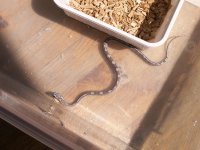
He sent me some photos of the Blue Corn (Normal Phase Blue) and a group shot, and they are what he says they are, but the photos were small, so I will wait until he sends me a larger file photo before I post them.

The questions of whether or not a Blue Phase Corn could be produced without the Motley gene in the mix has been answered, but where are the Dilute Normals and Dilute Motleys. I asked Rob if he thought it may be possible, that the Hypo Motley or even the high pink Motley are actually Dilutes and not Hypos at all? I would assume they would be similar and may be very difficult to distinguish a Dilute from a Hypo. They certainly have fooled a few people when combined with Anery.
 
Blue Motley X Het Blue Motley Pewter

Rob sent me some larger file photos of the thumbnails he sent me. The first photo is a shot of the clutch and was intended to show the “Hypo” Motley. I think it looks a little odd to be a “Hypo” Motley, and Rob just “thought” it was a Hypo, but it may be the Dilute Phenotype we were all hoping for. There is a Normal Pattern one in this photo too, which may be of the same phenotype. It will be very interesting to see them after they shed.

I think this clutch is pretty much exactly what you would have expected from a Dilute Anery Motley X Het Dilute, Anery Motley, Charcoal, Blood mating, especially if we didn’t suspect the hypo gene was in the mix. ( Dilutes, Dilute Motley, Blue, Blue Motley, Anery, Anery Motley, Normals)

The last photo is of the Blue with a Normal pattern, so now combined with the Striped Blues, the “Blues” are certainly is not a Motley phenomenon.
 

Attachments

  • Clutchrs.jpg
    Clutchrs.jpg
    125.2 KB · Views: 62
  • Normal Bluers.jpg
    Normal Bluers.jpg
    115.9 KB · Views: 62
Here are a couple more photos that Rob sent me of Blues compared to Anerys.
 

Attachments

  • Blue Moltey and Anery Motleyrs.jpg
    Blue Moltey and Anery Motleyrs.jpg
    109.7 KB · Views: 60
  • Blue Stripedrs.jpg
    Blue Stripedrs.jpg
    84.1 KB · Views: 60
Back
Top