• Hello!

    Either you have not registered on this site yet, or you are registered but have not logged in. In either case, you will not be able to use the full functionality of this site until you have registered, and then logged in after your registration has been approved.

    Registration is FREE, so please register so you can participate instead of remaining a lurker....

    Please be certain that the location field is correctly filled out when you register. All registrations that appear to be bogus will be rejected. Which means that if your location field does NOT match the actual location of your registration IP address, then your registration will be rejected.

    Sorry about the strictness of this requirement, but it is necessary to block spammers and scammers at the door as much as possible.

Breeding project results from 2006 wild-caught corn

fljeep74

New member
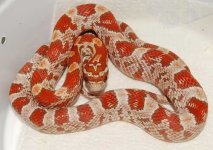
It's been quite a while since I've posted here, 2007 in fact. I posted at that time after finding a strange looking corn in Levy County, FL. Here are some pics of him the night he was found.

cornbabyold_zpsac2e3c99.jpg


snakebabyold1_zps096bc484.jpg


At this point he seemed to look like some sort of Amel, but not quite like any others I'd seen. Over the next year he started to lose a lot of his 'Amel' look and began to look almost like a Hypo but he definitely wasn't lacking dark pigment. He almost became peach colored around his saddles.

yearling1_zps8fa9eb1f.jpg


yearling_zps74ba244e.jpg


As he's gotten older he's become much more orange and peach looking.

dadcorn11of1_zps2837324a.jpg


Not being sure exactly what/who to breed him with, I decided to mate him with a normal Miami Phase female that I had. She laid 9 eggs, 6 of which survived. The largest one happened to be a female which was perfect.

This is his Daughter, shortly after she laid this years eggs. She's definitely a bit different looking, almost having a light bronze/pewter color to her.

daughter1of1_zps896565e7.jpg


Of 18 eggs she laid, 14 were odd looking like he was as a hatchling. Here are some of his daughters offspring.

This is one of the 4 'normal' looking corns. This one still seems to have coloring like his mom. Seems most corns continually change as they grow, so who knows how this guy/gal will turn out.

baby21of1_zps1e8950b9.jpg


These are some of the ones that look kinda like dad did.

This one is somewhat light throughout.
baby31of1_zps5c373ab3.jpg

baby11of1_zps389803dd.jpg


some of them are very, very orange and their bellies almost blood red.

baby41of1_zps992771da.jpg

baby51of1_zps3c6593f4.jpg


I'm really not sure what exactly the dad is nor what his 'odd' looking offspring have become. They don't look a ton like anything else I've seen.

If anybody has any insight to what might be going on with these or any thoughts on their genetics it would be greatly appreciated.

Thanks for your time,

Mike
 
No clue about the genetics with this one but the babies do look awesome with that ventral red coloring.
 
I'm assuming you bred him back to his daughter? Here's a my quick thought based on the numbers you've given us.

The daughter has some clear miami traits, but the reds have been replaced by an orange hue, and the silver has a definite orange wash.

Out of the 18 babies, only 4 of them had a "normal-esque" look. I'd like to know how many of them display the super-saturation of orange.

I'd like to preface this by saying that this is probably more likely a polygenic inheritance, or "line-breeding" if you will. Breeding daughter to dad most likely intensified this in some of the snakes, and less in others. The 4 normals still have a orange tinted look correct?

The other option given the numbers, and the one that would merit further breeding testing, is that you may have found a dominant mutation. When you breed the male to the original Miami female, how many of the 6 looked like the father did? If its 2-4, you may be onto something here.

Assuming that the daughter you bred him back to was also a carrier for the dominant mutation (again, we're just theorizing here), the numbers could account for a hetrozygous dominant to a hetrozygous dominant breeding. The 4 normals would be about the 25% range. The rest of the 14 looking like the father would account for the other rough 75% being a carrier of at least one of the mutated dominant gene. Now here's where my question about the super-satured ones come into play. If you have between 3-5 of the intense colored ones, the could very well be a "Super" form.

When you have a Dominant mutation, that means that you only need one gene to be visually different. For example, if you breed a Tessera to any other non-Tessera cornsnake, you will get approximately 50% Tesseras. But if you breed a Tessera to a Tessera, you will get 75% Tesseras because each parent has a 50/50 odd of passing down that dominant gene. Of the 75% you would get, 25% would actually be a "Super" form of Tessera, meaning that those 25% actually have 2 of the dominant genes on the same allele. If you breed any of these Super forms to any Cornsnake, you will get 100% Tesseras because the animal will always pass one of the dominant genes. Now in Tesseras, we cannot visually distinguish the Super-form from the normal dominant form, (at least that I'm aware of). However, in other species with dominant genes, sometimes there is a visual difference. In Carpet Pythons, there is a dominant hypo gene called Caramel that lightens up the overall appearance of the animal in a yellow tint. However, when you breed a Caramel to a Caramel, 25% of the animals are Super Caramels, which all but eliminate the darker pigments, and really brighten the yellow. So if 3-5 of your special looking offspring are remarkably more saturated, these may be Super-Forms.

So I would definitely raise up one of these Super-Saturated guys and breed him/her to a completely normal looking corn. If all of the offspring look just like the original sire, you may have a new gene on your hands.

Incidentally, if you're interested in some helping hands on this project, I've got plenty of goodies and project corns myself and would be open to some trading. ;) Otherwise, even if this is Polygenic, you've got some really neat stuff there.
 
There is something hypo in those animals. They should get test bred to other hypogenes (ultra?) and also testbred to determinate if they are single recessives or polygenetic.

Those orange ones look great!

Good luck!
 
cool red bellies! Is that a normal thing to see? I am not sure I've ever seen them get more red toward the belly!! awesome!!
 
There could also be two recessive genes that gave the results, one hypo gene and one red saturation gene.

If the father is homozygote for both recessive genes and the daughter is het for both recessive genes, the you should (if I calculate it right) get:
25 % homozygote for both recessives (like the father).
25 % homozygote for the hypo recessive but just heterozygote for red saturation.
25 % heterozygote for the hypo recessive but homozygote for red saturation.
25 % heterozygote for both traits (normals).

If you can discriminate those 4 groups in the clutch it might be 2 recessive genes.

If it is more of a gradual change in the hatchlings, from some like the father and some normals, then it might be polygenetic (3 or many more genes).
 
I think I would put him over an amel female to test out the ultra, some of the pics look kinda ultramel. A great project though, thank you for sharing.
 
To me especially in the second and third pics if you look at the coloring of the snake and the coloring of the borders on the saddles is what you usually see when the ultra gene is present. That odd greyish looking coloring. Here is a pic of an ultramel I purchased a couple of years ago as a hatchling.
 

Attachments

  • FemaleUltramel.jpg
    FemaleUltramel.jpg
    37.6 KB · Views: 21
Back
Top