• Hello!

    Either you have not registered on this site yet, or you are registered but have not logged in. In either case, you will not be able to use the full functionality of this site until you have registered, and then logged in after your registration has been approved.

    Registration is FREE, so please register so you can participate instead of remaining a lurker....

    Please be certain that the location field is correctly filled out when you register. All registrations that appear to be bogus will be rejected. Which means that if your location field does NOT match the actual location of your registration IP address, then your registration will be rejected.

    Sorry about the strictness of this requirement, but it is necessary to block spammers and scammers at the door as much as possible.

Corn Snake Caging Arrangements.

Random8A

Cornaholic
At the moment I have 1 40 Breeder, 4 20 Longs and 1 10 gallon.

I have 3 Adult Corn Snakes, 3 Hatchlings and two yearling Ball Pythons. Now what I cannot decide are my caging arrangements, my adults are currently in 20's ( short term ) Is it more price worthy if

I bought a rack system, or bought 30/40 gallon tanks, as my hatchlings are growing at a rapid rate. I have 1 hatchling in a 10 gallon, and two problem feeders in bins on heat tape.

I'm really confused as to what I want to do. I do plan on expanding my collection, but not until I have proper housing arrangements for all.

I was thinking the racks would be more price efficient, but would it be better to make my own racks, or to buy one already made, (then I would have to buy bins, because I see most pre made racks, donot come with bins) * Thinking aloud here sorry*.

If anyone has directions, pictures of their racks,tank arrangements please! I'd love to see!

~Thank you.:spinner:
 
The most cost-effective solution would probably be to build a rack system. My current rack can hold 9 adults. I don't remember the actual cost but all the materials to build it definitely were not over $100. Add on about $30 for the flexwatt and an extension cord and 9 tubs at $4/ea. That's about $150-160. Like I mentioned, I don't have my original receipts anymore, but I doubt I spent more than that.

Of course, that may vary depending on what kind of materials you buy and where you buy them. Plus, you will likely be saving a lot more space going with a rack instead of a bunch of big aquaria.
 
What type of material did you need to build your rack? Also what size bins are you using, I was thinking 32 to a 41 quart.:uhoh:
 
My local Lowes and Home Depot didn't have melamine sheets or pre-cut melamine. Instead, I found 8' lengths of 5/8" plywood that were 16" wide, which is just about perfect for the sterilites that I use. I had them cut in the store to the lengths I needed. Then a piece of peg board for the back and a some screws are the only other two things you need material-wise.

I'm currently using 28qt for the adults and 16qt for my hatchlings. However, my shelves are 32" from side to side and 28qt sterilites are only ~22", so I have some extra room to work with. If I decide to move to larger tubs, I can, as long as they aren't any taller than the type of sterilite I designed this rack for.

There's no reason the same thing can't be done for 32 or 41qt sterilites. Of course, it would probably need to be a bit deeper than 16" like mine. Anytime you have to scale it up it will cost a bit more, but I doubt it would be prohibitive. The good thing is you can sit down with a pencil and paper and figure out exactly how much wood you will need based on the number of snakes in the rack and the size of tub, and the amount of wood is the main 'x' factor in determining the cost of building the rack.

Here's a picture to help you visualize it:
rack.jpg
 
Interesting, I will have to look into that, I believe your right Blckkat!

Thanks, I will send pictures once I build/find what I'm going to do!

So you guys think min. size bin for an adult corn snake is? And how large for a hatchling/yearling>?

Thanks
 
Most folks say that a 20L aquarium is sufficient (the minimum) for an adult corn. A 28qt sterilite is just as big as a 20L or maybe slightly larger. I can't remember the exact dimensions for the 28s. Of course, I'm talking about area and not volume.
My hatchlings get 16qt sterilites. That's more than enough space to be comfortable but not enough to stress them out (they do each get two hides). At the rate my hatchlings are currently growing, they'll get moved into 28qts within a year. When to move them into something bigger is mostly a judgment call, IMO. When that time comes I will have to build another rack. The new rack will hold larger sterilites (>28qt) and will be for adults. All my yearlings and hatchlings will stay in the current rack in 16 and 28qt bins.
 
The most cost efficient is having no snakes at all. Bins or racks are only suitable for young snakes and maby snakes that are very small.

I've made my own hatchling rack. Just a tryout. I'll see if i can make some pics of that.
 
The most cost efficient is having no snakes at all. Bins or racks are only suitable for young snakes and maby snakes that are very small.

I've made my own hatchling rack. Just a tryout. I'll see if i can make some pics of that.

Racks are a perfectly effective solution for housing adults as well.
 
For humans maby. I would *never* house an adult snake larger then 1M in one of those. Unless ofcource you have a Rack the same size of a viv. And even then a clear tub they can look thought the plasic to even remotely have a spark of any form of stimulation.
 
For humans maby. I would *never* house an adult snake larger then 1M in one of those. Unless ofcource you have a Rack the same size of a viv. And even then a clear tub they can look thought the plasic to even remotely have a spark of any form of stimulation.
It's easy to provide as much if not bigger space using a rack/bin system IMO. With clear bins the snakes can see out of the front, but they can also retreat out of sight if they want to. I'm wondering what stimulation you consider the snakes to need?
Many snakes that are stressed due to activities around the viv respond well to it being covered up and could possibly do better in a rack system due to the added illusion of security and seclusion. I use substrate they can burrow in as well as tubes and fake plants for hides, and by using larger underbed storage tubs there seems to be plenty of slither room :shrugs:
 
I don't think it's healty for a snake to be without any stimulant except a mouse thrown in every now and then. You should avoid to much stress yes but not to the extent the snake eats and sleeps nothing else. That can't be healty. They do move in the wild. To drink, to find a place to ambush a prey, to get to a warmer places, to get to a cooler place, to hide from a predator or bad weather. Finding a mate.
I see my snakes often respond to what's happening outside. They look around to see what's going on but have all the opertunity to completely hide away. I doubt there are bins as big as viv's out there. That would be to large to handle. Usually bins are small bins, with water and newspaper... What's wrong with a viv?
 
I don't see anything intrinsically wrong with either a viv or a rack, depending on the set-up and how each snake reacts to it.
Vivs in this country tend to be of the wooden box with sliding doors variety. My leopard gecko is in one. The only time she comes up to the doors is when she is due feeding.The rest of the time she's resting, digesting or climbing around in there, paying no attention to the outside world.
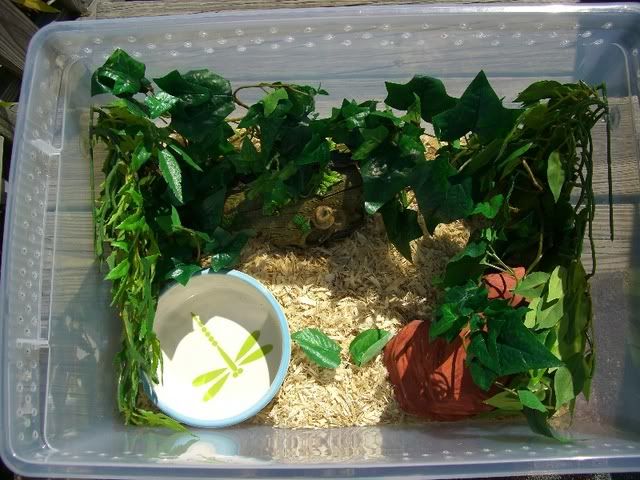
The tubs I use for the snakes are totally clear. The only time I see the snakes spending much time at the front is when they are due for a feed. The rest of the time they are resting, digesting, burrowing or climbing around in there. They receive natural daylight (but not direct sunlight). I handle each snake on average twice a week, only for feeding and cleaning of smaller snakes but for my own selfish delight as they get older and the feeds are spaced out more. I personally wouldn't keep on newspaper without burrowing substrate and the plants etc to climb on. The tubs have a temperature gradient, and again, with a floor space of @ 30 x 15 2inches (40 x 75 cm) for the largest tubs, they have as much room as in the standard vivs sold for adult corns in this country
 
I'm setting up my rack with 66 quart bins that measure roughly 24x18x12 high. Then I'm putting in vines, three hides, a water bowl the snake can get into, and lots of aspen for burrowing. The rack will hold five bins.

JasminesBin002_800.jpg


Nanci
 
40 x 75 sound way to small for an adult corn to me. 100 x 50 x 50 is bare minimum. Here i don't want to see them under 120 x 50 x 60. When there single housed 40 deep.
If there are clear tubs with that floor space i would consider those.
 
I'd still like to know what extra stimulation your snakes get? Can you post a picture of your vivs?
 
I built my rack to hold 5 90 quart sterilite bins. These have the same floorspace as the 41 quart ones a lot of people seem to use in high density racks, except they're 12 inches tall instead of 6. I just felt better using something with more 'headroom' for my snakes. Unfortunately, it looks like Sterilite has discontinued this particular one. I went to Wal*Mart this weekend to get the 5th one I needed, and there were only 3 or 4 left. In my opinion, these are (were, I guess now) a great option. Slightly larger than a 20L, but only about 8 bucks. I'm sure they'll come out with other models of similar dimensions.
 
I don't think it's healty for a snake to be without any stimulant except a mouse thrown in every now and then. You should avoid to much stress yes but not to the extent the snake eats and sleeps nothing else. That can't be healty. They do move in the wild. To drink, to find a place to ambush a prey, to get to a warmer places, to get to a cooler place, to hide from a predator or bad weather. Finding a mate.
I see my snakes often respond to what's happening outside. They look around to see what's going on but have all the opertunity to completely hide away. I doubt there are bins as big as viv's out there. That would be to large to handle. Usually bins are small bins, with water and newspaper... What's wrong with a viv?


Let's not get too carried away with the "how close are we mimicking mother nature" debate. You talk about weather, but when was the last time there was rain, lightning, thunder, floods, wind, etc in your vivs? There are plenty of bins that have the same or greater floorspace than many vivs that adults are kept in. You know another very common experience for snakes in the wild is mortality and predation. My snakes respond to outside things. I use ambient light and they are perfectly capable of perceiving light through their bins. And contrary to your portrayal, my snakes are often active in their bins and don't just lounge around 24/7. Would I like to be able to find and afford a massive apartment with room to have huge vivs for them to enjoy? Sure. I don't think anyone here would say that they wouldn't like that, but it's just not reasonable. Animal health and happiness is often defined by production. Snakes housed in racks grow just as well as those in vivs and appear to produce just as many eggs. My snakes as well as those of most other members here are safe, secure, have room to move, have a stable source of food, and are free from the vast majority of mortality risks. That's a pretty good quality of life. And at the end of the day, there's no real way for you to tell that your snakes are any happier than anyone elses and your opinion of what is the bare minimum is inherently just as subjective as mine.


Even if this is how you see keeping snakes in bins, how is this all that different from how other captive-bred animals are kept? Wild canids can cover miles in a single day yet we confine them to our homes, pens or backyards. Cats are much the same way. Most cats and dogs sleep the majority of the day when their owners aren't home. At most their owners take them (mostly dogs) out for exercise once a day. So that means most of their time is spent sleeping or eating with daily bouts of exercise. How is this any different from how corns are kept in captivity? Even if they are kept in a slightly larger viv, it's still not comparable to natural conditions.
 
Back
Top