• Hello!

    Either you have not registered on this site yet, or you are registered but have not logged in. In either case, you will not be able to use the full functionality of this site until you have registered, and then logged in after your registration has been approved.

    Registration is FREE, so please register so you can participate instead of remaining a lurker....

    Please be certain that the location field is correctly filled out when you register. All registrations that appear to be bogus will be rejected. Which means that if your location field does NOT match the actual location of your registration IP address, then your registration will be rejected.

    Sorry about the strictness of this requirement, but it is necessary to block spammers and scammers at the door as much as possible.

Experts -- please define Okeetee coloration

SnakeNutt

New member
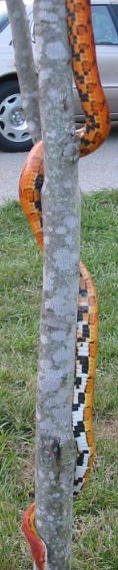
I realize that purists insist that true Okeetees are only those that originate from a specific Carolina locale. My local reptile store, however, sells corns as "Okeetees" as long as they're brilliantly colored AND have some orange coloration on their bellies (basically, if the "white" scales on the lower half or third of the ventral side are orangish instead of white). Would a senior member (or two or more) of this forum please define the "look" of an Okeetee?

Thanks!
 
I also thought a feature of the ventral coloring of an Okeetee was the marked checker board pattern and WHITE background?

Tina
 
I'm gonna, er, be careful with this one

Okay, I've been called a few things for being of the mindset that Okeetee is a locational variety, not a "look". And that there is no reason just because some snakes look like them, should they be called that. I have been very careful to obtain only corns from there to add to my breeding collection. And I've passed over some stunning corns by doing so. So perhaps I take it personally.
I'll be the first to admit that I can not look at an "Okeetee" corn and determine if it is an authentic local. But I can wager a good guess. Tina, you are right; well two-thirds right. The belly is very much black and white. Until about two-thirds down. Then it gradually becomes washed out with orange USUALLY. The brighter the snake, the more orange on the belly, at least with those I own and have seen/caught. But the same could be said about most normals. The dorsal coloration and pattern is the reason people became interested in these Jasper County snakes, though. They are brightly colored and beautifully patterned.
Much like the Miami and Keys corns, the snakes from "Okeetee" have a distinct appearance. Rather than describe it, check out pictures. It'll save my 1000 words (500 of which would have to be "usually" and "often"):)
 
Last edited:
Ventral pic

Elrojo-

Would you mind sharing what your longest okeetee line is?Or-how many generations deep are you in selective breeding.

Very much interested in some of your okeetee stock.Can you supply a link for pic's

Thnx in advance
 

Attachments

  • july 2003 097 (2).jpg
    july 2003 097 (2).jpg
    27.7 KB · Views: 73
Last edited:
I'd need a genetics 101 refresher first!

I have w/c, f1s, f2s and f3s. I have record of who bred to whom, but what is the progeny called when and f2 is outcrossed with a w/c? Or an f2 and f3?
And I cut back two years ago (decided to get out of snakes but couldn't part with some) and have no yearlings and only one 2001. So things are slowed down unless someone will sell me a few back! (hint)
I don't have a website, but have taken lots of photos, which I am happy to share. I don't double clutch (on purpose anyway) and usually sell out pretty fast. Any hatchlings that regurge, don't eat, or have any health issue are frozen or given away. It's just a hobby for me. I'm no "real" breeder, nor have I ever made a profit with snakes. I just like 'em.
 
Back
Top